Tours
Activities
Places of interest
Where to eat
Where to sleep

Discover Guitte, Côtes-d'Armor, Brittany's Hidden Gems

Are you in charge of the destination?
Embark on an exceptional adventure in Guitte, Côtes-d'Armor, Brittany, where authentic Breton charm meets natural beauty. Start by exploring the picturesque trails that wind through verdant hills, leading to breathtaking views of the surrounding countryside. Don't miss the historical wealth of churches and regional monuments, bearing witness to a fascinating past.

Enjoy local markets to discover ...
See more

Walking around Guitte

See more suggestions
Walks and hikes around Guitte.
See more suggestions
In Chateaubriand's footsteps in Plancoët (grand tour)
26 km

In Chateaubriand's footsteps in Plancoët (grand tour)

Nazareth district was attached to Plancoët as late as 1841. Before then, it was an important hamlet of Corseul, the Roman city. The central rue de l'Abbaye, with its preserved architecture, is one of the oldest streets of the town. This bank of the Arguenon River is the theater of the first steps of great Romantic author: François-René de Chateaubriand. François-René de Chateaubriand was born in St Malo on Septembre 4th 1768 and was buried, as he asked, at the Grand Bé, in front of St Malo, July 19th 1848. Feeble newborn, he spent his early childhood "at Plancoët's fresh air' where his grand-mother, Madame de Bedée placed him in a nanny's care. He stayed there for approximately three years, then it was Saint-Malo and Combourg, Dol, Rennes and Dinan's schools from where, adolescent, he comes to visit his family. He's the witness of his kin's happiness... This walk follow the circuit that Chateaubriand's mother and grand-mother took between la Bouëtardaye manor, the rented house of Rue de l'Abbaye and Nazareth church. (These suggested itineraries are given as an indication and don't take the possible evolution of the grounds or the environment into account. The use of these circuits is, therefore, left to the personal responsability of the users, the Office de tourisme disengages itself of any responsability towards the use of the maps and the possible accidents that might occur on the offered itinerary).

2 h
7.4 km
Medium
1 Rue Notre Dame 22130 Plancoët
Show
GR®223 - Genêts - Pontaubault
63 km

GR®223 - Genêts - Pontaubault

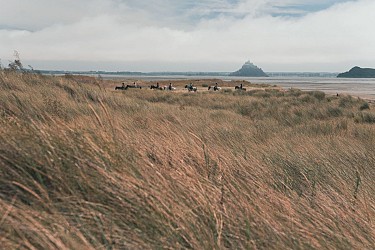
At the start of this 22 km stage, you’ll go around the village of Genêts, walking next to the salt meadows. When you get to a gabion wall, go along the edge of the meadows and climb over the stiles to get to the Pointe du Mont Manet then Les Porteaux. Next, you’ll go past Le Grand-Port. Note: with very high tidal coefficients, it’s best to take the coastal road between Le Grand-Port and Le Rivage hamlet. The path alternates between salt meadows and roads on the way to the rocky headland at Grouin du Sud, where you’ll have a superb view of the Bay of Mont Saint-Michel. This is where the Sée and Sélune streams meet to form a river. During the spring tides, you can watch the famous “mascaret” tidal bore here. This “wall of water” goes up the river an hour and a quarter before the high tide. Next, the coastal path takes you to a bridge that you’ll cross before getting back to the salt meadows. Walk alongside the racecourse that takes you to the departmental road (D911). Next, take a path parallel to the road along the river to the footbridge over the Sée. From here, if you want to explore Avranches, you can follow the GRP path “Les Belvédères du Mont Saint-Michel”. It takes you into the town centre and you can get back on the GR®223 in Bouillé via the GR®22. If you carry on following the GR®223, turn right after going over the footbridge. The road goes through Les Plataines, La Roche and Mirey. From Mirey to Bouillé, you’ll walk through the saltmarshes surrounded by herds of sheep (don’t disturb them). During the spring tides, it’s better to take the road. From Bouillé, carry on this section along the road to Gué de l’Epine. At Moulin de Flaget, you’ll enter the saltmarshes again. Between here and Pontaubault, the path alternates between roads and salt meadows.

6 h
22 km
Medium
Show

What to do in Guitte

See more suggestions
Explore the bookable activity options in Guitte for all tastes and ages.
See more suggestions

What to visit in Guitte

See more suggestions
Visit the iconic landmarks of Guitte.
See more suggestions
Ossuary and the 3 crosses
18 km

Ossuary and the 3 crosses

The ossuary dates back to the 17th century. It was incorporated to the graveyard next to the church. The parochial presinct being abandonned, the ossuary in the way of traffic, the Germans wanted to raze it, it was moved in 1941/42. It was a collective grave used before the French Revolution. At the time of the ossuary construction, the graveyard was a living place, a fair where happy moments happen.This ossuary is in granite, of heavy architecture, the roof is made of stone slates and the aperture is decorated with two collars. In 1861, the Priest of Plélan, Father Morin, wished to bring those three crosses to make a calvary, destined to walks of Fête-Dieu. Therefore, a mound was raised, half-circular, held by a wall with a earth ramp to access it on marshes grounds where the actual Salle des Fêtes is. The three crosses were moved by some twenty metres on the road to Saint-Maudez (current Media Centre). This new place next to an electric transformer was polemical and in 1971, the municipality decided on a new change, by the graveyard. The two crosses on the sides are called "pattées" (legged), they are latin crosses with the branches wider at the end. They surround the third cross, more curious, in the shape of a Lorraine cross with two cross-pieces, with its shaft slightly curved. The pedestal of these crosses, more ancient, were chosen on the Etrat Path (road from Corseul to Vannes)

15-17 Rue de la Croix Briand 22980 Plélan-le-Petit
Show

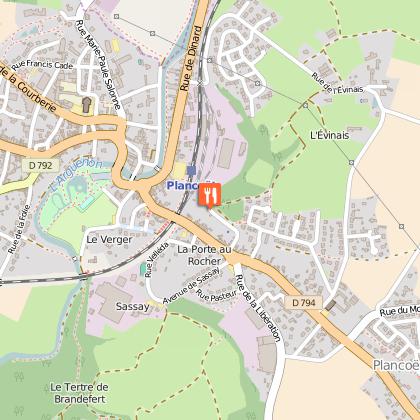
Where to eat in Guitte

See more suggestions
Restaurants in Guitte are ready to welcome you.
See more suggestions
Where to sleep in Guitte

See more suggestions
Enjoy our accommodation recommendations in Guitte.
See more suggestions
Saint-Jacut's Abbey
35 km

Saint-Jacut's Abbey

After the Plage des Haas, the costal path follows the abbey’s park. A gate allows you to access this private property and discover its remarkable edifice. History and legend tell us that in the 5th century, two twin monks, Jacut and Guéthenoc, arrived on this peninsula called « Landoac » looking for a fitting place to create a hermitage. A Benedictine monastery was established there and had a great influence on the region’s development and evolution until the French Revolution. Sold as Bien National (National Good), sold again many times, the abbey knows many vicissitudes and different uses (Border guard caserns, home to a wealthy foreign family...). In 1875, the monastery’s ruins are bought by the Congrégation des Sœur de l’Immaculée: a religious order from St-Méen-le-Grand (Ille-et-Vilaine), they’ll turn it into a nursing home for the nuns and a free school for the children of the area. The restoration starts right away. To finance the school, the nuns host, firstly the British tourists who came, under doctor’s orders, to take sea water and hot algae baths. They stream in right from 1876. That’s the start of the “guesthouse”. Along the years, the summer holiday goers keep growing in numbers; the nuns develop the hotel capacities of the Abbey and diversify the activities and the hosting: the Abbey is now a guesthouse and a high place of cultural and spiritual encounters. Please respect the environment and the quietness of the residents.

31-43 Rue des Haas 22750 Saint-Jacut-de-la-Mer
Show
Caution!
We have no information on the difficulty of this circuit. You may encounter some surprises along the way. Before you go, please feel free to inquire more and take all necessary precautions. Have a good trip! 🌳🥾