Tours
Activities
Places of interest
Where to eat
Where to sleep

Activities and discoveries around Camping Huttopia Royat

Are you the owner?
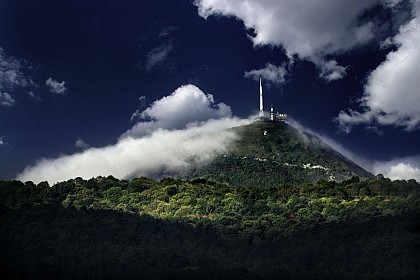
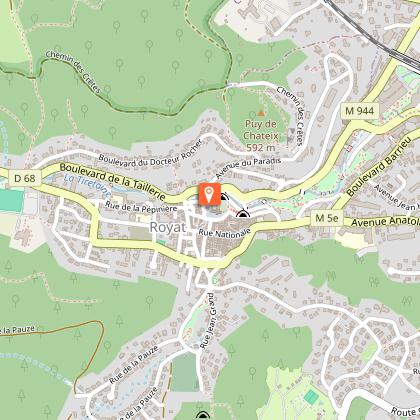
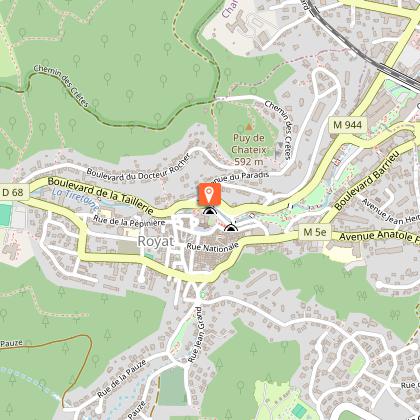
Discover a multitude of activities and exceptional sites around Camping Huttopia Royat, nestled in the heart of Puy-de-Dôme in Auvergne. Hiking enthusiasts shouldn't miss the ascent of Puy de Dôme, an iconic volcano offering breathtaking panoramic views of the UNESCO-listed Chaîne des Puys. Royat is renowned for its thermal baths and architectural heritage with Belle Époque villas and buildings. N...See more

Walking around CAMPING HUTTOPIA ROYAT

See more suggestions
Embark on a hike in CAMPING HUTTOPIA ROYAT.
See more suggestions
Redon-Artière
3.8 km

Redon-Artière

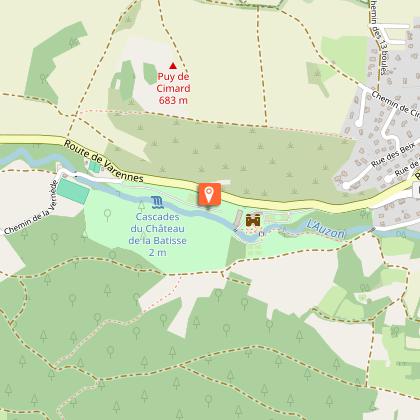
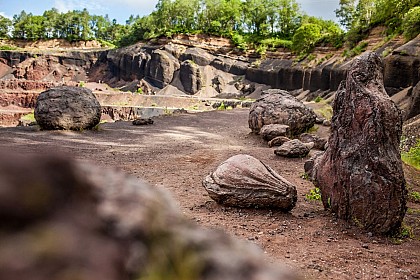
We start by climbing into the forest overlooking the stream. Arriving at the Redon farm, the Puy de Dôme is right in front of you. On the way back, we descend into the wild Artière valley, past boulders including the Samson dolmen. 1 - After 300m, at the foot of a gigantic scree, take the path on the left. It climbs gradually above the valley, into the forest; through the trees you can see Ceyrat and Clermont Fd. 2 - Turn left and continue until you reach marker 3. 3 - Turn right. View of the Gergovie plateau and Montrognon; a little further on the right, you can see the hamlet of Berzet. As you leave the forest, which has been replaced by meadows, the view opens up and the climb is almost over. Go around an anti-vehicle barrier and straight across the Redon farm (watch out for dogs!). After the farm, don't take the path to the left, but continue along the wide track. 4 - Take the right-hand track, which changes direction from south-west to north-west, with a view of Puy de Dôme. Leaving a track coming from the left, go straight ahead until you reach the gate of the INRA research center; at this point, turn sharp right, heading northeast. The path begins to descend. Immediately after crossing it, take a narrower path to the right on the left bank of the river, altitude 815m, a sign reads "Mairie de Ceyrat 4.5km". Follow this path to marker 5. 5 - Take the steep, descending path on the right: "Ceyrat 3.6km", descending towards the Artière; new crossroads under the trees: turn right, continuing downhill. Footbridge over the Artière: from left bank to right bank. The river looks like a torrent, amid the rocks. You arrive at the foot of the Samson dolmen: a huge slab of rock that looks as if it has been carved by man. At a ford, we cross back over to the left bank and discover a gigantic octopus, the work of Breton sculptor Francis Berninca. Crossing a new bridge over the Artière, we walk back along the right bank to the huge scree slope of the outward journey; from here, the path remains the same until we reach the parking lot.

3 h
6.7 km
Parking des "Gorges de l'Artière" Avenue de la Libération 63122 Ceyrat
Show

What to do in CAMPING HUTTOPIA ROYAT

See more suggestions
Relax and have fun with the available activities in CAMPING HUTTOPIA ROYAT.
See more suggestions
Lemptégy Volcano
11 km

Lemptégy Volcano

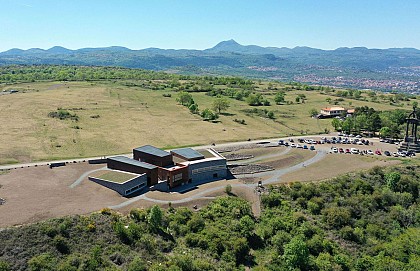
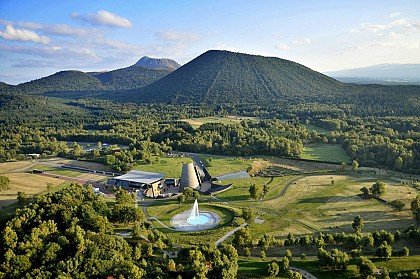
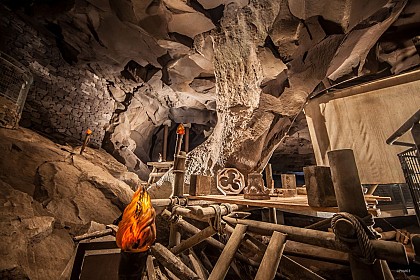
Explore the heart of a real volcano... Located at the center of the tectonic "Chaîne des Puys - Faille de Limagne" UNESCO World Heritage Site, we offer you the unique and unusual opportunity to discover the inside of a 100% natural volcano. Discover the secrets of volcanology with a 2h30 interactive tour of the Lemptégy volcano, comprising 5 stages: - The "volcano and men" tour: this fun, interactive introduction to the visit will familiarize you with the volcano and give you a better understanding of its metamorphosis. A 30-minute self-guided tour. - Guided exploration of the volcano's anatomy: meet your guide on foot or by train. He'll share all his geological and volcanological knowledge with you: bombs, volcanic chimneys, lava flows... and you'll leave with scoria (solidified lava). A wealth of information to help you better understand the landscape around you. - L'âme de Lemptégy": an unusual journey into the site's industrial past, with a visit to the old pozzolan extraction machines once used by quarrymen. - The immersive "Volcano 'Express" attraction: this sensory and emotional experience reveals all the secrets behind the formation of the Chaîne des Puys and the Faille de Limagne. What if the fault were to reopen... Will you reach your destination? - The dynamic 4D film "Aux Origines": enjoy an unprecedented flight over the volcanoes of Auvergne and relive the history of the volcano as if you were there, from its eruptions to the present day. While you're there, treat yourself to a gourmet break at the Volcan de Lemptégy restaurant. The chef offers traditional regional dishes (sausage/aligot, truffade, petit salé...). You can also stroll through the new boutique and discover a wide range of regional products, souvenirs, books... LE REVEIL DU VOLCAN" NIGHT TOUR: a breathtaking nocturnal experience! Entering at night, you'll be propelled into the heart of the Lemptégy Volcano for an extraordinary experience. Along the way, you'll plunge into an erupting volcano and discover magical creatures. A new world to discover and a new way to experience Volcan de Lemptégy. 1.5 km on foot. Prices and schedule: see website. IN JULY AND AUGUST

31 route des Puys Les Maisons Rouges 63230 Saint-Ours
Book from 0 €Book
Show

What to visit in CAMPING HUTTOPIA ROYAT

See more suggestions
Discover the local markets of CAMPING HUTTOPIA ROYAT.
See more suggestions
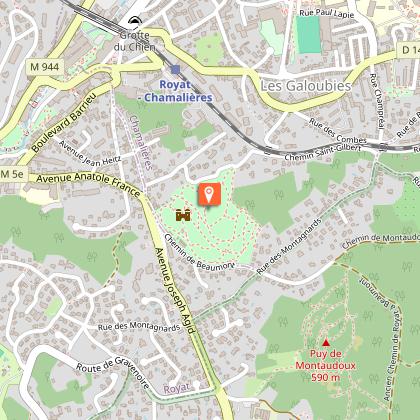
Parc Bargoin - Pavillon de Bellevue
666 m

Parc Bargoin - Pavillon de Bellevue

Bargoin park was designed based on an English-style garden, featuring picturesque elements. In its centre sits an 18th century building, formerly the country house of the previous owner of the estate. In 1868, Jean-Baptiste Bargoin, a pharmacist in Clermont-Ferrand, bought the Bellevue estate from the Onslow family. Bargoin and Henri Lecoq made their fortune with the invention of "Gland doux", a drink made from acorns, rye and chicory. On his death in 1885, Bargoin bequeathed the property to the Conseil Départemental du Puy-de-Dôme for use as a public park. He imposed drastic regulations, which are still in force today. The Bargoin park opens onto the wider landscape. It is designed on the model of an English garden, where nature, deceptively wild, is reinvented by man. The winding paths vary the views and reveal picturesque elements: the chalet, the bandstand, the dovecote, the pond, the statues, the Semeuse (sculptor Jean Ossaye-Mombur) and the Faune. In the center, the Pavillon de Bellevue (18th century) was Bargoin's country home. The tower of the two brothers, resembling a fake ruin, evokes the memory of his sons, Jocelyn and Edmond, who died young of phthisis. The park covers more than 7 hectares, with 800 trees of 60 different species, including hundred-year-old redwoods, cedars of Lebanon and Ginkgos Biloba. Excerpt from the park's outdated but protective regulations: - Carts are prohibited. - Luxury cars may enter the park, but parking is prohibited. - Refreshment stands and cafés of all kinds are strictly forbidden, to ensure that the park doesn't turn into a "guinguette". - Music is permitted in the park on weekdays and Sundays, but any kind of strolling music is strictly forbidden.

1 Chemin de Beaumont 63400 Chamalières
Show
Chapel of memories and war memorial
783 m

Chapel of memories and war memorial

As important places of remembrance, the chapel of memories and the war memorial in Royat feature remarkable architecture which earned them places on the historic monuments registry. In 1921, the municipality asked sculptor Raoul Mabru, from Royat, to propose two models for a memorial monument dedicated to the victims of World War I (1914-1918). It surveyed the inhabitants for the choice of one of the two models. The monument was completed in late 1924 and inaugurated on 26 April, 1925. In 1927 it was awarded the Mège award by the Clemont Académie des Sciences, Belles Lettres et Arts (Academy of science, literature and the arts) as the best sculpture of the past five years. It was designed based on the model of a Burial of Jesus. The soldier in the middle, represented as a tomb effigy, is watched by two groups sculpted using in the round technique. At his head are his wife and child, and at his feet his parents dressed in traditional Auvergne dress, namely overalls and flat hat clasped against the chest for the father, and the fluted bonnet for the mother. The regional representation accentuates the dramatic effect. Through the position of the bodies and the facial expressions, the artist manages to express the immense pain of the characters and to elicit emotion. The chosen location was opposite the new cemetery, on a small promontory where a neo-medieval chapel stands, built in 1876 to accommodate the remains of French soldiers who had died in the hospitals at Royat, and to pay tribute to the native soldiers of Royat who had died in the Franco-German war of 1870. Known as “chapelle du souvenir” (chapel of memories), it displays its dedications on the tympanum above the entrance door and on plaques affixed to the façade. Individual and collective commemorative plaques are displayed inside. The monument and chapel have been listed on the historic monuments registry since 2019.

rue de la Chapelle 63130 Royat
Show
Cave of the whashing ladies
956 m

Cave of the whashing ladies

There are several caves opening along the river Tiretaine, formed by volcanic eruptions, including the “grotte des laveuses” (cave of the washing ladies). Some of them had some very unusual uses. The Tiretaine valley in Royat has inspired many artists whose paintings are displayed in the Roger-Quilliot art museum in Clermont-Ferrand. Painters often chose to depict the river, the mills along it and the Église Saint-Léger overlooking it (Charles Théodore Sauvageot, Léon Fleury, Paul Huet, Théodore Rousseau). Charles Taylor and Justin Nodier, in the volume devoted to Auvergne in their book “Voyages pittoresques et romantiques dans l’ancienne France” (1829), depict the Grotte des Laveuses (cave of the washing ladies) under the priory of the Église Saint-Léger. It formed in the basaltic lava flow coming from the Petit-Puy-de-Dôme during eruptions in the Quaternary period. A blister of steam formed under the flow and was trapped after the lava cooled. The Tiretraine river bed was carved out, thus forming the cave. The cave is 30 metres long, 10 metres wide and 3.5 metres high. Seven springs flow from there. The cave appears to have been certified “national heritage” in 1949 at the request of the municipality. It still houses the remains of a washing basin. Other caves open along the Tiretaine, including the neighbouring Siméoni cave. It houses the spring that supplied the famous Amboise fountain in Clermont thanks to the work performed by the 16th century Florentine engineer Gabriel Siméoni. The famous Grotte du Chien (dog’s cave), located close to the railway viaduct, is known for its carbon gas emanations and mofettes. Odourless CO2, lighter than air, occupied the lower part of the cave and thus caused dogs to be asphyxiated, as explained by the guides to their visitors. The poor animal would then be replaced by a candle. The cave is now closed to the public.

Rue de la Grotte 63130 Royat
Show
Majestic Hotel and Lodge
972 m

Majestic Hotel and Lodge

In the 19th and 20th centuries, the former Majestic hotel and lodge boosted the reputation of the spa town.They offered wealthy bathers and their esteemed guests the most modern luxury and comfort. After the Grand Hôtel was built, spa visitors had accommodation on site, but also were housed as far away as Clermont in wooden huts, eastern-style tents or rooms improvised in grain stores, according to Émile Thibaud, master glassmaker and son of the mayor of Royat. From 1874 onwards, land located along the cliff opposite the spa was purchased in order to build hotels. It ran along Boulevard Vasquez . The visit to Royat of the Prince of Wales, the future Edward VII, on 27 July, 1884, led to a form of Anglomania that lent itself to the names of hotels, including Hôtel Majestic, Royal St-Mart and Royat Palace. The Grand Hôtel Majestic was built between 1861 and 1864 by Madame Neuville, then purchased by Léon Servant and extended from 1876 to 1911. Construction of this building in brick and stone in neo-Louis XIII style was the work of architects from Clermont (Nicolas Mourton) and Paris (William Klein, Albert Duclos and Ernest Mizard). Once successive renovations were completed, the hotel featured 300 rooms and 50 apartments, all with private bathrooms. The hotel featured the latest technical innovations including lifts and electric lighting from 1891. The interior was decorated in luxurious style. In 1912, the architect Mizard built the Majestic lodge, an Art Nouveau-style annex to the hotel. The two buildings are listed on the historic monuments registry. The hotel's guests included the Goncourt brothers, Alexandre Dumas the son, the Prince of Wales, Émile Zola, Bartholdi, Félix Faure, Armand Peugeot, and Belgian King Léopold II, François Mauriac, the Sultan of Morocco, Pierre Laval, Marshall Pétain and General De Gaulle.

1 Boulevard Bazin 63400 Chamalières
Show
Eugenie drink stand and Velleda Spring
982 m

Eugenie drink stand and Velleda Spring

The Eugénie drink stand was more than the icon of the thermal spa, it was the embodiment of spa treatments (it also appeared in the Asterix story “Asterix and the Chieftain’s Shield”). The “large spring” discovered in 1843 was named the “Eugénie spring” following the visit of Napoleon and the empress in 1862. The drink stand, which for a long time was a simple stone-edged well, was developed in 1872 and surrounded by a circular cast-iron counter sheltered under a cast-iron kiosk. In 1913, Auguste Rouzaud, director of the spa, commissioned the Clermont-based architect Louis Jarrier to embellish the spring. Jarrier designed a glass bell-shaped cover that was worked like a piece of silverware. The new counter was coated with flamed sandstone and opaline. In 1938, the municipality planned to extend and embellish the thermal spa and commissioned Antoine Chanet and Jean Liogier, architects from Vichy, to work on the drink stand. They replaced the kiosk with a tholos (a circular Greek temple) made from reinforced concrete, enhanced with a water mirror. The columns and bays of the tambour were reminiscent of those of the spa resort and provided a certain harmony. The outer edge of the drink stand was decorated with Greek ceramic mosaics, as were the decorative elements of the counter, designed by Gentil and Bourdet. To echo this, the former building housing the spring, adjoining the drink stand, covered with simple wood trellises, was replaced by a lodge with a resolutely neo-Antique style (four Doric columns, an entablature, a pediment and semi-circular bays). In the 1980s the building housing the spring accommodated the new channels for the Velléda spring, and became the “Pavillon Velléda”. Today the spa water is used for exterior body treatments and is no longer ingested.

Parc Thermal 63130 Royat
Show
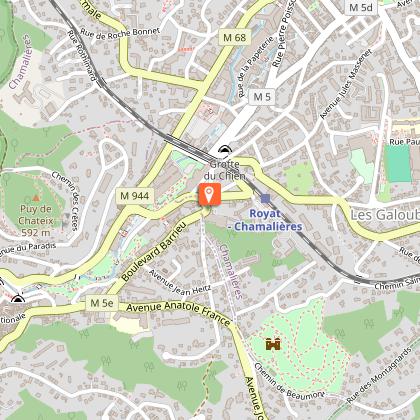
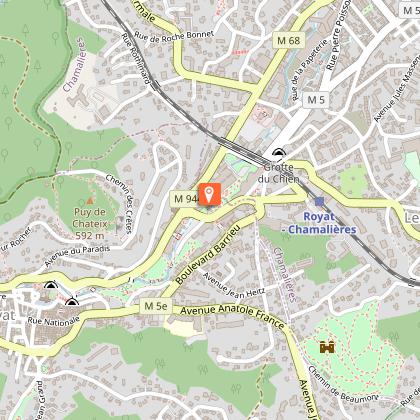
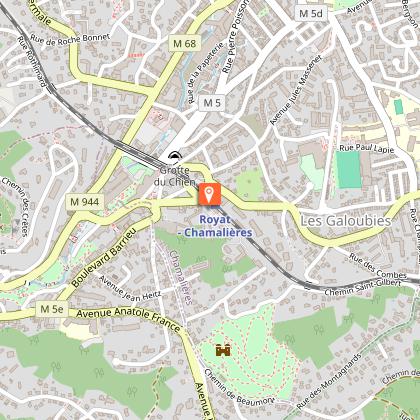
Royat-Chamalières train station
1 km

Royat-Chamalières train station

The Royat-Chamalières train station originated during the spa boom. Its style is in keeping with typical rail station architecture of the Third Republic. Until the Royat train station was built, spa visitors left the train at Clermont-Ferrand and finished their journey by horse and carriage, as Napoleon III when he visited Clermont-Ferrand and Royat in 1862. With the growing success of spa resorts, it became necessary to open new railway lines. Three sections were built to serve these spas: Vichy from Saint-Germain-des-Fossés in 1862, Le Mont-Dore from de Laqueuille, added to the Clermont-Tulle line in 1899 and Châtel-Guyon via Riom in 1912. Decided in 1880, Royat train station was inaugurated in 1886, after the construction in 1881 of the viaduct on the Tiretaine valley. Bathers then arrived from “all four corners of the world” to enjoy the benefits of a thermal cure. The station was the work of Jules Martin, assisted by the engineer Colin. The style of the station was in keeping with typical rail station architecture of the Third Republic, both functional and picturesque. The façade featured a central building with two storeys and three bays. The first storey with wide segmental arch openings, preceded by an atrium window, looks onto the lobby where the ticket offices are located. The second storey houses the station manager’s quarters. The interplay of materials - brick and limestone - is evocative of the architecture under Louis XIII. The hip roof is laid with slate tiles. The train station has been on the historic monuments registry since 1994.

Avenue de la Gare 63400 Chamalières
Show
Spa resort
1 km

Spa resort

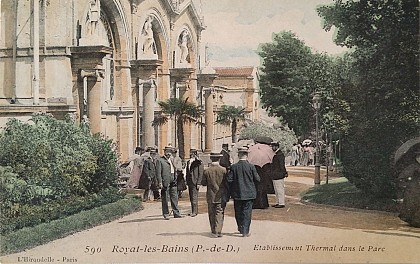
Built in the 19th century, the spa is the centre-piece of the Royat-Chamalières resort. The only spa town in the metropolitan area, the Royat-Chamalières spa developed at the outlet of the Tiretaine valley, below the ancient village of Royat, close to the springs. In the make-up of a spa town the spa is the central monument of the resort, close to the springs. The spa was built between 1852 and 1856 by Agis-Léon Ledru (1816-1885), an architect from Clermont, also the designer of the baths at La Bourboule. It was built at the edge of route 5 leading to Clermont, and today has been converted into an alley in the park. The spa town is connected to the Clermont-Ferrand town centre via the centre of Chamalières, through the tunnelling in 1878 of the current Avenue de Royat. Ledru designed a building made from arkose, considered one of the first spas to have a central gallery and a hall with spacious, bright and airy spaces. On either side two wings are reserved to the west for men and to the east for women. The Antiquity-inspired façade features ionic columns at the top of which are copies of antique statues kept at the Louvre: Diana of Gabii and Venus Genitrix. The interior is decorated in luxury with mosaics. The treatment rooms are equipped with Volvic stone bath tubs. In 1913-1914, the architect Louis Jarrier (1862-1932) extended the building towards the rear for the second- and third-class baths. A building intended for luxury baths was built between 1948 and 1955 by architects Antoine Chanet and Jean Liogier. The spa was completed in 1964 with the Galerie Laussedat (by architect Georges Guignabert) and extended in 1978-1980 (by architects Mosseri and Lanquette).

1 place Allard 63130 Royat
Show

Where to eat in CAMPING HUTTOPIA ROYAT

See more suggestions
Establishments in CAMPING HUTTOPIA ROYAT offer dishes for all tastes.
See more suggestions

Where to sleep in CAMPING HUTTOPIA ROYAT

See more suggestions
Stay near CAMPING HUTTOPIA ROYAT with our lodging options.
See more suggestions
Caution!
We have no information on the difficulty of this circuit. You may encounter some surprises along the way. Before you go, please feel free to inquire more and take all necessary precautions. Have a good trip! 🌳🥾