Tours
Activities
Places of interest
Where to eat
Where to sleep

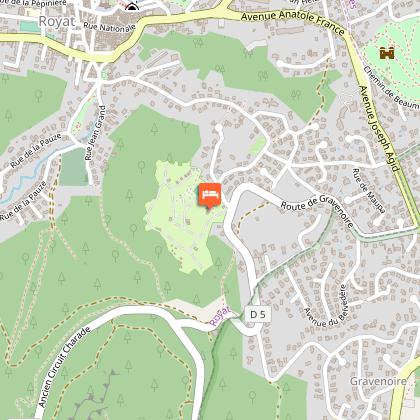
Unveil the charm of Hotel de Plein Air, Ceyrat

Are you the owner?
Nestled a few kilometers from Ceyrat in the stunning Puy-de-Dôme, Auvergne, your stay at the Hotel de Plein Air camping grounds promises a wealth of discoveries. Start your adventure with a hike on one of the many trails crossing the unique volcanic landscapes of the Chaîne des Puys. For breathtaking panoramas, climb the Puy de Dôme, offering unforgettable views of the surrounding mountains. For a...See more

Walking around HOTEL DE PLEIN AIR

See more suggestions
Take a walk around HOTEL DE PLEIN AIR.
See more suggestions
Redon-Artière
1.5 km

Redon-Artière

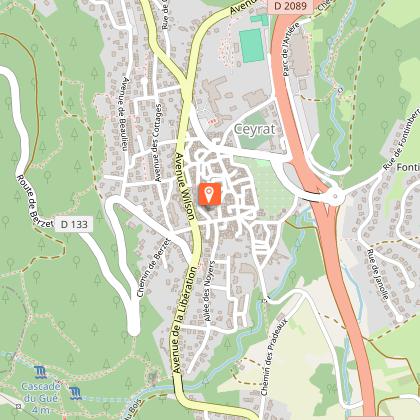
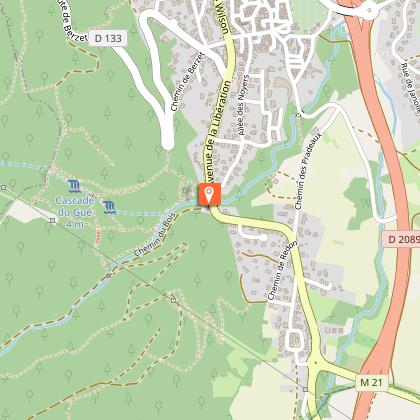
We start by climbing into the forest overlooking the stream. Arriving at the Redon farm, the Puy de Dôme is right in front of you. On the way back, we descend into the wild Artière valley, past boulders including the Samson dolmen. 1 - After 300m, at the foot of a gigantic scree, take the path on the left. It climbs gradually above the valley, into the forest; through the trees you can see Ceyrat and Clermont Fd. 2 - Turn left and continue until you reach marker 3. 3 - Turn right. View of the Gergovie plateau and Montrognon; a little further on the right, you can see the hamlet of Berzet. As you leave the forest, which has been replaced by meadows, the view opens up and the climb is almost over. Go around an anti-vehicle barrier and straight across the Redon farm (watch out for dogs!). After the farm, don't take the path to the left, but continue along the wide track. 4 - Take the right-hand track, which changes direction from south-west to north-west, with a view of Puy de Dôme. Leaving a track coming from the left, go straight ahead until you reach the gate of the INRA research center; at this point, turn sharp right, heading northeast. The path begins to descend. Immediately after crossing it, take a narrower path to the right on the left bank of the river, altitude 815m, a sign reads "Mairie de Ceyrat 4.5km". Follow this path to marker 5. 5 - Take the steep, descending path on the right: "Ceyrat 3.6km", descending towards the Artière; new crossroads under the trees: turn right, continuing downhill. Footbridge over the Artière: from left bank to right bank. The river looks like a torrent, amid the rocks. You arrive at the foot of the Samson dolmen: a huge slab of rock that looks as if it has been carved by man. At a ford, we cross back over to the left bank and discover a gigantic octopus, the work of Breton sculptor Francis Berninca. Crossing a new bridge over the Artière, we walk back along the right bank to the huge scree slope of the outward journey; from here, the path remains the same until we reach the parking lot.

3 h
6.7 km
Parking des "Gorges de l'Artière" Avenue de la Libération 63122 Ceyrat
Show

What to do in HOTEL DE PLEIN AIR

See more suggestions
Experience unique moments with the bookable activities in HOTEL DE PLEIN AIR.
See more suggestions
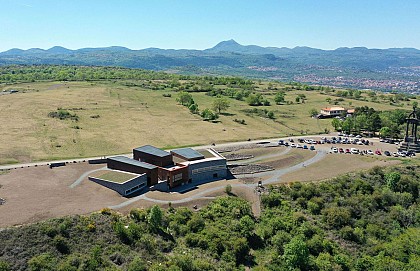
Lemptégy Volcano
12 km

Lemptégy Volcano

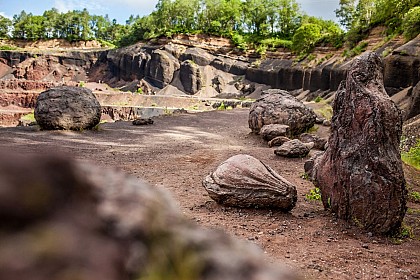
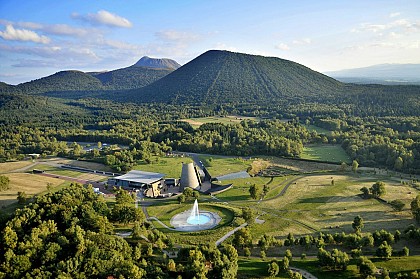
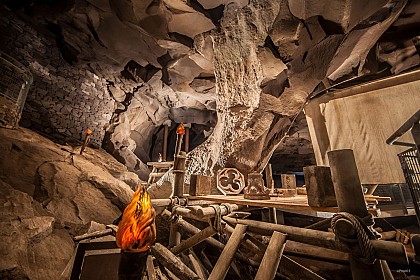
Explore the heart of a real volcano... Located at the center of the tectonic "Chaîne des Puys - Faille de Limagne" UNESCO World Heritage Site, we offer you the unique and unusual opportunity to discover the inside of a 100% natural volcano. Discover the secrets of volcanology with a 2h30 interactive tour of the Lemptégy volcano, comprising 5 stages: - The "volcano and men" tour: this fun, interactive introduction to the visit will familiarize you with the volcano and give you a better understanding of its metamorphosis. A 30-minute self-guided tour. - Guided exploration of the volcano's anatomy: meet your guide on foot or by train. He'll share all his geological and volcanological knowledge with you: bombs, volcanic chimneys, lava flows... and you'll leave with scoria (solidified lava). A wealth of information to help you better understand the landscape around you. - L'âme de Lemptégy": an unusual journey into the site's industrial past, with a visit to the old pozzolan extraction machines once used by quarrymen. - The immersive "Volcano 'Express" attraction: this sensory and emotional experience reveals all the secrets behind the formation of the Chaîne des Puys and the Faille de Limagne. What if the fault were to reopen... Will you reach your destination? - The dynamic 4D film "Aux Origines": enjoy an unprecedented flight over the volcanoes of Auvergne and relive the history of the volcano as if you were there, from its eruptions to the present day. While you're there, treat yourself to a gourmet break at the Volcan de Lemptégy restaurant. The chef offers traditional regional dishes (sausage/aligot, truffade, petit salé...). You can also stroll through the new boutique and discover a wide range of regional products, souvenirs, books... LE REVEIL DU VOLCAN" NIGHT TOUR: a breathtaking nocturnal experience! Entering at night, you'll be propelled into the heart of the Lemptégy Volcano for an extraordinary experience. Along the way, you'll plunge into an erupting volcano and discover magical creatures. A new world to discover and a new way to experience Volcan de Lemptégy. 1.5 km on foot. Prices and schedule: see website. IN JULY AND AUGUST

31 route des Puys Les Maisons Rouges 63230 Saint-Ours
Book from 0 €Book
Show

What to visit in HOTEL DE PLEIN AIR

See more suggestions
Take a boat tour around HOTEL DE PLEIN AIR.
See more suggestions
Ceyrat Town Hall-School
573 m

Ceyrat Town Hall-School

As in many small municipalities from the second half of the 19th century, the Ceyrat town hall shared its premises with the primary school. This former town hall-school features remarkable architecture. Under the Third Republic, the general architectural style for new town hall projects was neo-classicism, often austere, with constant use of Volvic stone. The model was almost always that of a “town hall-school”, according to the principle of town hall areas located in the centre of the building and schools on the side wings, a girls’ side and a boys’ side. To control municipal spending, areas were shared and so were skills, with the schoolteacher sometimes also working as the town hall secretary. The Ceyrat town hall-school retained this traditional layout, but innovated with its decorative script. It was built in 1932-1933, by Jean Amadon (1886-1954), also the architect for the polyclinic (1930) on the site of Hôtel-Dieu in Clermont-Ferrand. The building offered a balanced composition. The central part is projected, and features three bays on three levels, including an attic level. On either side of the front section, the two wings, each with eight bays, are intended for the boys’ and girls’ school, with independent entrances. Above are the teachers’ apartments. The tops of the walls are decorated with an entablature enhanced by a frieze. The two bays closest to the front section are decorated with bossing to further enhance the central part. In the mid-1970s, the pre-school left the building shortly after the departure of the elementary school. The town hall now occupies the entire building.

1, rue Frédéric Brunmurol 63122 Ceyrat
Show
Church of Our Lady of the Nativity
757 m

Church of Our Lady of the Nativity

Église Notre-Dame de la Nativité was originally a small chapel from the 17th century. Since then it has been revamped several times. Located at the foot of Puy Gravenoire, the village of Boisséjour – whose name has evolved from Essejoux to Boissehoux to Boisséioux to Boisséiour… – is part of Ceyrat. It is separated from it by the Artière, a small river that also irrigates Beaumont and Aubière. The church’s construction began in the late 17th century, as evidenced by the inscription “1699” on the entrance door’s keystone. It was originally a small chapel, with a low semi-circular vault and a side chapel in the left section. At an unknown date, a second side chapel was added, in symmetry with the first. In the 19th century, this chapel became too small and was extended and the vault raised. Two renowned Clermont architects worked on it. Hugues Imbert (1807-1876) built the church’s sacristy for which he proposed a plan in 1859. He was also the architect of the Église Saint-Martin de Ceyrat and other buildings in Clermont, such as Église Saint-Eutrope (1858-1862, listed as a historic monument in 1986). François-Louis Jarrier (1829-1881) extended the church by adding a choir, against the originally flat apse, and a bell tower in 1862. François-Louis Jarrier, architect for the city of Clermont-Ferrand, was responsible for the synagogue in Clermont-Ferrand. The southern crosspiece of the transept has a baroque altarpiece which has been listed as a historic monument since 1982. The stained-glass windows came from donations by the inhabitants, including on the western façade, an Art Deco stained-glass window by master glassmaker François Taureilles, depicting Jesus at the home of Martha and Mary.

2, rue de l'église Boisséjour 63122 Ceyrat
Show
Eglise Saint-Martin
928 m

Eglise Saint-Martin

Église Saint-Martin is a church with medieval foundations, revamped in the 19th century. It retains precious furnishings. A village governed by the château de Montrognon/Chamalières, Ceyrat spiced up the tales of Auvergne. A franchise charter was granted to the inhabitants in 1351 and confirmed in 1377. The historic district was organised around Place du Four and forms an outline where we can see the fortification of 1540. With its medieval foundations, Église Saint-Martin was redesigned over the centuries. To the south, the present-day garden was the site of the cemetery. The church’s layout features a single nave with a semi-circular apse hidden in the constructions of the former village fort. Inside, the west-facing choir was extended in 1845. A single groin-vault nave, without aisle, is preceded by a gallery that corresponds to the bell tower raised on a square plan. The church was given a new façade by architect Hugues Imbert (1807-1876) in 1842. Hugues Imbert, architect of the Hospices of the city of Clermont-Ferrand designed the Église Saint-Martin d’Aubière, the Église Saint-Eutrope and the Chapelle de l’Hôpital général in Clermont-Ferrand. The neo-classical façade features a triangular pediment and Volvic stone pilasters. A spire was added to its bell tower in 1895. The monumental staircase preceding it enhances its grandeur. The furnishings comprise mainly statues listed as historic monuments and a barrel organ that is also listed. The Volvic stone high altar, enamelled by artist Jean Jaffeux in 1965, evokes the Last Supper as well as field labour and wine making, activities that were specific to the municipality of Ceyrat.

Rue de l'église 63122 Ceyrat
Show
Ceyrat Gorge
1.5 km

Ceyrat Gorge

Hollowed out of a granite plateau by the river Artière, the Ceyrat caves house a remarkable range of plants and wildlife typical of rocky environments. The Artière is a small river with two branches. One of them originates at the north of Saint-Genès-Champenelle near to Puy de Chatrat at 900 m altitude, and is called Ruisseau de Saint-Genès. The other one, at Manson is called Artière de Boisséjour. These two branches meet at Beaumont, in the Parc du Stade, then the Artière crosses Aubière and Aulnat, bypassing Puy de Crouël in Clermont-Ferrand, and flows into the river Allier at Les Martres-d’Artière. The Gorges de Ceyrat are part of the Ruisseau de Saint-Genès valley, carved out of the eastern edge of a granite plateau south-west of Clermont-Ferrand. The Gorges de Ceyrat are recognised as a natural wildlife and nature preserve (ZNIEFF certification). The plant life is typical of rocky environments and particularly damp cliffs, in a cold micro-climate. Plant life includes a great variety of mosses and lichens, Asplenium foreziense, a protected fern species that clings to cliffs and rocks, the Martagon lily and the early spider-orchid, which spread on chalk grassland. Among the birds we note a species in decline due to semi-open environments: the Eurasian wryneck. Two species on the regional endangered butterfly list also live on the site: the Poplar admiral, a forest species, and the Chequered blue, which lives in rocky areas. A marked hiking trail lets visitors discover the Gorges de Ceyrat. Along this trail you will discover the Dolmen de Samson archaeological site, as well as a small waterfall.

26 avenue de la Libération 63122 Ceyrat
Show
Château de Montrognon
1.6 km

Château de Montrognon

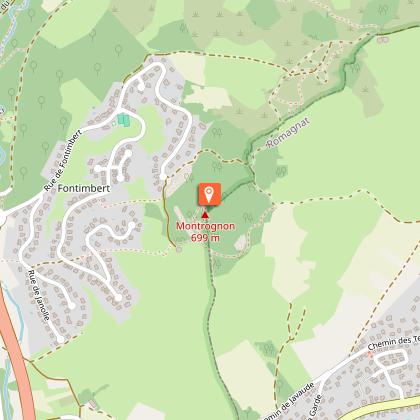
On its volcanic piton overlooking part of the city, the Tour de Montrognon (“Mons rugosus”, the rocky mountain) is the only remains of the château-fort built by Count Robery, 1st Dauphin of Auvergne in 1190. On its volcanic piton overlooking part of the city, the Tour de Montrognon (“Mons rugosus”, the rocky mountain) is the only remains of the château-fort built by Count Robery, 1st Dauphin of Auvergne in 1190. The château was originally built in a trapezoid shape, comprising a curtain wall connecting several flanking towers. At the top, a system of battlements and merlons protected the round path. In the courtyard was the keep, of which it seems that the present-day tower is a vestige, and several dwellings for the lord and his family, as well as a garrison for one hundred men-at-arms. The keep had three vaulted storeys, with a watchtower on top. The postern, visible from Ceyrat, was preceded by a drawbridge and a ditch. The château was levelled in 1633 on the orders of King Louis XIII. One of the main remaining towers collapsed in 1828 and a portion of the tower and a section of wall were destroyed by wind in February 1840. The ruins became a quarry for the inhabitants of Ceyrat. In 1884, two individuals, Auguste Vignon and Joseph Gouny known as Naca, hoping to discover a treasure dating back to the time of the Knights Templar, were buried beneath a landslide after digging a 10-metre deep well. Vignon was killed on the spot. Gouny was rescued after seven days. For a time, he made a living by exhibiting himself at fairs as a “miracle”.

54, avenue de Fontimbert 63122 Ceyrat
Show
Saint-Pierre abbey and its convent buildings
2.3 km

Saint-Pierre abbey and its convent buildings

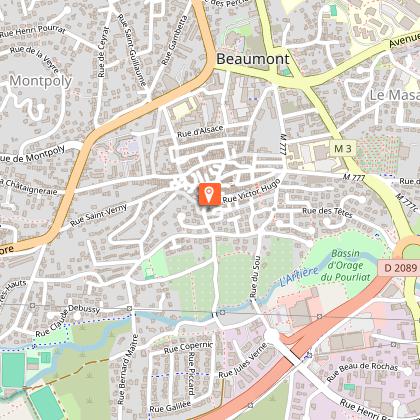
The Église Saint-Pierre was the site of a powerful Benedictine nunnery that was founded in the 7th century. The Romanesque-style church was built at the end of the 11th century. The monastery buildings are still partially preserved. The ancient village of Beaumont was structured around a Benedictine abbey housing nuns from the upper aristocracy of Auvergne. It appears to have been founded at the end of the 7th century. In the ancient village two neighbouring churches are properties of the abbey - Saint-Pierre and Notre-Dame de la Rivière. The Romanesque-style Église Saint-Pierre was built between 1060 and 1090 from arkose and volcanic stone. The building features a Latin cross floor plan with projecting transept and semi-circular apse flanked by two side chapels. The church is fully vaulted: barrel, half-barrel and semi-dome. To cover the transept crossing, the unusual solution of a transverse vault was preferred to that of a dome. To the north the church forms the fourth wing of monastery buildings set out in a “U” shape, around a cloister. The present-day Place Saint-Benoît traces the layout of this space. The oldest recognised parts date back to the 12th century, and include the cloister gallery on the north side, leading to several rooms (refectory, infirmary, warming room, chapter, etc.). Some vestiges of the cloister galleries are still visible (sculpted arches, columns and capitals. At the time of the French Revolution, the community was dissolved and the monastery buildings were sold as National Assets then fully revamped. The cloister courtyard is crossed by a street towards the west and an alley towards the east. Its arches have been blocked and partially destroyed. The church and the remains of the cloister have been on the historic monuments registry since 1926 and 1927.

1 Place de la République 63110 Beaumont
Show
Winegrower's house in Beaumont
2.3 km

Winegrower's house in Beaumont

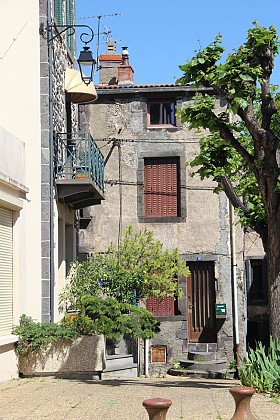
The winemaker’s house is testimony to a previously prosperous business in Beaumont and on all the hillsides of Limagne: vine growing. From the second half of the 19th century, it changed to reflect the economic and social success of wine makers. The winemaker’s house is testimony to a previously prosperous business in Beaumont and on all the hillsides of Limagne from the Middle Ages to the 19th century: vine growing Documents from the 14th to 18th century attest to its importance in Beaumont. In 1545, Abbaye Saint-Pierre featured ten large cellars in its vat rooms and in 1792 its footprint included 15 hectares of vines. In 1831 the Beaumont vineyard spanned 263 hectares over 3,910 plots. After its heyday, the Beaumont vineyard was completely destroyed by phylloxera between 1890 and 1895. The region has two types of winemaker houses. The first type is the traditional winemaker house located in the village centre. A narrow construction, it houses both the business premises and the living quarters: a buried cave for wine storage, a vat room on the ground floor for pressing and fermentation, a single room with living quarters on the first floor, accessed via an outdoor staircase, and an attic under the roof. The second type of house was developed in the second half of the 19th century, at the height of vine growing. It reflected the economic and social success of the winemaker. These houses are more imposing and generally have an extra floor for living quarters. They use Volvic stone for the window and door frames, storey separation panels, cornices and corner quoins. They have balconies with guardrails in metalwork or cast iron. They also have courtyards and technical buildings that give the residence a certain professional dimension, focused on the exclusive and important business of wine production. The streets around the abbey feature many examples of these houses with vat rooms and cellars.

Rue Antoine Maradeix 63110 Beaumont
Show
Saint-Jean-Marie-Vianney Church
2.4 km

Saint-Jean-Marie-Vianney Church

The Église Saint-Jean-Marie-Vianney is an important example of sacred 20th century architecture. With its 1,860 coloured glass slabs, it is representative of the vitality of contemporary religious design in the region. The Église Saint-Jean-Marie-Vianney was built between 1961 and 1962 to serve the new booming parish of the Vallières neighbourhood. The project was entrusted to architects Albéric Aubert (1895-1971) and Joseph Massota (1925-1989). Albéric Aubert was the designer of modern constructions in the region such as the Sabourin sanatorium (now the École Nationale Supérieure d’Architecture), certified as Architecture Contemporaine Remarquable (remarkable contemporary architecture), and the children’s health centre (Centre médical infantile) at Romagnat. The church is built entirely from reinforced concrete, with a facing rectangular layout. It is built parallel to the slope, with the north façade then becoming the main façade facing the street. The six-bay front section features four bays in the form of porticoes. The first one, on the right, leads to the main entrance. The other two bays to the left feature the baptismal font chapel closed off by glass slabs. The walls of the nave are made from concrete lattice. This lattice is formed by alternating horizontal beams and concrete cinder blocks in header layout. The openings thus created are filled in with 1,860 glass slabs that let in coloured light, whose effects vary depending on the time of day. The coffered ceiling is decorated with a large painted cross. The bell, with its bell-tower, announces the building in the neighbourhood. This neighbourhood church is therefore an example of sacred architecture in the region, with its high-profile architects, innovative concepts and remarkable light work.

17, rue du Dr Lepetit 63110 Beaumont
Show

Where to eat in HOTEL DE PLEIN AIR

See more suggestions
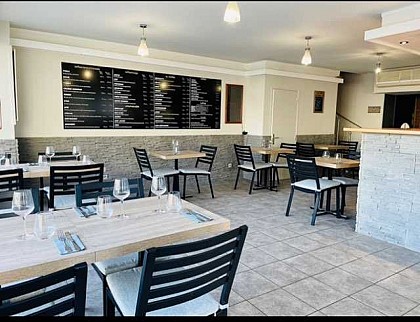
Restaurants in HOTEL DE PLEIN AIR offer a friendly atmosphere.
See more suggestions

Where to sleep in HOTEL DE PLEIN AIR

See more suggestions
Book a quality accommodation in HOTEL DE PLEIN AIR.
See more suggestions
Caution!
We have no information on the difficulty of this circuit. You may encounter some surprises along the way. Before you go, please feel free to inquire more and take all necessary precautions. Have a good trip! 🌳🥾