Tours
Activities
Places of interest
Where to eat
Where to sleep

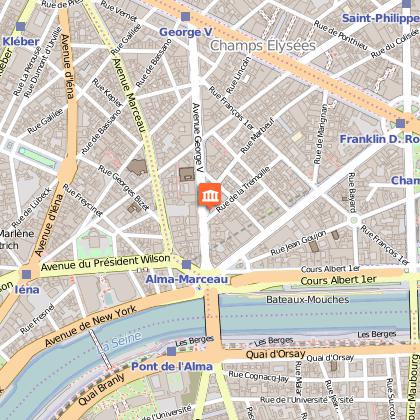
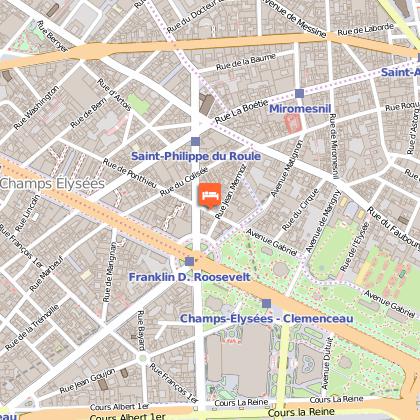
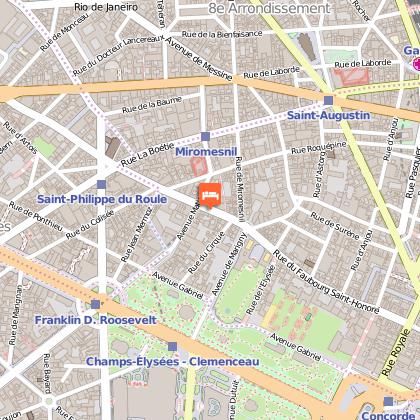
Discover Paris-8th with ELYSEES HOTEL

Are you the owner?
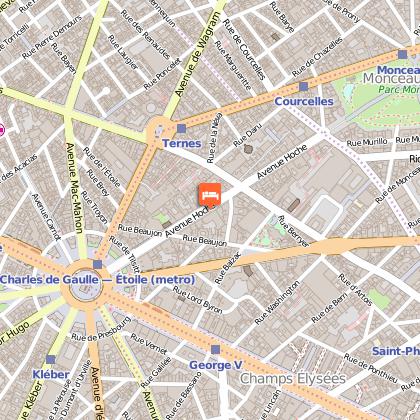
Situated in the heart of the prestigious Paris 8th arrondissement, ELYSEES HOTEL is the perfect starting point to explore local wonders. Begin your day strolling along the Avenue des Champs-Élysées, known for its luxury boutiques, elegant cafes, and charming atmosphere. Don't forget to visit the Arc de Triomphe, an iconic monument offering a breathtaking view of the city.
Art and culture enthusi...
See more

Walking around ELYSEES HOTEL

See more suggestions
Hikes for all levels in ELYSEES HOTEL.
See more suggestions

What to do in ELYSEES HOTEL

See more suggestions
Make your stay in ELYSEES HOTEL special by booking activities.
See more suggestions
The Lido Cabaret Show – With a glass of champagne
576 m

The Lido Cabaret Show – With a glass of champagne

Located on the Champs Elysées, close the the Arc de Triomphe, the Lido Cabaret is the ideal setting for an unforgettable evening. Watch the Lido's latest production and make the most of the experience with a glass of champagne! LOCATED ON THE CHAMPS ELYSÉES, CLOSE THE THE ARC DE TRIOMPHE, THE LIDO CABARET IS THE IDEAL SETTING FOR AN UNFORGETTABLE EVENING. WATCH THE LIDO'S LATEST PRODUCTION AND MAKE THE MOST OF THE EXPERIENCE WITH A GLASS OF CHAMPAGNE! Ever since it first opened its doors in 1928, the Lido has been at the cutting edge of cabaret, earning an international reputation for its spectacular shows that employ innovative techniques.  Launched in spring 2015, the Lido's 27th production, 'Paris Merveilles', is bigger and better than ever!  Come and discover the brand new show created and directed by Franco Dragone, known for his work with the Cirque du Soleil and the Céline Dion Show in Las Vegas, as well as the magnificent 2014 World Cup opening ceremony in Brazil!  The new show is a fantastical journey during which the famous emblems of Paris are brought to life through impressive scenery and choreography.  The delirious dances lead by the famous Bluebell Girls and Lido Boys are performed at a frenzied pace; their extravagant hats and majestic costumes adorned with feathers and sparkling like diamonds! Attend a one-of-a-kind show in homage to the elegance and beauty of Paris! Alcohol abuse is dangerous for your health. Please drink responsibly

Avenue des Champs-Elysées 75008 Paris
Book from 85 EURBook
Show
Lido Cabaret Show & Dinner – With champagne
575 m

Lido Cabaret Show & Dinner – With champagne

Situated on the Champs Elysées, the Lido Cabaret, an internationally renowned venue, is the ideal setting for an unforgettable evening. Dine at the venue and discover the brand new show created and directed by Franco Dragone. SITUATED ON THE CHAMPS ELYSÉES, CLOSE THE THE ARC DE TRIOMPHE, THE LIDO CABARET PROVIDES THE IDEAL SETTING FOR AN UNFORGETTABLE EVENING! Ever since it first opened its doors in 1928, the Lido has been at the cutting edge of cabaret, enjoying an international reputation thanks to its spectacular shows and innovative staging. Launched in spring 2015, the Lido's 27th production "Paris Merveilles" is bigger and better than ever! Make the most of your evening with a pre-show dinner served from 7:30pm, before the 9pm performance of "Paris Merveilles", created and directed by Franco Dragone. Dragone is known for his work with the Cirque du Soleil and the Céline Dion Show in Las Vegas, as well as the magnificent 2014 World Cup opening ceremony in Brazil. This new show is a magical journey in which the famous emblems of Paris are brought to life with spectacular scenery.  The delirious dances are performed at a frenzied pace by the famous Bluebell Girls and Lido Boys; their extravagant headpieces and majestic costumes adorned with feathers and sparkling like diamonds! Attend a one-of-a-kind show in hommage to the elegance and beauty of Paris!

Avenue des Champs-Elysées 75008 Paris
Book from 145 EURBook
Show

What to visit in ELYSEES HOTEL

See more suggestions
Enjoy the green spaces of ELYSEES HOTEL.
See more suggestions
La flamme de la Liberté
805 m

La flamme de la Liberté

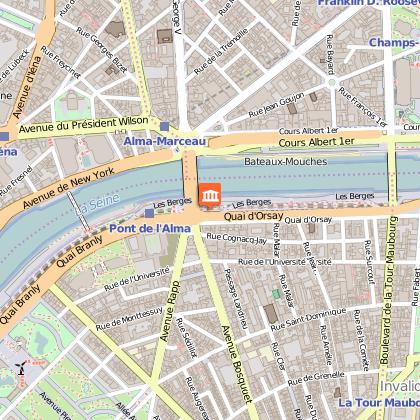
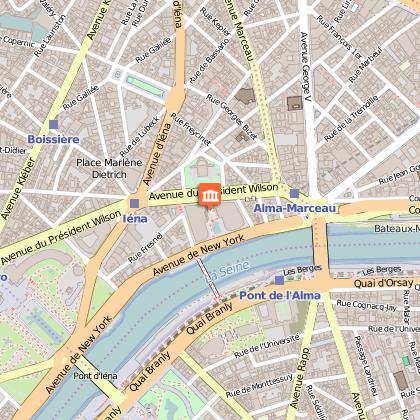
The Flame of Liberty (Flamme de la Liberté) in Paris is a full-sized, gold-leaf-covered replica of the new flame at the upper end of the torch carried in the hand of the Statue of Liberty at the entrance to the harbor of New York City since 1986.The monument, which measures approximately 3.5 metres in height, is a sculpture of a flame, executed in gilded copper, supported by a pedestal of gray-and-black marble. It is located near the northern end of the Pont de l'Alma, on the Place de l'Alma, in the 8th arrondissement of Paris.It was offered to the city of Paris in 1989 by the International Herald Tribune on behalf of donors who had contributed approximately $400,000 for its fabrication. It represented the culmination of that newspaper's 1987 celebration of its hundredth anniversary of publishing an English-language daily newspaper in Paris. More importantly, the Flame was a token of thanks for the restoration work on the Statue of Liberty accomplished three years earlier by two French businesses that did artisanal work on the project: namely, Métalliers Champenois, which did the bronze work, and the Gohard Studios, which applied the gold leaf. While the gift to France was prompted by the centennial of the newspaper, the Flame of Liberty, more broadly, is a lasting symbol of the friendship uniting the two countries, just as the statue itself was, when it was given to the United States by France.This project was overseen by the director of the French craft unions at that time, Jacques Graindorge. He foresaw an installation of the Flame of Liberty in a public square called Place des États-Unis (United States Place) in the 16th arrondissement, but the then mayor of Paris, Jacques Chirac, was opposed to it. After a protracted period of negotiations, it was decided that the Flame would be placed in an open area near the intersection of l'Avenue de New-York (New York Avenue) and the Place de l'Alma. The monument was dedicated on May 10, 1989 by Chirac.On the base of the monument, a commemorative plaque recounts the following story:"The Flame of Liberty. An exact replica of the Statue of Liberty's flame offered to the people of France by donors throughout the world as a symbol of the Franco-American friendship. On the occasion of the centennial of the International Herald Tribune. Paris 1887-1987."The flame became an unofficial memorial for Diana, Princess of Wales after her 1997 death in the tunnel beneath the Pont de l'Alma.[3] The flame became an attraction for tourists and followers of Diana, who fly-posted the base with commemorative material. Anthropologist Guy Lesoeurs said, "Most people who come here think this was built for her."The site of the monument is served by the Métro de Paris subway station called Alma-Marceau on Line No. 9 and by the RER commuter rail station, Pont de l'Alma, on its 'C' Line, as well as by buses numbered 42, 63, 72, 80, 92, and the Balabus sightseeing buses. Source : Wikipédia – Reproduction d’extraits du texte original. 
 Licence Créative Commons paternité partage à l’identique. Photo : Ignis

18 Avenue George V 75008 Paris
Show
Paris sewers
1.1 km

Paris sewers

The Parisian sewer system dates back to the year 1370 when the first underground system was constructed under "rue Montmartre". Since then, consecutive French governments have enlarged the system to cover the city's population. History Until the Middle Ages, the drinking water in Paris was taken from the river Seine. The wastewater was poured onto fields or unpaved streets, and finally filtered back into the Seine. Around 1200, Phillipe Auguste had the Parisian streets paved, incorporating a drain for waste water in their middle. In 1370 Hugues Aubriot, a Parisian provost had a vaulted, stone walled sewer built in the "rue Montmartre". This sewer collected the wastewater and took it to the "Ménilmontant" brook. However the wastewater was still drained in the open air. Under the reign of Louis XIV, a large ring sewer was built on the right bank, and the Biévre River was used as a sewer for the left bank of the Seine. On at least two occasions in the late 1700s, Paris refused to build an updated water system that scientists had studied. Women were actually carrying water from the river Seine to their residences in buckets. Voltaire wrote about it, saying that they "will not begrudge money for a Comic Opera, but will complain about building aqueducts worthy of Augustus". Louis Pasteur, himself lost three children to typhoid. Under Napoleon I, the first Parisian vaulted sewer network was built that was 30 km long. In 1850, the prefect for the Seine Baron Haussmann and the engineer Eugène Belgrand, designed the present Parisian sewer and water supply networks. Thus was built, more than a century ago, a double water supply network (one for drinking water and one for non drinking water) and a sewer network which was 600 km long in 1878. Source : Wikipédia – Reproduction of extracts of original text. Creative Commons Attribution-ShareAlike License. Crédit photo : Ignis

89 Quai d'Orsay 75007 Paris
Show
Pont de la Concorde
1.2 km

Pont de la Concorde

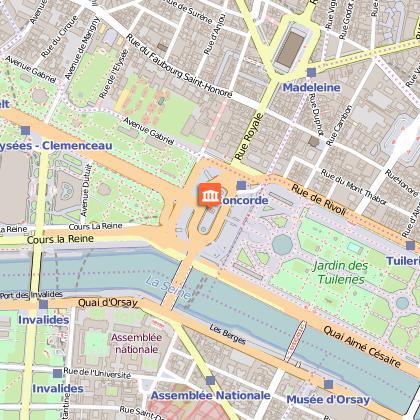
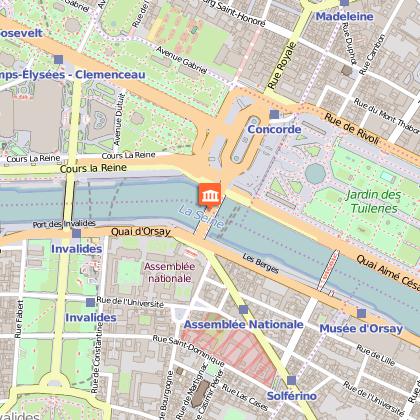
The Pont de la Concorde is an arch bridge across the River Seine in Paris connecting the Quai des Tuileries at the Place de la Concorde (on the Right Bank) and the Quai d'Orsay (on the Left Bank). It has formerly been known as the Pont Louis XVI, Pont de la Révolution, Pont de la Concorde, Pont Louis XVI again during the Bourbon Restoration (1814), and again in 1830, Pont de la Concorde, the name it has retained to this day. It is served by the Metro stations Assemblée nationale and Concorde. HistoryThe architect Jean-Rodolphe Perronet was commissioned in 1787 with this new bridge. It had been planned since 1755, when construction of place Louis XV (now place de la Concorde) began, to replace the ferry that crossed the river at that point. Construction continued in the midst of the turmoil of the French Revolution, using the dimension stones taken from the demolished Bastille (taken by force on 14 July 1789) for its masonry. It was completed in 1791. In 1810, Napoléon I placed along the sides of the bridge the statues of eight French generals killed in battle during the campaigns of the First French Empire. On the Bourbon Restoration these were replaced with twelve monumental marble statues, including four of the "grands ministres" (Suger, Sully, Richelieu, Colbert), four royal generals (Du Guesclin, Bayard, Condé, Turenne) and four sailors (Duguay-Trouin, Duquesne, Suffren, Tourville). However, this collection of statues proved too heavy for the bridge, and Louis-Philippe I had them removed and transferred to Versailles. Traffic across the bridge became very congested and the bridge had to be widened on both sides between 1930 and 1932, doubling the width of the original bridge. The engineers Deval and Malet nevertheless took care to preserve the neoclassical architecture of the original. It was renovated one last time in 1983. Today, this bridge bears the brunt of Paris's road traffic (except for those of the Boulevard Périphérique). Source : Wikipédia – Reproduction of extracts of original text. Creative Commons Attribution-ShareAlike License. Photo : Créative Commons

84 Pont de la Concorde 75008 Paris
Show

Where to eat in ELYSEES HOTEL

See more suggestions
Explore the culinary traditions of ELYSEES HOTEL.
See more suggestions

Where to sleep in ELYSEES HOTEL

See more suggestions
Explore accommodation options in ELYSEES HOTEL.
See more suggestions

Caution!
We have no information on the difficulty of this circuit. You may encounter some surprises along the way. Before you go, please feel free to inquire more and take all necessary precautions. Have a good trip! 🌳🥾