Tours
Activities
Places of interest
Where to eat
Where to sleep

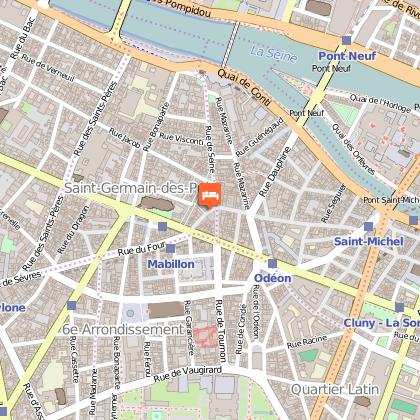
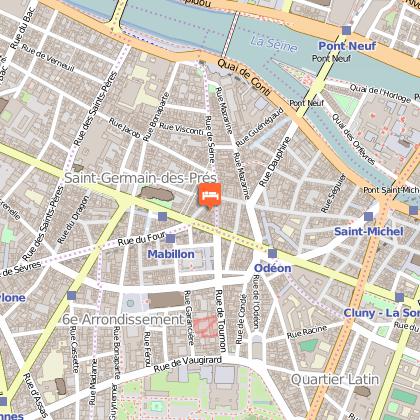
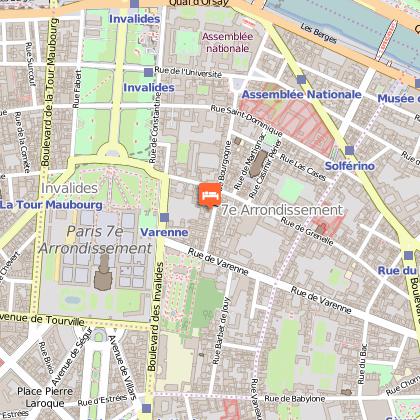
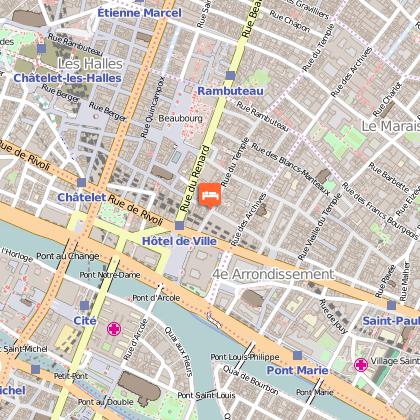
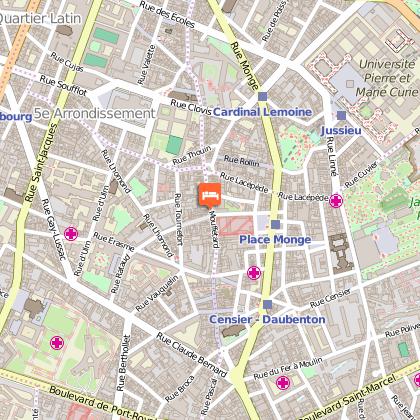
Discover Paris-6e's charm from Millesime Hotel

Are you the owner?
Welcome to the 6th arrondissement of Paris, a district rich in history and culture. From Millesime Hotel, embark on an adventure to iconic spots such as the Luxembourg Gardens, a true oasis in the city's heart, or the famed Saint-Sulpice Church. Wander through the picturesque streets of Saint-Germain-des-Prés and be charmed by its art galleries, antique bookstores, and literary cafés. For a deligh...See more

Walking around MILLESIME HOTEL

See more suggestions
Explore the walking circuits of MILLESIME HOTEL.
See more suggestions
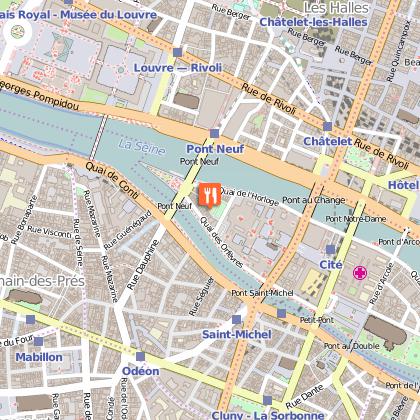
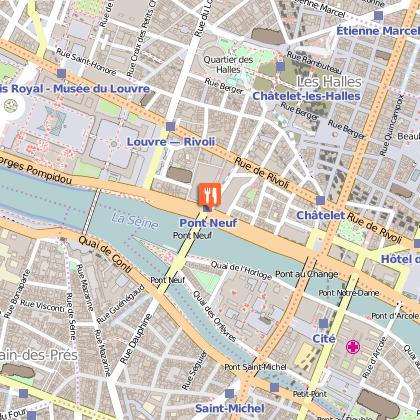
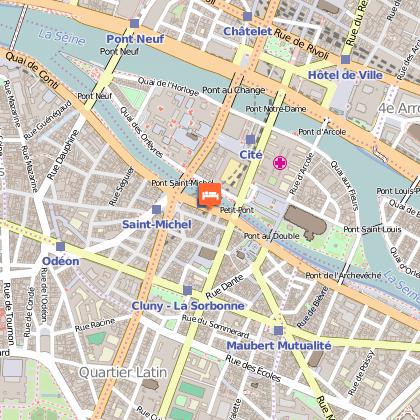
The Coats of arms of Paris « Fluctuat nec mergitur »
1.2 km

The Coats of arms of Paris « Fluctuat nec mergitur »

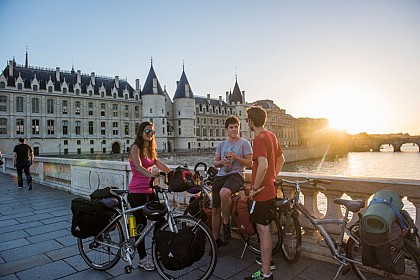
Leave to the discovery of the blazons of Paris and follow its currency " Fluctuat nec mergitur ", what means " He is beaten by streams, but does not sink ". Its balson evokes Scilicet, vessel and symbol of the powerful corporation of Nautes or the Traders of the water, manager of the municipality in the Middle Age. Its complete representation, it also contains the decorations that the city was authorized to make represent in its coats of arms, the Legion of Honour (decree of October 9th, 1900), the Croix de guerre 1914-1918 (decree of July 28th, 1919) and the cross of the Liberation (decree of March 24th, 1945). It is surmounted by a wall golden crown in five towers, and framed in right hand of a branch of oak and in sénestre of one of laurel. The currency is classically registered down. The blazon of Paris, under its current shape, date of 1358, time when king Charles V gave the leader sowed with flowers of lily. A nef, or a vessel, appear to have been of any time the symbol of the corporation of the traders of the water, which gave then birth to the municipality of Paris. It was necessary to wait for the First Empire so that cities are again officially authorized to be equipped with coats of arms. We find himit on numerous Parisian public equipments, among which the city hall, the city halls of district, the Parisian stations, bridges, schools and Parisian schools, fountains Wallace, theatre publicity displays and the other Parisian urban furnitures.

13 km
75004 Paris
Show

What to do in MILLESIME HOTEL

See more suggestions
The best experiences in MILLESIME HOTEL are just a click away, book now.
See more suggestions
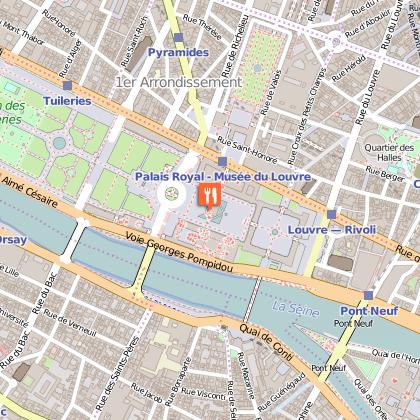
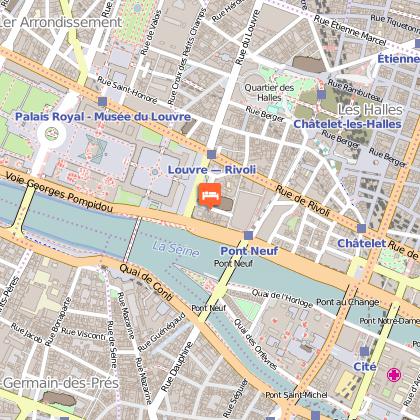
Louvre Museum: Skip the Line Tickets
641 m

Louvre Museum: Skip the Line Tickets

ArrayYour Experience Purchasing tickets for entry at the venue is not only time consuming but oftentimes, futile. Usually, same-day entry tickets on-site tend to sell out before mid-day, even if you waited in line for several hours. The Louvre in fact is the most visited museum in the world with over 10+ million visitors every year. Our fast track Louvre tickets provide you with priority access to this iconic museum. You will be able to bypass the arduous ticketing queues in your line and after a brief security check that is mandatory for every visitor, you are free to roam the halls of the Louvre. Once you've entered, feel free to browse through some of the 380,000 exhibits (with 35,000 currently on display) in the Louvre Museum. These are spread over 8 curatorial departments - Egyptian Antiquities; Greek, Etruscan, and Roman Antiquities; Near Eastern Antiquities; Islamic Art; Decorative Arts; Sculpture; Paintings; Drawings and Prints. From Egyptian artifacts that are 4,000 years old to modern works of art from Oriental artists, the Louvre has been the honorary arbiter of our artistic heritage. Some of the must-sees that you should try to not miss at the museum are Da Vinci's Mona Lisa, Liberty Leading the People by Eugène Delacroix, Michelangelo's The Dying Slave and the Rebellious Slave, the ancient Greek statues of Venus de Milo and Winged Victory of Samothrace, Hammurabi’s Code from 1754 B.C. and much more. As you gaze at these works of art, you aren’t just looking at paintings but emblems of our history. Most people only visit the Louvre once in a lifetime. Our priority access to the Louvre guarantees that you have a once-in-a-lifetime, hassle-free experience when you're there. Your tickets to the Louvre Museum combine the benefits of a fluid redemption process with priority access that helps you save your precious time by booking exclusively with Headout.

Musée du Louvre 75001 Paris-1ER-Arrondissement
Book from 17 EURBook
Show

What to visit in MILLESIME HOTEL

See more suggestions
Experience the annual festivals of MILLESIME HOTEL.
See more suggestions
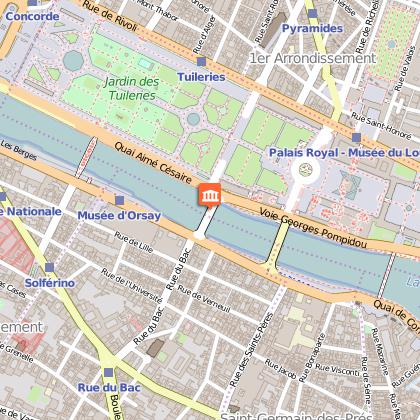
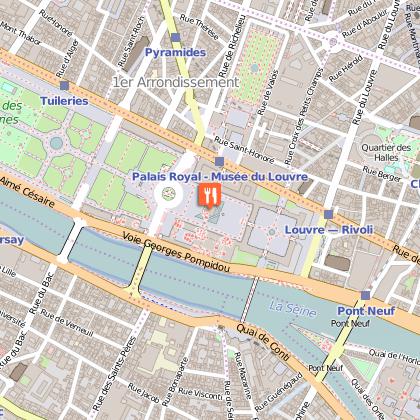
Pont Royal
686 m

Pont Royal

The Pont Royal is a bridge crossing the river Seine in Paris. It is the third oldest bridge in Paris, after the Pont Neuf and the Pont Marie. Located near the metro station: Tuileries LocationThe Pont Royal links the Right Bank by the Pavillon de Flore with the Left Bank of Paris between rue du Bac and the rue de Beaune. The bridge is constructed with five elliptical arches en plein cintre. A hydrographic ladder, indicating floods' highest level in Paris, is visible on the last pier nearest each bank. History In 1632, the entrepreneur Pierre Pidou directed the construction of a wooden toll-bridge which would be called Pont Sainte-Anne (in deference to Anne of Austria) or Pont Rouge (due to its color). It was designed to replace the Tuileries ferry upon which the rue du Bac (bac meaning ferry in French) owes its name. The ferry had been offering crossings since 1550. Fragile, this bridge of fifteen arches would be repaired for the first time in 1649, completely redone two years later, burnt in 1654, flooded in 1656, completely rebuilt in 1660, propped up in 1673 and finally carried away by a flood in February 1684. Madame de Sévigné reported that this last incident caused the loss of eight of the bridge's arches. It was finally reconstructed between October 25, 1685, and June 13, 1689, this time with stone, receiving complete financing from the king Louis XIV; it was the king who gave it the name Pont Royal. Louvois director of the Bâtiments du Roi, charged Jacques Gabriel, Jules Hardouin-Mansart and François Romain with the construction project. In the 18th century, the bridge was a popular meeting place for various festivities and celebrations. At the time of the French Revolution, in the period following the fall of the monarchy on 10 August 1792 and the beginning of the First French Empire in 1804 - the name of Pont Royal was changed to Pont National. During that period, General Napoléon Bonaparte (future Napoléon I, Emperor of the French) had cannons installed on the bridge in order to protect the Convention Nationale and the Committee of Public Safety, housed in the Tuileries Palace.During the First French Empire (1804-1814), Napoléon I renamed the bridge the Pont des Tuileries, a name that was kept until the Restoration in 1814 when Louis XVIII gave back to the bridge its royal name. The bridge underwent a last reconstruction in 1850. In 1939, it was classified as a monument historique under the same bill as the Pont Neuf and the Pont Marie.In 2005, the Pont Royal was illuminated by lights at night as one of the Paris Olympic Bid highlights. Source : Wikipédia – Reproduction of extracts of original text. Creative Commons Attribution-ShareAlike License. Photo : Wikimédia Commons

Pont Royal 75001 Paris
Show

Where to eat in MILLESIME HOTEL

See more suggestions
Savor culinary specialties in MILLESIME HOTEL.
See more suggestions

Where to sleep in MILLESIME HOTEL

See more suggestions
Explore hostels and hotels in MILLESIME HOTEL.
See more suggestions
Caution!
We have no information on the difficulty of this circuit. You may encounter some surprises along the way. Before you go, please feel free to inquire more and take all necessary precautions. Have a good trip! 🌳🥾