Tours
Activities
Places of interest
Where to eat
Where to sleep

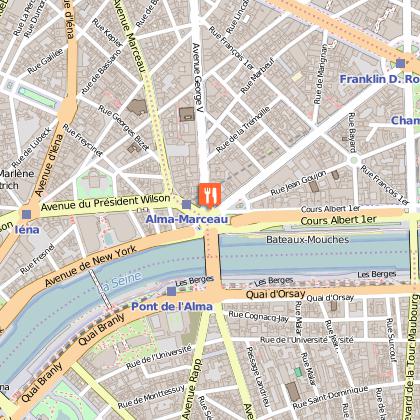
Experience Paris at HOTEL BRASSERIE THOUMIEUX

Are you the owner?
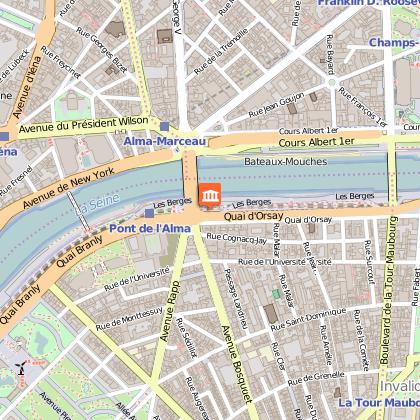
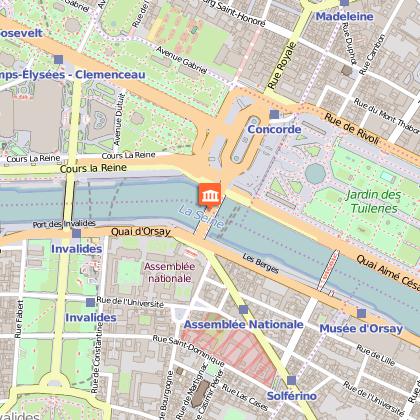
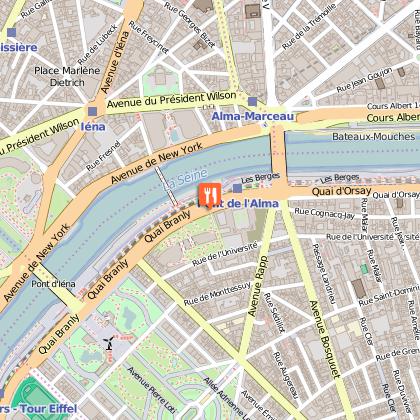
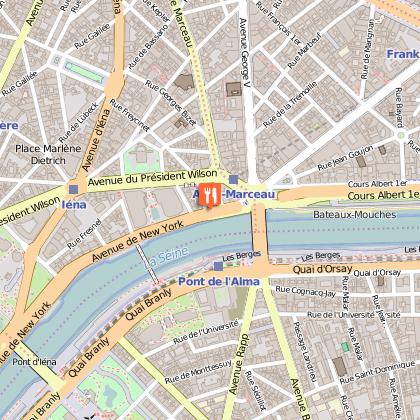
Immerse yourself in the charm of Paris's 7th arrondissement with a stay at HOTEL BRASSERIE THOUMIEUX. Ideally located, the hotel places you close to some of the capital's most iconic attractions.

Start your exploration with the Eiffel Tower, just a short walk from the hotel. Enjoy unforgettable panoramic views before strolling along the Seine. On clear days, a Seine river cruise is an excellent w...
See more

Walking around HOTEL BRASSERIE THOUMIEUX

See more suggestions
Discover the walking paths of HOTEL BRASSERIE THOUMIEUX.
See more suggestions

What to do in HOTEL BRASSERIE THOUMIEUX

See more suggestions
Explore HOTEL BRASSERIE THOUMIEUX through its many bookable activities.
See more suggestions
Les Invalides: Napoleon’s Tomb and the Army museum Tour
412 m

Les Invalides: Napoleon’s Tomb and the Army museum Tour

ArrayLes Invalides is a famous French monument which houses several museums and artifacts pertaining to the military. You can also see Napoleon’s Tomb here along with incredible paintings and more! Les Invalides Highlights Discover the Hotel Des Invalides, a building complex dedicated to the French Military. Visit the grave of famous French commander, Napoleon Bonaparte. See the collection of artifacts at the Military Museum. Visit the Dome Church and the cathedral of Saint Louis. Local English speaking guide providing insights through the duration of the tour. Your Experience The Hotel des Invalides was founded by Louis XIV to accommodate the veterans and wounded soldiers. Today it hosts one of the largest collections of weapons and armor in the world dating from ancient times to the present day. Led by a guide, you will discover the history and the architecture of this emblematic and historical place for France. You will see, for example, one of the most beautiful pieces of the 16th-century collection: the armor of François 1er, weighing more than 30 kilos. Your guide will also show you the famous painting of Napoleon by French painter Ingres, which shows the Emperor Napoleon 1st in coronation costume on the imperial throne. Then you will have the opportunity to visit the magnificent Cathedral of Saint-Louis, which was originally the soldiers’ church and is connected directly to the Dome of Invalides. There, under the Dome, you will be able to contemplate the impressive Tomb of Napoleon Bonaparte and the guide will tell you all about the legends surrounding the death of the Emperor in 1821 in Sainte-Hélène.

Metro Exit on Rue de l'Université, Place des Invalides 75007 Paris
Book from 110 EURBook
Show
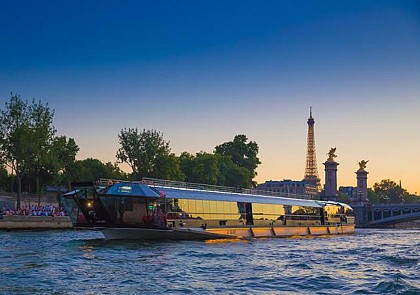
Bateaux Mouches: Seine River Sightseeing Cruise with Audio Commentary
508 m

Bateaux Mouches: Seine River Sightseeing Cruise with Audio Commentary

ArrayWhy You Shouldn’t Miss This Paris, often dubbed the City of Lights, is considered one of the foremost developed cities in the world. Steeped in history, the city has been a hub for art and business since the late 17th Century. It is the most popular tourist destination in the world, with 23 million unique visitors every year. The city's Louvre Museum houses what could possibly be considered the most famous painting in the world, the Mona Lisa. It is also home to another stunning museum, Musee d’Orsay, with numerous French artworks from the late 1800s and early 1900s. What makes the museum unique is that it was originally a railway terminal. The Notre Dame in Paris is one of the most renowned cathedrals in the world, and is one of the most stunning examples of French Gothic architecture, and another worthy reason to visit this splendid city. Your Experience The calm waters of the Seine make for a relaxing cruise. With commentary from an expert, you will understand the historical significance of each of the attractions that you pass by. Your tour will begin by passing the Louvre Museum and the Conciergerie towards the Notre Dame. The glass pyramid monument of the Louvre, however, are not visible from your ship due to the walls covering the area. The Notre Dame eastern facade is stunning to see in person. The tall spires and flying buttresses are in the typical Gothic style. The Musee d'Orsay with its two massive clocks is on the right bank of the Seine. Seven large windows can be seen between the two clock towers. You can also catch a glimpse of the Conciergerie, where Queen Marie Antoinette was jailed before her execution during the French Revolution. The massive stone structure with its numerous imposing towers is in stark contrast to the other monuments. At the end of the 70-minute your, you will be dropped back to the point where you boarded the ship. The Seine River Cruise Witnessing the beauty of Paris by boat is truly enchanting. Views from the Seine give you a different perspective to the heart of the city and an excellent audio commentary on board keeps your Parisian knowledge up to date. Key Inclusions Eiffel Tower Louvre Notre Dame Cathedral Conciergerie Musée d’Orsay

Bateaux-Mouches 75008 Paris
Book from 14 EURBook
Show

What to visit in HOTEL BRASSERIE THOUMIEUX

See more suggestions
Admire the unique architecture of HOTEL BRASSERIE THOUMIEUX.
See more suggestions

Paris sewers
542 m

Paris sewers

The Parisian sewer system dates back to the year 1370 when the first underground system was constructed under "rue Montmartre". Since then, consecutive French governments have enlarged the system to cover the city's population. History Until the Middle Ages, the drinking water in Paris was taken from the river Seine. The wastewater was poured onto fields or unpaved streets, and finally filtered back into the Seine. Around 1200, Phillipe Auguste had the Parisian streets paved, incorporating a drain for waste water in their middle. In 1370 Hugues Aubriot, a Parisian provost had a vaulted, stone walled sewer built in the "rue Montmartre". This sewer collected the wastewater and took it to the "Ménilmontant" brook. However the wastewater was still drained in the open air. Under the reign of Louis XIV, a large ring sewer was built on the right bank, and the Biévre River was used as a sewer for the left bank of the Seine. On at least two occasions in the late 1700s, Paris refused to build an updated water system that scientists had studied. Women were actually carrying water from the river Seine to their residences in buckets. Voltaire wrote about it, saying that they "will not begrudge money for a Comic Opera, but will complain about building aqueducts worthy of Augustus". Louis Pasteur, himself lost three children to typhoid. Under Napoleon I, the first Parisian vaulted sewer network was built that was 30 km long. In 1850, the prefect for the Seine Baron Haussmann and the engineer Eugène Belgrand, designed the present Parisian sewer and water supply networks. Thus was built, more than a century ago, a double water supply network (one for drinking water and one for non drinking water) and a sewer network which was 600 km long in 1878. Source : Wikipédia – Reproduction of extracts of original text. Creative Commons Attribution-ShareAlike License. Crédit photo : Ignis

89 Quai d'Orsay 75007 Paris
Show
Pont de la Concorde
903 m

Pont de la Concorde

The Pont de la Concorde is an arch bridge across the River Seine in Paris connecting the Quai des Tuileries at the Place de la Concorde (on the Right Bank) and the Quai d'Orsay (on the Left Bank). It has formerly been known as the Pont Louis XVI, Pont de la Révolution, Pont de la Concorde, Pont Louis XVI again during the Bourbon Restoration (1814), and again in 1830, Pont de la Concorde, the name it has retained to this day. It is served by the Metro stations Assemblée nationale and Concorde. HistoryThe architect Jean-Rodolphe Perronet was commissioned in 1787 with this new bridge. It had been planned since 1755, when construction of place Louis XV (now place de la Concorde) began, to replace the ferry that crossed the river at that point. Construction continued in the midst of the turmoil of the French Revolution, using the dimension stones taken from the demolished Bastille (taken by force on 14 July 1789) for its masonry. It was completed in 1791. In 1810, Napoléon I placed along the sides of the bridge the statues of eight French generals killed in battle during the campaigns of the First French Empire. On the Bourbon Restoration these were replaced with twelve monumental marble statues, including four of the "grands ministres" (Suger, Sully, Richelieu, Colbert), four royal generals (Du Guesclin, Bayard, Condé, Turenne) and four sailors (Duguay-Trouin, Duquesne, Suffren, Tourville). However, this collection of statues proved too heavy for the bridge, and Louis-Philippe I had them removed and transferred to Versailles. Traffic across the bridge became very congested and the bridge had to be widened on both sides between 1930 and 1932, doubling the width of the original bridge. The engineers Deval and Malet nevertheless took care to preserve the neoclassical architecture of the original. It was renovated one last time in 1983. Today, this bridge bears the brunt of Paris's road traffic (except for those of the Boulevard Périphérique). Source : Wikipédia – Reproduction of extracts of original text. Creative Commons Attribution-ShareAlike License. Photo : Créative Commons

84 Pont de la Concorde 75008 Paris
Show
La flamme de la Liberté
906 m

La flamme de la Liberté

The Flame of Liberty (Flamme de la Liberté) in Paris is a full-sized, gold-leaf-covered replica of the new flame at the upper end of the torch carried in the hand of the Statue of Liberty at the entrance to the harbor of New York City since 1986.The monument, which measures approximately 3.5 metres in height, is a sculpture of a flame, executed in gilded copper, supported by a pedestal of gray-and-black marble. It is located near the northern end of the Pont de l'Alma, on the Place de l'Alma, in the 8th arrondissement of Paris.It was offered to the city of Paris in 1989 by the International Herald Tribune on behalf of donors who had contributed approximately $400,000 for its fabrication. It represented the culmination of that newspaper's 1987 celebration of its hundredth anniversary of publishing an English-language daily newspaper in Paris. More importantly, the Flame was a token of thanks for the restoration work on the Statue of Liberty accomplished three years earlier by two French businesses that did artisanal work on the project: namely, Métalliers Champenois, which did the bronze work, and the Gohard Studios, which applied the gold leaf. While the gift to France was prompted by the centennial of the newspaper, the Flame of Liberty, more broadly, is a lasting symbol of the friendship uniting the two countries, just as the statue itself was, when it was given to the United States by France.This project was overseen by the director of the French craft unions at that time, Jacques Graindorge. He foresaw an installation of the Flame of Liberty in a public square called Place des États-Unis (United States Place) in the 16th arrondissement, but the then mayor of Paris, Jacques Chirac, was opposed to it. After a protracted period of negotiations, it was decided that the Flame would be placed in an open area near the intersection of l'Avenue de New-York (New York Avenue) and the Place de l'Alma. The monument was dedicated on May 10, 1989 by Chirac.On the base of the monument, a commemorative plaque recounts the following story:"The Flame of Liberty. An exact replica of the Statue of Liberty's flame offered to the people of France by donors throughout the world as a symbol of the Franco-American friendship. On the occasion of the centennial of the International Herald Tribune. Paris 1887-1987."The flame became an unofficial memorial for Diana, Princess of Wales after her 1997 death in the tunnel beneath the Pont de l'Alma.[3] The flame became an attraction for tourists and followers of Diana, who fly-posted the base with commemorative material. Anthropologist Guy Lesoeurs said, "Most people who come here think this was built for her."The site of the monument is served by the Métro de Paris subway station called Alma-Marceau on Line No. 9 and by the RER commuter rail station, Pont de l'Alma, on its 'C' Line, as well as by buses numbered 42, 63, 72, 80, 92, and the Balabus sightseeing buses. Source : Wikipédia – Reproduction d’extraits du texte original. 
 Licence Créative Commons paternité partage à l’identique. Photo : Ignis

18 Avenue George V 75008 Paris
Show
Passerelle Debilly
917 m

Passerelle Debilly

The Passerelle Debilly (Debilly Footbridge) is an arch bridge situated in Paris bestriding the Seine. It is a footbridge that connects the quai de New York to the quai Branly, close to the Eiffel Tower. HistoryIn order to accommodate visitor traffic to the 1900 World's Fair across the Seine, the General Commissioner of the Exposition, Alfred Picard, approved the construction of a provisional footbridge opposite the Avenue Albert de Mun, to join the Army and Navy Halls to the exhibit recreating old Paris. Its architect, Jean Résal, also designed the Pont Alexandre III and the Viaduc d'Austerlitz. The Debilly footbridge had, as well, a succession of provisional names. It was initially called passerelle de l'Exposition Militaire or passerelle de Magdebourg, only later passerelle Debilly, after General Jean Louis Debilly of the French First Empire who was killed in the Battle of Jena in 1806. The bridge became a permanent fixture from its original provisional status under the management of the City of Paris in 1906 after it was relocated opposite to the rue de la Manutention. The footbridge is built on a metallic framework resting on two stone piers at the riverbanks, and decorated with dark green ceramic tiles arranged in a fashion that suggests the impression of waves. Along with the Eiffel Tower, this is the second metallic structure that stands as an attestation to the engineering achievements of its epoch. Nevertheless, in 1941, the Debilly footbridge was threatened with disappearance when the president of the architectural society characterized it as a forgotten accessory of a past event. Fortunately, as a contemporary of the Pont Alexandre III and the Austerlitz Viaduct, the Passerelle Debilly was eventually included in the supplementary registry of historical monuments in 1966.The bridge was repainted in 1991 and its cladding resurfaced with hard tropical wood in 1997. German DiplomatIn 1989, a German diplomat working for the Secret Service of the Democratic Republic of Germany was found dead on this footbridge, several days after the Fall of the Berlin Wall. As it turned out, the footbridge was used as a secret gathering place for the secret service agents of East Germany during the Cold War. It is certainly one of the reasons that pushed Brian De Palma to shoot a scene of his thriller Femme Fatale on that footbridge in 2002. Source : Wikipédia – Reproduction of extracts of original text. Creative Commons Attribution-ShareAlike License. Photo : Mbzt

Place Debilly 75007 Paris
Show

Where to eat in HOTEL BRASSERIE THOUMIEUX

See more suggestions
The flavors of HOTEL BRASSERIE THOUMIEUX await you.
See more suggestions

Where to sleep in HOTEL BRASSERIE THOUMIEUX

See more suggestions
Explore hostels and hotels in HOTEL BRASSERIE THOUMIEUX.
See more suggestions

Caution!
We have no information on the difficulty of this circuit. You may encounter some surprises along the way. Before you go, please feel free to inquire more and take all necessary precautions. Have a good trip! 🌳🥾