Tours
Activities
Places of interest
Where to eat
Where to sleep

Explore Bailly, Yvelines: Charm and Heritage

Are you in charge of the destination?
Nestled in the Yvelines, Bailly is a small town brimming with activities and discoveries. Start your visit at the magnificent Château de Versailles, just a few kilometers away, where its French gardens and Hall of Mirrors will dazzle you. Dive into history with the Lambinet Museum in Versailles or the Jouy-en-Josas Toile Museum, both easily accessible from Bailly. For nature lovers, the Versailles...See more
Walking around Bailly

See more suggestions
Hiking trails in the Bailly area.
See more suggestions
Exploring the village of Marly
3.3 km

Exploring the village of Marly

Marly le Roi owes its notoriety to Louis XIV who had his country residence built here. In the 19th century, artists came in search of tranquillity and inspiration. Nowadays, the village's picturesque little streets continue to attract and charm visitors! Departure point: Marly-le-Roi Information Point On Grande Rue, at No. 41: Until the 1970s, this beautiful property housed a hotel and restaurant, "Au Roi Soleil". Pierre Bourdan, a former presenter of France Libre for London radio, used to stay here, away from the hustle and bustle of Paris. At No. 46: Here once stood the Hôtel du Comte de Toulouse (named after the legitimate son of Louis XIV and Madame de Montespan). At No. 39: Refurbished shops from the 17th and 18th centuries. Shops and royal nurseries used to fill the area between Rue Madame and Avenue des Combattants. Rue de Madame recalls the memory of Princess Palatine, the second wife of Philippe d'Orléans, brother of Louis XIV. She enjoyed staying in Marly. At No. 6: This is the house where one of the greatest crooks of the 20th century, Alexandre Stavisky, was arrested in July 1926. Stage 1 - Place de la Vierge The square, once known as "carrefour d'en bas", was located in the heart of Marly village. The statue of the Virgin pays tribute to the village's Notre Dame church which was destroyed at the end of the 17th century. Opposite, stands the former dwelling of the Pourvoyeurs du Roy, which belongs to the royal palace. Nearby, at No. 5 Rue Pasteur: Maison de la Blanchisserie du Château, another royal outhouse. There is still a wash house here. Opening onto this square is the Lycée Louis de Broglie, built in 1990 on the site of a property where the great tragedian, Rachel,once lived. Stage 2 - Place du Chenil Part of this square was once occupied by the ancient cemetery of Marly le Bourg, previously surrounded by the Prieuré Saint Etienne, Notre Dame church and the Hôtel Dieu. It is lined with some old houses, one of which was a key establishment in French cuisine for many years: the Auberge du Vieux Marly, where owner André Guillot welcomed many famous people. Opposite the town hall, is an enamelled plate reproduction of a painting by Alfred Sisley, "Place du Chenil at Marley, snow effect". This reproduction is found on the "Chemin des Impressionnistes" which stretches across eight towns and villages in the Seine loop. Hôtel de Ville and Parc du Chenil. During his stays in Marly, Louis XIV spent a great deal of time hunting in the forest. After becoming Lord of Marly le Bourg in 1693, he established his kennels in the gardens of the former seigniorial dwelling, and the great hunter, Monsieur de la Rochefoucauld, stayed in the renovated dovecote. The current building has retained some of its 18th-century structure, including the overall framework and the mascarons of the façade. The municipality purchased the building in 1966 and it has housed the council offices since 1988. Stage 3 - Hôtel Couvé An 18th-century hôtel particulier with a wrought iron balcony supported by corbels, cartouches and mascarons. It was used as the town hall between 1846 and 1988. The lower building, with a pediment and clock, was built in 1894 to house the boys' school. Rue Champflour. In the Middle Ages, this street, then called Rue de l'Hôtel Dieu, connected Marly le Bourg to Marley le Chastel. At No. 1bis: Maison "Champflour", a vast property built in the 17th century for an old Marly family and of which only the communal areas remain. After renovation and conversion work, the house was occupied by Alexandre Dumas junior from 1884 until he died in 1895. Stage 4 - Eglise Saint-Vigor Adjoining the castrum, the original church dedicated to Saint-Vigor was built in the 11th century. By order of the king, it was replaced by the current church which was built by Jules-Hardouin Mansart and Robert de Cotte, and consecrated in 1689. This rural but royal church is dedicated to Saint-Vigor and Saint-Etienne. Its classical sobriety is remarkable. The entrance is on the left-hand side, opposite the presbytery. The church was lavishly endowed by Louis XIV who came several times to attend service or Te Deum mass. Some liturgical items and paintings have been deposited at the Musée-Promenade de Marly-le-Roi - Louveciennes. Place Victorien Sardou Domaine du Berduron. In the 17th century, the property belonged to Louis Blouin, the first valet de chambre of Louis XIV. Substantially transformed, it was acquired in 1863 by Victorien Sardou, who established an orange orchard there. Château des Délices. Built in the 18th and 19th centuries, behind the church. The estate was taken over in 1955 by the Drouot group and today houses the regional headquarters of Assurances Axa. A beautiful construction with glass features which fits perfectly with its surroundings. Stage 5 - La Grande Rue The backbone of the ancient village which leads to the park entrance. This fairly steep street (Louis XIV called it the "very steep mountain" and had it paved in 1690), is lined with typical houses that make up a beautiful uniformity. It was inhabited in the 17th and 18th centuries by the winegrowers, tradesmen and craftsmen who worked for the palace, as well as noblemen, bourgeois and "scoundrels" wanting to gamble at the palace "casino". Worth noting: the old tile roofs, the hipped dormer windows and the little niches in the façades, housing protective saints. Rue Coysevox, at No. 12: Pretty country house with a hipped dormer window via which grain was hoisted to the attic with the help of a pulley system fixed under the roof overhang. Grande Rue, at No. 18: an old canted house with wrought iron window supports and an interior staircase with railings. At No. 19/21: A classical 17th and 18th century mansion. At No. 23: Outhouses of the Hôtel du Duc de Gèsvres, who was a Paris governer, built of 18th-century ashlar. Vast carriage gate with mascaron and small timber balcony, 19th century. At No. 27: In the courtyard, a typical country house with a balcony and covered gallery, 16th and 17th centuries. At No. 52: House with 3 mascarons and 2 bull's eye windows (Hôtel de Toulouse outhouses). End point: Tourist Office

1 h
1.2 km
78160 Marly-le-Roi
Show
Cycling route - Discovering Versailles
5.3 km

Cycling route - Discovering Versailles

Discover Versailles by bike through its historic neighborhoods and the magnificent Château park. A 14 km route blending history, culture, and nature, perfect for a family outing or a trip with friends. Start at the Carrés Saint Louis, a picturesque spot with historic buildings. Then, head to the Saint Louis Cathedral, an example of classical architecture with impressive stained glass windows. Continue to the Potager du Roi, a historic garden created for Louis XIV, where traditional gardening techniques are still practiced. Stop at the Jeu de Paume Hall, an emblematic site of the Tennis Court Oath, a significant event of the French Revolution. Next, go to the Pièce d'eau des Suisses, a large basin surrounded by lawns and trees, perfect for a break. Enter the park of the Palace of Versailles, famous for its French gardens and groves. Explore the Domaine de Trianon, including the Grand Trianon, the Petit Trianon, and the Queen's Hamlet, which offer a glimpse into royal life. Return to town to visit the Notre-Dame Church, an example of Baroque architecture where many royal events took place. Continue to the Notre-Dame Market Square, the center of the local market with its fresh and artisanal products. Pass by the Hoche Square, the first octagonal square in France, and end your tour at the Equestrian Academy, where equestrian art is showcased. This bike route offers a comprehensive exploration of the history and beauty of Versailles. Please note : Certain areas of the Château de Versailles park will be closed during the Olympic Games.

14 km
Very easy
1 place du maréchal Lyautey 78000 Versailles
Show

What to do in Bailly

See more suggestions
Book your activities in Bailly and experience memorable moments.
See more suggestions
The Petit Trianon
3.1 km

The Petit Trianon

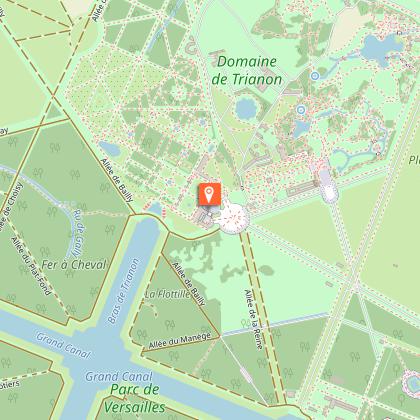
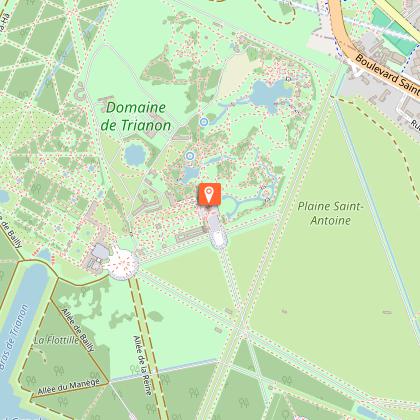
The Petit Trianon was built between 1763 and 1768 by the architect Gabriel, requested by Madame de Pompadour, mistress then friend of king Louis XV. Madame de Pompadour, who wished to “relieve the king’s boredom” — though no longer his mistress, she remained his friend — was the instigator of this small château, built by architect Gabriel between 1763 and 1768. It was erected near the Botanical Garden and the new menagerie, as Louis XV had a keen interest in the sciences. To please the marquise, always at the forefront of fashion, the king’s architect broke away from the rococo aesthetic and adopted a cubic form with very pure lines, in keeping with the brand-new “Greek style” then in vogue. Its simplicity is only apparent, for each façade is different, designed in relation to the space it overlooks: the courtyard, the French Garden with its elegant pavilion, the Botanical Garden, and the Florist’s Garden. Inside, one finds the same modernity of style. Simpler than the rest of the estate, the decoration of the Petit Trianon lies not in lavish materials — gilding is almost absent — but in the refinement of its sculptures, in a château entirely dedicated to nature. Madame de Pompadour died in 1764 and never saw the château completed. Today, it is above all the memory of Marie-Antoinette that it evokes. In 1774, Louis XVI gave the Trianon estate to his wife, who was able to live here a life apart — too much so for some — from the Court.

Château de Versailles 78000 Versailles
Book from 0 €Book
Show
Palace of Versailles All Access Passport Entry with Audioguide
4.6 km

Palace of Versailles All Access Passport Entry with Audioguide

ArrayYour Experience Use Your Passport to Tour the Château de Versailles Your ticket gives you access to the most famous places within the royal estate including the Royal Palace, the Park, Gardens, Marie Antoinette’s Estate, and entry to any exhibitions on show at the time of your visit. If you plan to visit on a Friday, Saturday or Sunday, it’s worth paying the extra €8 for an upgraded Passport ticket, which includes access to the Musical Fountain and Garden shows. Learn About the French Monarchy with the Help of a Multilingual Audio Guide Upon entering the Palace, collect your complimentary audio guide from one of the two pick-up counters located on the ground floor, one at the entrance to the Apartment Ladies and the other at the entrance to the Gallery of Castles. Audio guides are available in 11 languages: Spanish, Chinese, English, French, German, Italian, Japanese, Korean, Polish, Portuguese and Russian. Begin your visit by exploring the ornate King and Queen's State Apartments. Learn about the French monarchy and peek into the private lives of the infamous King Louis XIV and Marie Antoinette. Next, make your way to the glittering Hall of Mirrors. Designed to protect the ornate walls and ceilings from smoke, the hall’s 357 mirrors were strategically placed to reflect the light of candles. With just a few flames, the reflection from so many mirrors was enough to light up the whole hall! Explore 250 Acres of Gorgeously Landscaped Lawns and Fountains After admiring the inside of the Palace, head outdoors and take in the grandeur of the estate’s impressive architecture. Stroll along the cobblestone grounds, through the beautiful French gardens, and pass by the gorgeous Versailles fountains. Next, stop by the Estate of Marie Antoinette and discover the life and antics of the Queen at the Petit Trianon. Walk around the Village of the Queen and English gardens, then see where Marie Antoinette built her own house, a Mill, a Preparation Dairy, a Cave, a Belvedere and the magnificent Temple of Love where lovers get engage. At the Carrosses Gallery, travel back in time as you explore carriages, coaches, sculptures and other artifacts left behind by the French Monarch. If you’re short on time and would prefer to skip the long lines, a Versailles skip-the-line entry ticket will allow you to save your time. If you’d like to maximize your time at the palace of Versailles and get a more in depth Castle experience, click here. Each year, it is estimated that approximately 5 million people visit the Palace of Versailles, and between 8 and 10 million people walk its gardens. A place of immense beauty, Versailles stands as a symbol of France’s monarchy and its glorious history.

Book from 20 EURBook
Show
Palace of Versailles
4.6 km

Palace of Versailles

Since 1979, the Palace of Versailles has been listed as a UNESCO World Heritage Site. It stands as one of the finest masterpieces of 17th-century French art. The Palace and the Trianon Estate are open every day, except Mondays. The Palace opens at 9 a.m., while the Trianon Estate opens only from 12 p.m. The Park and Gardens are open daily with free admission (access to the Gardens is ticketed on the days of the Musical Fountains Shows and Night Fountains Shows, as well as during the Musical Gardens). You can only access the Park via: the Queen’s Gate (Grille de la Reine, entrance for pedestrians, cyclists, and vehicles every day), the Saint-Antoine Gate (Porte Saint-Antoine, pedestrians and cyclists every day, vehicles only on weekends and public holidays), the Matelots Gate (Grille des Matelots, pedestrians and cyclists every day), from 7 a.m. to 8:30 p.m., with last entry at 6:15 p.m. in high season, and from 8 a.m. to 6 p.m. in low season. By exploring the Hall of Mirrors, the King’s State Apartments, and the Museum of the History of France, you step into a palace that, until 1789, was the heart of royal power and continued to evolve over the centuries. Originally, Versailles was nothing more than a hunting lodge built by Louis XIII. But it was here that Louis XIV chose to construct the majestic palace we know today, a symbol of absolute monarchy and French classical art. In the 1670s, Louis XIV commissioned the construction of the King’s and Queen’s State Apartments. The most emblematic creation of these ceremonial spaces is undoubtedly the Hall of Mirrors, designed by Mansart. During the following century, the palace kept expanding, with major works such as the Royal Chapel and the Opera. Today, the Palace covers 63,154 m², spread across 2,300 rooms. Although the Palace lost its role as the seat of power in 1789, in the 19th century it was given a new purpose: to become the Museum of the History of France, an idea launched by Louis-Philippe, who ascended the throne in 1830. Many rooms of the palace were then transformed to house collections recounting the great moments of French history, enriched until the early 20th century.

Château de Versailles Place d'armes 78000 Versailles
Book from 0 €Book
Show
Palace of Versailles Entry Ticket with Audioguide
4.9 km

Palace of Versailles Entry Ticket with Audioguide

ArrayWhat to Expect Begin your visit by exploring the ornate King and Queen's State Apartments. Learn about the French monarchy and peek into the private lives of the infamous King Louis XIV and Marie Antoinette. Next, make your way to the glittering Hall of Mirrors. Designed to protect the ornate walls and ceilings from smoke, the hall’s 357 mirrors were strategically placed to reflect the light of candles. With just a few flames, the reflection from so many mirrors was enough to light up the whole hall! After admiring the inside of the Palace, head outdoors and take in the grandeur of the estate’s impressive architecture. Stroll along the cobblestone grounds and pass by the gorgeous Versailles fountains. At the Carrosses Gallery, travel back in time as you explore carriages, coaches, sculptures and other artifacts left behind by the French Monarch. If you’re short on time or would prefer to skip the long entry lines, a Versailles skip-the-line entry ticket will allow you to save anywhere from 1-3 hours of waiting. If you happen to visit the Palace on a Tuesday, Saturday or Sunday, consider opting for a Versailles Passport ticket and catch one of the famous water fountain and musical shows. Each year, it is estimated that approximately 5 million people visit the Palace of Versailles, and between 8 and 10 million people walk its gardens. A place of immense beauty, Versailles stands as a symbol of France’s monarchy and its glorious history.

Book from 18 EURBook
Show

What to visit in Bailly

See more suggestions
Visit the museums and galleries of Bailly.
See more suggestions
The Petit Trianon
3.1 km

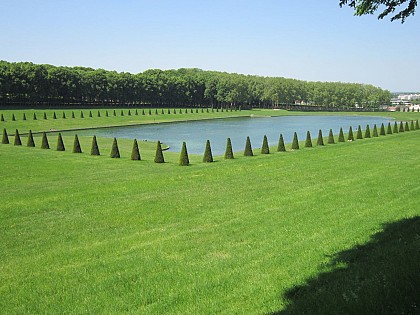
The Petit Trianon

The Petit Trianon was built between 1763 and 1768 by the architect Gabriel, requested by Madame de Pompadour, mistress then friend of king Louis XV. Madame de Pompadour, who wished to “relieve the king’s boredom” — though no longer his mistress, she remained his friend — was the instigator of this small château, built by architect Gabriel between 1763 and 1768. It was erected near the Botanical Garden and the new menagerie, as Louis XV had a keen interest in the sciences. To please the marquise, always at the forefront of fashion, the king’s architect broke away from the rococo aesthetic and adopted a cubic form with very pure lines, in keeping with the brand-new “Greek style” then in vogue. Its simplicity is only apparent, for each façade is different, designed in relation to the space it overlooks: the courtyard, the French Garden with its elegant pavilion, the Botanical Garden, and the Florist’s Garden. Inside, one finds the same modernity of style. Simpler than the rest of the estate, the decoration of the Petit Trianon lies not in lavish materials — gilding is almost absent — but in the refinement of its sculptures, in a château entirely dedicated to nature. Madame de Pompadour died in 1764 and never saw the château completed. Today, it is above all the memory of Marie-Antoinette that it evokes. In 1774, Louis XVI gave the Trianon estate to his wife, who was able to live here a life apart — too much so for some — from the Court.

Château de Versailles 78000 Versailles
Book from 0 €Book
Show
The Grand Canal
3.3 km

The Grand Canal

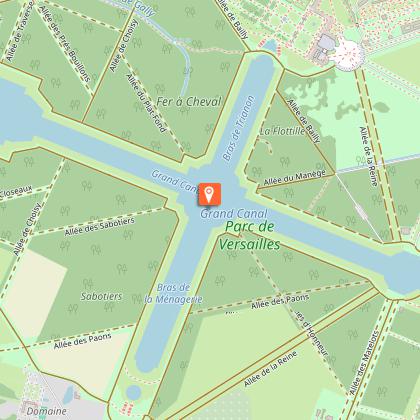
Set around the majestic Grand Canal, the park of the Palace of Versailles stretches over several hectares and is open free of charge all year round. Designed between 1668 and 1679, the Grand Canal is one of the most remarkable creations of André Le Nôtre, King Louis XIV’s landscape gardener. Covering 23 hectares, 60 meters in width, 1,700 meters east to west, and 1,000 meters north to south, the Grand Canal offers an exceptional perspective, carefully designed to highlight the beauty and grandeur of the royal estate. Whether on foot, by bike, or on rollerblades, the Palace park invites you to enjoy a refreshing walk in an extraordinary setting. The full loop around the Grand Canal stretches 5.5 km and can be covered in: - 1h00 to 1h15 on foot, - 25 to 30 minutes by bike, - 35 to 40 minutes on rollerblades. The paved, relatively flat path is wheelchair accessible, allowing everyone to fully enjoy this remarkable natural landscape. A masterpiece of landscape design and nature The Grand Canal forms the main east-west axis of the Versailles gardens. Once a wetland, this part of the park was transformed by Le Nôtre into a vast water reservoir that now serves as an essential decorative element, reflecting changing light through the seasons. Whether you visit the gardens in summer, autumn, or winter, the natural spectacle is breathtaking. Practical information Access to the park is free and can be made through several entrances, notably Boulevard de la Reine or directly from the Palace entrance. Please note, however, that entry to the gardens (the area near the Palace with the groves) is ticketed during the *Grandes Eaux Musicales* in high season. On site, you’ll find several restaurants and tea rooms for refreshments. You can also rent rowboats, bikes, or segways to explore the park in a different way. A unique experience on the water: rowboat rental The Grand Canal, this majestic cross-shaped basin, invites relaxation and contemplation. Renting a rowboat gives you access to an exceptional vantage point over the estate: the groves, fountains, royal perspectives, and the Palace reveal themselves in a peaceful, bucolic setting. This activity is perfect for couples seeking romance, families out for a stroll, or friends in search of something original. Rental hours : daily from 10 a.m. to 6:45 p.m. (last departure at 6:15 p.m.), closed annually in December, January, and February. Rates: available by the half-hour or by the hour, depending on your preference. Let yourself be lulled by the calm of the water, watch swans glide by, and take in the changing light of the park. A timeless experience, not to be missed during your visit to the Versailles estate.

Château de Versailles 78000 Versailles
Show

Where to eat in Bailly

See more suggestions
Discover the local flavors of Bailly.
See more suggestions

Where to sleep in Bailly

See more suggestions
Discover the best lodging options in Bailly.
See more suggestions
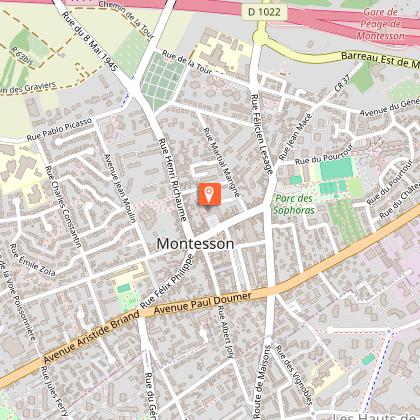
Campanile Montesson-Le Vésinet
9.5 km

Campanile Montesson-Le Vésinet

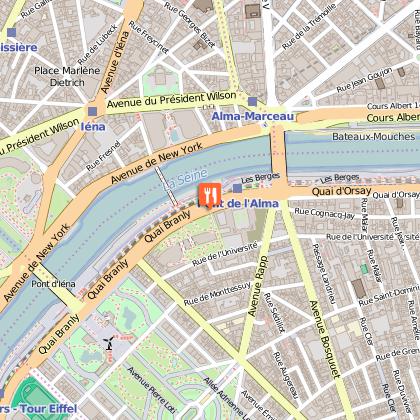
An entirely renovated Campanile hotel which invites you to enjoy the calm of this residential district of Montesson Located 15 km from Porte Maillot, our establishment offers a strategic position for business travellers in north-western Paris. Close to Saint-Germain en Laye, Le Vésinet, Port-Marly and Le Pecq, the hotel is easily accessible from the A86, A13 and A14 motorways. Le Vésinet-Le Pecq RER train station (line A serving La Défense and the centre of Paris) is a 15-minute walk away, Use your leisure time here to visit the Palace of Versailles or the Château de Maisons-Laffitte, both within easy reach of our hotel which proposes bright, modern 3-star rooms in Montesson. Our rooms are air-conditioned and sound-proofed and boast a contemporary style. Recently renovated in line with New Generation standards, they feature all the modern comforts needed for a restful stay. The hotel has 3 specially-adapted rooms to accommodate people with disabilities. To make your stay even more pleasant, you can also enjoy the television channels Canal + and Bein Sport, free of charge. We have a restaurant and terrace, as well as a secured indoor car park. In its lush green setting, our restaurant is open for breakfast, lunch and dinner. It is a modern, convivial venue that opens onto a shady terrace accommodating up to 35 people. Our chefs propose traditional French cuisine and seasonal dishes concocted from fresh ingredients. Our all-you-can-eat buffet menus for adults and children will satisfy every appetite,

9 Rue du Chant des Oiseaux 78360 Montesson
Show
Caution!
We have no information on the difficulty of this circuit. You may encounter some surprises along the way. Before you go, please feel free to inquire more and take all necessary precautions. Have a good trip! 🌳🥾