Tours
Activities
Places of interest
Where to eat
Where to sleep

Discover Durbuy, Luxembourg, Luxembourg: Enchanting Gem

Are you in charge of the destination?
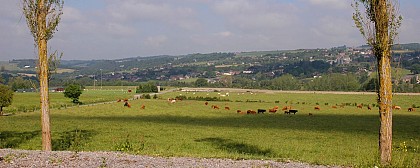
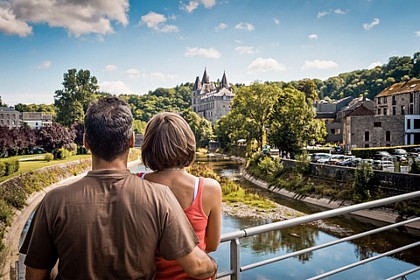
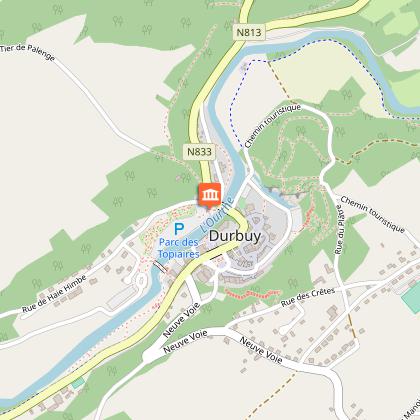
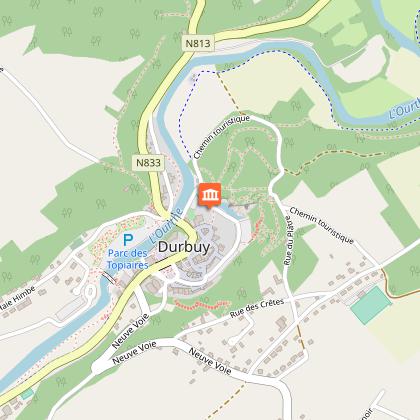
Welcome to Durbuy, Luxembourg, Luxembourg, a picturesque town nestled in the magnificent landscape of the Luxembourg region. Embark on a rewarding visit where every street corner tells a story and each view invites awe.

Start your exploration with a romantic stroll through the old town of Durbuy, renowned for its beautifully preserved medieval architecture. Don't miss the Durbuy Castle, majestic...
See more

Walking around Durbuy

See more suggestions
Walks and discoveries in Durbuy.
See more suggestions
What to do in Durbuy

See more suggestions
Activities for all tastes await you in Durbuy, book them today.
See more suggestions

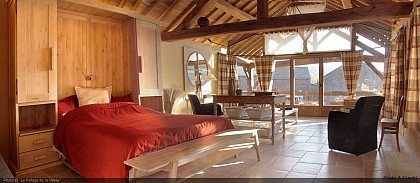
What to visit in Durbuy

See more suggestions
Relax in the parks of Durbuy.
See more suggestions
The Mill
61 m

The Mill

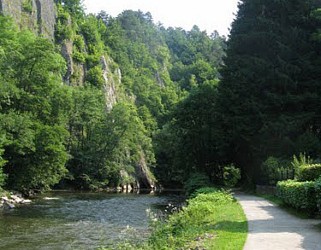
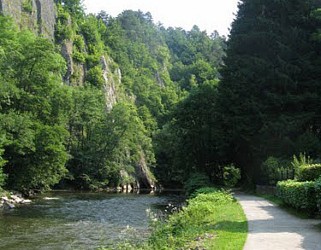
  What would Durbuy be without its river? Over the course of thousands of years, the river Ourthe has shaped the countryside and enveloped the limestone that defined the opposite bank in a meander that no longer exists. The course of the ancient arm of the river that turned Durbuy into an island until the 18th century can be easily traced: the river eroded the rock as far as the Hôtel du Sanglier on the right and the rocks of the anticline on the left, where it re-joined the main river. Protected by steep slopes, the small island was the ideal location for the construction of a fortress in the Middle Ages. It sprung up in the 11th century in the location of the current castle. From the 14th - 17th century, the town which developed at the foot of the castle was protected by a wall. It was 550 metres long, 6-7 metres tall and followed the river's course. At the site of the two current bridges, the wall has been interrupted with two drawbridge gates that controlled access to the town. Today, Durbuy's old town retains its medieval arrangement and confined to a steep-sided valley and isolated from important communication channels, the town has never been able to expand. Durbuy presents a nugget of old uniformity: a handful of 18th and 19th century houses, two ancient convents, a corn exchange and a castle. Nestled in green surroundings, it really is a theatrical setting dominated by the grey limestone. But is that not what makes the 'smallest city in the world' so charming?

Show
Durbuy Anticline
83 m

Durbuy Anticline

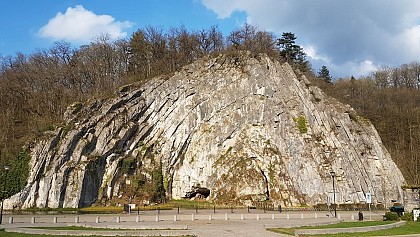
You are now standing in front of the Durbuy Anticline, otherwise known as the Rocher de la Falize (Al Rotche al Falèye), also otherwise known as the Omalius Anticline in honour of the famous Belgian geologist Jean-Baptiste-Juliend’Omalius d’Halloy(1783-1875). It was he, one of the pioneers of geology in Belgium and Northern France who, in 1807, first described the rock in a scientific journal. The anticline is a geological phenomenon, unique by virtue of its situation, its size and its ease of observation. So, now for a brief geology lesson. The Omalius Rock is what is known as an anticlinein geological terms. An anticline is an A-shaped fold in a rock layer. Its inverse, a V-shaped fold, is known as a syncline. It is made up of well-stratified Frasnian limestones. Going back in time to the Frasnian stage, between 385 and 375 million years ago, the Geopark lay beneath the southern tropic in a warm ocean. The ocean bed was made up of alternating deposits of carbonated mud and layers of reef-building organisms (corals, sponges, etc.), forming horizontal banks. In order to take on the folded appearance we see today, these banks had to be forced out of shape. This forcing occurred when the earth’s crust was compressed. In Belgium, this happened when a mountain chain was formed some 320 million years ago (the Variscan orogeny). When the force of the pressure became too great, the banks snapped. The resulting mountain chain was subsequently eroded away to a flat, featureless surface known as a peneplain. Rivers then incised their way into this rocky base to form the landscapes we see today.

9 Rue des Récollets 6940 Durbuy
Show
The Recollet Monks
101 m

The Recollet Monks

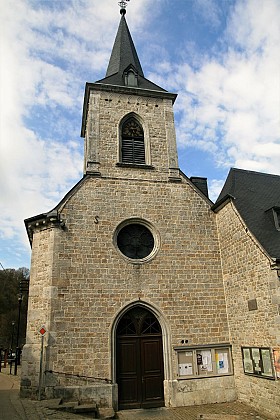
  The history of the Recollet Monastery dates back to 1625 when Laurent Lejeune, Lord of Ambly and Canon of Maastricht offered his family house at number X to the Franciscans of Liège. A stone inserted in the gable, near to the church courtyard commemorates the event. At this time of Counter Reformation, the Franciscans regularly sent monks into the countryside with the aim of protecting the population against heretics. Among them, there were Recollets who followed the Ourthe from Liège to Durbuy where witchcraft was wreaking havoc. In their house in Durbuy, the Franciscans accommodated 16 Recollet fathers. Surviving on charity, it was the financial aid and land that was given to them that the monks used to construct a chapel and a monastery on either side of the house forming a limestone quad with a cloister and a kitchen garden in the 17th century. Always ready to listen and be at the service of others, the Recollets oversaw boys' education. They also trained future monks and it can be said that their presence cultivated the little town. Following the forced departure of the monks in 1795, the monastery underwent significant transformations and irreversible alterations to accommodate a police station in the 19th century, followed by an orphanage and finally a school. The church of the Recollets was adopted by the residents of Durbuy around 1802 as their chapel, which was in a square near to the old market, had fallen into ruin. The parish priest moved into the Lejeune house which remains the presbytery today.

Show
The Castle of Durbuy
102 m

The Castle of Durbuy

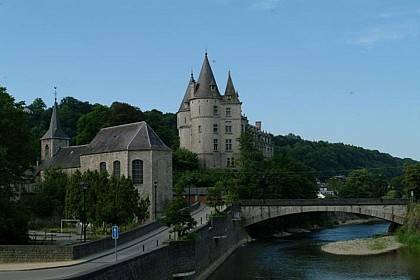
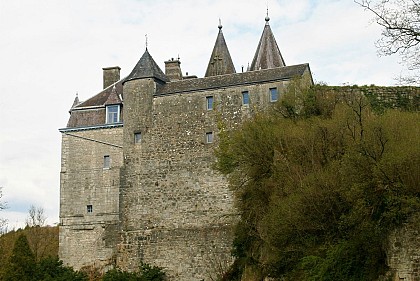
The town of Durbuy grew up on an island encircled by a meander cutoff of the River Ourthe, a position of great strategic importance. The site relied for its defence on the river surrounding the fortified enclosure, and on the castle, built on a rocky spur. It was not until the 18th century that the meander was drained and filled in, leaving the dry bed of the former course where you now stand. Facing you stands the Chateau. The town of Durbuy, first mentioned in written records in 1078, owes its existence to the castle. This landmark has had a chequered history, falling prey over the course of time to fire, dilapidation and destruction, alternating with periods of reconstruction. In its earliest form, the fortress was built primarily for military purposes, consisting of a platform on which stood a number of buildings and towers making up the fortifications. Accommodation was restricted to the bare minimum. From the 15th century onwards, the castle was to offer more comfortable quarters as rooms were added on the town side of the keep. The castle survived a number of wars before finally being razed by French troops in the 17th century. In 1731, the Duc d’Ursel, lord of Durbuy from 1726, embarked on its reconstruction. What he built, however, was not a fortress but a château, a courtly residence on the banks of the Ourthe. The chateau underwent further radical changes around 1880- 1882, giving it the neo-Gothic style it retains to this day. As the riverbank reveals, the base of the chateau rests on the limestone rock itself, providing solid foundations for the chateau. Between the chateau and the cutoff stands an impressive folded rock formation:the small anticline (geological details below). This anticline, along with outcrops along the course of the Ourthe, reveals the existence of a rock several metres in height on which the chateau is built, makingit a natural vantage point over the surrounding terrain.

14 Rue du Comte Théodule d'Ursel 6940 Durbuy
Show
The Old Market & Corn Exchange
113 m

The Old Market & Corn Exchange

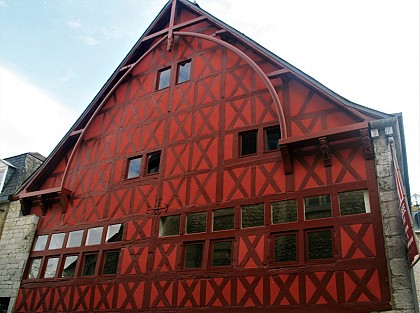
This is the oldest building in Durbuy. It dates from the 16th century and forms part of Wallonia's exceptional heritage. Its existence is linked to the town status that Durbuy received from the House of Luxembourg more than 700 years ago. In one document dating from 1331, Jean de Bohême confirmed Durbuy's role as a stronghold and as an administrative and judicial centre. In order to fulfil all its roles, the town needed a public building. The original Market existed until the 14th century when it burned down. A new one was constructed around 1530 entirely from wood and cob and, twice as long as it is today, the building housed the offices where the mayor, the councillors, the urban militia and the provost who presided over the courts and the magistrates met. At the back, the building has a vast covered market that was removed in 1630. Gradually  the half-timbering was replaced with limestone as it required too much maintenance. The loft was occasionally used to store grain, which is why the building was subsequently named the 'Corn Exchange'. In the 19th century, the building became a dwelling.   Recently, archaeological research has allowed focussed restoration and the reassignment of the public building to an exhibition centre. The restoration work combined ancient techniques with modern ones, and introduced contemporary elements in metal, new wood and glass, while being careful to preserve the original features, such as the remarkable half-timbered gable.

Show

Where to sleep in Durbuy

See more suggestions
Find the perfect lodging for your visit to Durbuy.
See more suggestions

Caution!
We have no information on the difficulty of this circuit. You may encounter some surprises along the way. Before you go, please feel free to inquire more and take all necessary precautions. Have a good trip! 🌳🥾