Tours
Activities
Places of interest
Where to eat
Where to sleep

Discover Marseille from Novotel Marseille Centre Prado Vélodrome

Are you the owner?
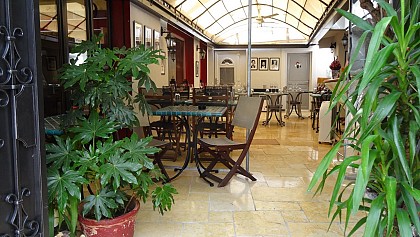
Welcome to Novotel Marseille Centre Prado Vélodrome! Located in the heart of Marseille's 8th arrondissement, our hotel serves as the perfect starting point to explore the wonders of this vibrant city. Enjoy easy access to major tourist attractions while staying in a lively and authentic neighborhood.\n\nStart your day with a stroll to the Old Port, one of Marseille’s most iconic spots. Wander amon...See more

Walking around NOVOTEL MARSEILLE CENTRE PRADO VELODROME

See more suggestions
Enjoy outdoor walks in NOVOTEL MARSEILLE CENTRE PRADO VELODROME.
See more suggestions
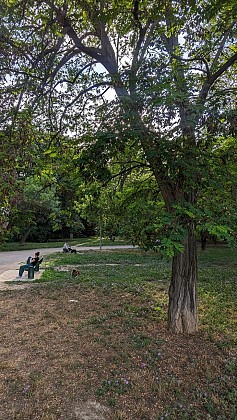
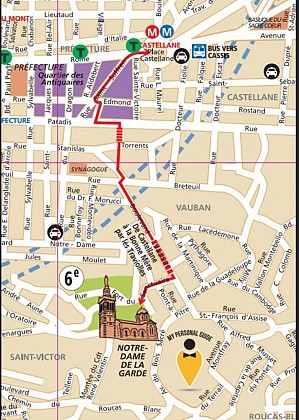
Urban stroll: a veritable green corridor between the Saint-Giniez, Bonneveine and Mazargues districts
629 m

Urban stroll: a veritable green corridor between the Saint-Giniez, Bonneveine and Mazargues districts

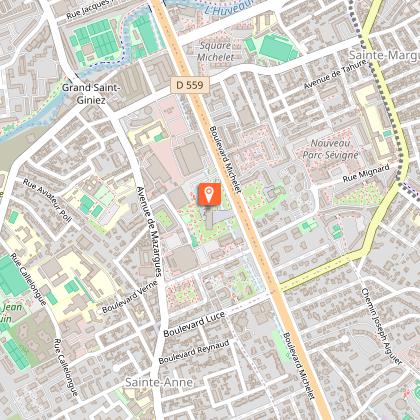
This tour, which can be done on foot or by bike, takes in some of Marseille's neighborhoods, which are home to a number of sites well worth a visit. The route is particularly pleasant in hot weather, as it is shaded. The starting point is a bridge at the beginning of impasse René Magnac (1). You'll walk alongside the sports complex named after the former president of the ASPTT club, who did a great deal for its development. You enter the Avenue de Mazargues and continue along a greener stretch of road, until you reach the back of the building housing the Ballet National de Marseille (2) and the Parc Henri Fabre (3). Continue along the original Huveaune riverbed to reach the main entrance to Parc Borély (4). Admire the view of the château (5). Pass through the gates and continue left to reach the rose garden. Pass under the imposing, majestic plane tree to reach the island of the former "Pavillon du Lac" establishment. Leave the island and head for the entrance to the botanical garden (6). If you've taken the necessary steps to reserve your entrance (it's free, but must be reserved in advance), you'll be in for a complete change of scenery. After this detour, walk past the Bird Man fountain to reach the children's play area. A gate leads from Parc Borély to Avenue Clot-Bey. Cross the avenue and continue along the narrow traverse Paul, which zigzags between properties. Fence walls protect some beautiful homes from view. You finally come to Rue Albert Dubout and, at the end, turn right down Avenue d'Haïfa. You'll come to the [mac ]musée d'art contemporain (7) and the Pouce de César (8). Via avenue de Hambourq, you'll reach the central Bonneveine park (9), where you'll also find some monumental works of contemporary art. Continue through the park to skirt the grounds of the Horticultural Society and Parc Bortoli (10). You've reached the end of the route. You now have several options: Continue the tour to discover the Mazargues district, take the 22/22S buses back to the rond-point-du-Prado, or take the 45 bus that brings you closer to the seaside, the Pointe-Rouge district and the Pastré countryside.

2 h
4.6 km
Very easy
88 Boulevard Michelet Au début de l’impasse René Magnac 13008 Marseille
Show
Hiking from Notre Dame de la Garde, to Roucas Blanc and Corniche
2 km

Hiking from Notre Dame de la Garde, to Roucas Blanc and Corniche

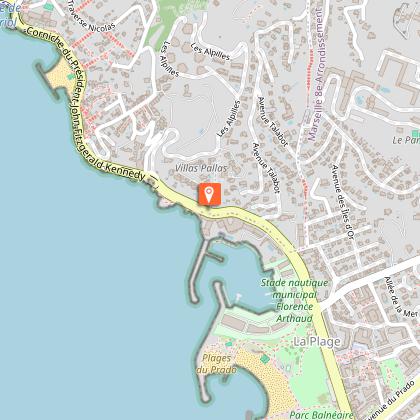
After visiting Notre-Dame de la Garde, explore the Roucas Blanc. This district, a real maze of narrow streets, can only be visited on foot and offers magnificent views of the city. The Roucas Blanc hill was also a place of free expression for 19th-century Marseilles Rocailleurs: craftsmen, masons and ornamental designers, some of whom were quite singular. Their creations can be found in the dreamy gardens of the neighborhood's opulent homes. Via uphill crossings and sloping alleyways, you'll reach Corniche Kennedy and Plage du Prophète. Its fine sand and turquoise waters are the perfect reward after a fairly strenuous walk. This really is the most stunning urban stroll, so we invite you to look at your surroundings with curiosity and care. At the foot of Notre-Dame de la Garde, as you look out towards the sea, there's a staircase leading down that you have to take. This is the Montée du Commandant Valentin and the start of the itinerary (1). Go down to the first crossroads with a house, where you turn left, the start of the traverse du Génie. A blue mark indicates the way. Then turn left on a path that slaloms between the agaves, the Chemin du Bois Sacré (2), which joins the street of the same name, which continues on the Chemin du Roucas Blanc down to the Place du Terrail (3). Turn right onto Avenue des Roches (4 and 5) to number 77b. Here, on your left, a staircase leads to rue Colline Chanot, which you must take up to the junction with traverse de Roux, on your left. At the next intersection, turn right into rue Emile Duployé to number 45. On your left, you'll find a steep, narrow staircase to climb: montée des Croquants (6), which leads to chemin du Souvenir. Catch your breath and follow it to the right (7). The path ends in front of the gate of the Buenos-Ayres villa, and you descend a staircase to the right which joins the Nicolas traverse. Take a few steps to the right to admire a tower (a dovecote?) and, above all, the Villa Maraveyre, whose slate roof contrasts with the tiles more typical of our region. Continue along the Nicolas traverse to the Napoule staircase on the left. Admire the rockwork (8) that replaces the classic white-edged blue street name signs (9) and (10). Descend the staircase until you can turn right up the montée de la Rotonde. Admire the view of the Mediterranean through the large rockwork portholes cut into the cement and complete your itinerary, which leads to the Corniche, opposite the Plage du Prophète (11). From the Corniche Kennedy, a bus line takes you to either the Rond-Point du Prado or the Vieux-Port.

45 min
1.9 km
Easy
Départ Notre-Dame de la Garde 13006 Marseille
Show
A stroll between land and sea at Pointe-Rouge
2.9 km

A stroll between land and sea at Pointe-Rouge

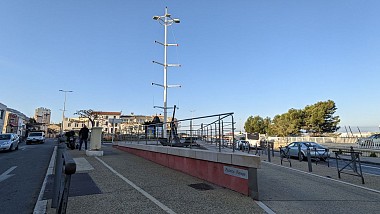
This is an urban stroll to discover the assets of the Pointe-Rouge district. The promenade offers two simultaneous atmospheres: the hustle and bustle of the seaside with its marina, beach and shops, and the tranquility of the wooded areas of Parc Pastré. The walk starts at the "Tiboulen" bus stop, served by line 19. Walk along the seafront to reach a staircase leading to the Pointe-Rouge beach(1). Walk towards the seawall, then when you come to the ASPTT building, walk along it to the left. At the intersection, turn right down the street. In front of the YCPR yacht club, turn left into "Port de la Pointe-Rouge" (2). At the next intersection, turn left and follow the sign "accès plage et commerces". Climb the stairs in front of you to reach Avenue d'Odessa. Then turn right. You'll pass a fire brigade barracks and then the municipal open-air swimming pool. On the right are the remains of a Südwall bunker (3). A little further on, there's a promontory with a view of the deep blue sea, the Mont-Rose hill (in the distance on the left) and, above all, two bathing creeks with cabins. L'anse des Phocéens, home to the men's bath (right) and the ladies' bath (left). Continue across the street to Boulevard Delpin, which you'll have to walk up to the end. Opposite you is Place Engalière and the church of Sainte Eusébie(4). It bears a strong resemblance to the Cathedral de la Major, which gives the impression of being miniaturized. Go up the street called "place" Engalière to enter a public garden and follow the path to the left. Then turn right to walk under the pine trees and go straight up. You're in the heart of the Campagne and Parc Pastré (5). Follow the path along the fence of the equestrian center to the first pool. Go around the basin to the left and walk along the Canal de Marseille (6). The canal winds its way to the sumptuous Château Pastré (7). Walk back down the main alley to the intersection with the Canal de Marseille, which you follow to the right (8). When you reach the small house, turn left to go around a second small lake in a clockwise direction. Return to the canal and follow it to the left. When you reach a wider path, turn right to go up a little, then left to continue along a line almost parallel to the canal route. When you again reach a wide track, descend to the left to reach the top of the Parangon traverse (9). Pass the Emmaüs Pointe-Rouge Community (10) and, if it's open, come on in! Reach the traffic circle in front of Lycée Marseilleveyre (11), then continue left along Avenue du Corail. On your right, at the foot of the hill, you'll see a navigation bridge and the elements usually found on a large merchant ship. This is the flagship building of the Ecole Nationale Supérieure Maritime (12). Finish your stroll by walking down the traverse Prat to the avenue de Montredon and a square lined with shops and restaurants (13).

5.6 km
Very easy
9 Avenue de Montredon 13008 Marseille
Show
Stroll from the Old Port to the Florence Arthaud nautical stadium
3 km

Stroll from the Old Port to the Florence Arthaud nautical stadium

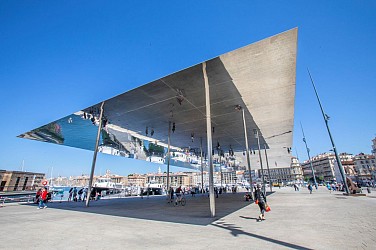
This urban walk begins on the Quai des Belges under the shade of the Old Port. It takes you to the Olympic marina, now the Florence Arthaud nautical stadium. Leaving Norman Foster's shade on the Old Port (1), walk along the Quai de Rive-Neuve. Turn left into rue Fortia, cross Cours Estienne d'Orves, a large Italian-style square (2), then join rue Emile Pollak to Cours Pierre Puget, skirting the Palais de Justice (3). Turn right up Cours Pierre Puget and pause in front of the entrance to the Colline Puget garden (4). Follow the winding path through the park until you reach the Sépia restaurant. On the left, there's an exit over a small bridge and a staircase leading to rue des Lices. As its name suggests, this is an ancient rampart wall that marked the boundary of the city of Marseille in the 17th century. Cross the small square planted with magnolias and a palm tree to reach rue d'Endoume. Join the grand avenue de la Corse, where hackberry and plane trees provide shade until you reach the junction with the Place du 4 septembre, its hackberry trees and avenue Pasteur. Rue Girardin, which joins the end of Avenue de la Corse, leads to Plage des Catalans (5), dominated by the Lazaret tower. This beach is ideal for a refreshing swim. Its waters are also home to the Musée Subaquatique de Marseille (6), which can be explored by simply taking a few dips in the water with a mask and snorkel. Then, for almost 5 km, the route follows a structuring coastal axis that links districts such as the Vieux-Port, Les Catalans and Malmousque along the seafront. The route follows a single artery all the way to the Olympic Marina: the famous Corniche Kennedy (7), where you'll find, in order : - The Monument de l'Armée aux Morts de l'Armée d'Orient (8) - Vallon des Auffes (9) - Le Marégraphe (10) - Villa Valmer Park (11 and 12) - La Plage du Prophète (13) - Memorial des rapatriés aka, l'hélice de César (14) - The nautical stadium (ex Olympic marina) (15) And let's not forget the many "follies" - villas and bastides built in the mid-19th century that dominate the Corniche from the hills of the Bompard and Roucas Blanc districts. We've already mentioned Villa Valmer, where the architect drew inspiration from the Renaissance style. This style is also to be found at Château Berger (now Promicea), which bears some similarities (albeit on a much smaller scale) to the Château de Chambord, with its slate roof and bell towers. But there are others to be found behind the vegetation.

2 h
6.9 km
Very easy
Quai des Belges 13001 Marseille
Show
Marseille – Ride Along the Southern Coast, Parks & Châteaux
3 km

Marseille – Ride Along the Southern Coast, Parks & Châteaux

✨ In a nutshell: this itinerary combines historical heritage (Pharo, Borély, Pastré), spectacular coastal landscapes (Corniche, Prado, Goudes), and the authentic soul of Marseille in its fishing villages. A perfect day to experience the essence of southern Marseille, blending culture, nature, and the Mediterranean. ➡️ This route takes you directly to the southern part of the city. For a deeper discovery of Marseille’s historic center, another itinerary is available (Mucem, Panier, Pharo, Malmousque, Vallon des Auffes, Prophet’s Beach, and Notre-Dame de la Garde). 🔧 Practical information before you go Start: Indigo Parking – Centre Bourse Duration: 5 to 8 hours (depending on visits, swimming stops, picnic breaks) Distance: about 37 km Bring along: Water, sunscreen, sunglasses, swimsuit, comfortable shoes Difficulty: Easy (a few climbs but mostly flat along the sea) 🗺️ Step-by-step itinerary Centre-Bourse → Vieux-Port Right from the start, cycle through the vibrant heart of Marseille. The Vieux-Port, cradle of the city, offers a unique atmosphere of fishermen, boats, and lively terraces. 👉 For the curious: a short detour to the Palais du Pharo rewards you with an exceptional panoramic view of the Vieux-Port, Notre-Dame de la Garde, and Fort Saint-Jean. Corniche Kennedy Ride along the legendary Corniche Kennedy, an urban balcony suspended above the Mediterranean. From here, enjoy breathtaking views of Château d’If and the Frioul Islands. 📍 Don’t miss the Marégraphe, a historic monument that has measured sea levels since 1883. The Prado Beaches Time for a swim at Prado, a wide stretch of sandy beaches loved by families and athletes alike. A true seaside atmosphere! Borély Park & Château Borély Enter the greenery of Borély Park, one of Marseille’s most beautiful gardens. The 18th-century Château Borély, listed as a Historic Monument, is now home to the Museum of Decorative Arts, Faience, and Fashion. Pastré Park & Château Pastré Wilder and more hilly, Pastré Park is perfect for a picnic break. Here you’ll find bastides and ruins of the Pastré estate, reminders of Marseille’s 19th-century bourgeois past. La Pointe Rouge → Montredon → La Madrague The ride continues along the seafront: Pointe Rouge: a lively beach, hub for water sports. Montredon & La Madrague: smaller coves with a charming fishing village feel. Les Goudes, the “end of the world” village Arrive at the picturesque village of Les Goudes, with its tightly packed cabanons, white limestone rocks, and breathtaking panoramas. This true “end of the world” marks the gateway to the Calanques National Park. 🎯 From here, you can set out on a hike to the calanques of Morgiou or Sormiou, Mediterranean gems of unspoiled beauty. Return to the Vieux-Port Head back along the same route. The scenery takes on a completely new perspective: the coast, the city, and the sea reveal different lights and contrasts. ✨ Magical moment: at the end of the day, the sunset behind the Frioul Islands with its orange glow over the city offers an unforgettable spectacle by bike.

37 km
Very easy
Show
A stroll through the Noailles district
3.1 km

A stroll through the Noailles district

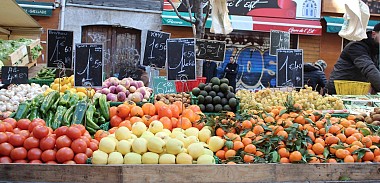
Take a free tour of the Noailles district, also known as the belly of Marseille. Noailles is made up of narrow streets where Marseillais come to stock up on spices, condiments, flavors and fragrances of all kinds! You'll find ingredients from all over the world. Exoticism guaranteed. The discovery of the Noailles district begins on the Cours Saint-Louis (2), Marseille's "ground zero". Since 1927, it's here, precisely at the corner of the Canebière and Cours Belsunce, that the numbering of buildings along all the city's streets has been determined. It's also kilometer zero for measuring the distance between Marseille and other French cities. Cours Saint-Louis extends into rue de Rome. Turn left into rue Méolan, where you'll find the famous shop founded by Père Blaize (3). At the end of the street, turn right onto rue d'Aubagne. At the next street, turn right again onto rue Vacon. On your left is rue Halle Delacroix, with its outstanding exotic goods merchants, such as Tam-Ky. Cross the square to reach rue Rouvière and continue up it to the left. Turn left down rue d'Aubagne to the crossroads with rue Longue des Capucins. This is where you'll find Saladin's cave of 1,000 spices (5). Continue straight on to the district's only fishmonger, du Lamparo, at the corner of Marché des Capucins and Marché de Noailles. Turn left down Rue des Feuillants onto La Canebière (1). Walk down the Canebière, then turn left into rue des Récolettes, where you'll discover another of the city's outstanding shops: the "Empereur" hardware store (8). Take time to explore this store, which is approaching 100 years of existence. There's a beautiful section of antique toys upstairs. As you leave the store, the neon sign of the Cours Saint-Louis pharmacy will lead you back to the starting point of this tour.

45 min
1 km
Very easy
Le point de départ de cette visite en boucle, se trouve sur le Cours Saint-Louis Cours Saint-Louis 13001 Marseille
Show
Stroll along the south shore of the Old Port
3.1 km

Stroll along the south shore of the Old Port

This easy walking tour combines beautiful facades along the streets with panoramic views and grand monuments. The route is suitable for strollers. * The itinerary begins on the Canebière, a mythical and historic artery, lined with majestic facades, which in its heyday was home to grand hotels and the most beautiful cafés in Marseille. At number 9 is the Palais de la Bourse, the chamber of commerce and industry. Rue Beauvau leads to the Opera House. It was partially destroyed by fire in 1919, hence its Art Deco facade. At the back of the building. * Turn right onto rue Francis Davso which leads to the Cours Estienne d'Orves. A real city within the city, the Arcenaulx were the former warehouses of the arsenal of the royal galleys at the time of Louis XIV. Today, this Italian-style square is an attractive district with its cafés, restaurants and artists' galleries. * Parallel to this is the Rue Sainte, which leads to the Abbaye Saint-Victor, join it. Stop at the Four des Navettes, the oldest bakery in Marseille (1781) where you can taste the navettes, a dry orange blossom cookie typical of Marseille and very popular with gourmets. To the right of the Bertie Albrecht square, enjoy the panoramic view of the Old Port and the old city. * Then head for Fort Saint-Nicolas (17th century), the work of the Chevalier de Clerville. During the construction of the Palais du Pharo, the fort was cut in two, in order to create an access road and that is why today, Fort Saint-Nicolas is composed of Fort d'Entrecasteaux for the upper part and Fort Ganteaume for the lower part. * When you arrive in front of the gates of the Palais du Pharo, cross the public garden which offers other magnificent views of Marseille.

45 min
2.5 km
Very easy
11 La Canebière 13001 Marseille
Show

What to do in NOVOTEL MARSEILLE CENTRE PRADO VELODROME

See more suggestions
Enjoy unforgettable moments in NOVOTEL MARSEILLE CENTRE PRADO VELODROME by booking activities for everyone.
See more suggestions
La Cité Radieuse (residential complex)
1.2 km

La Cité Radieuse (residential complex)

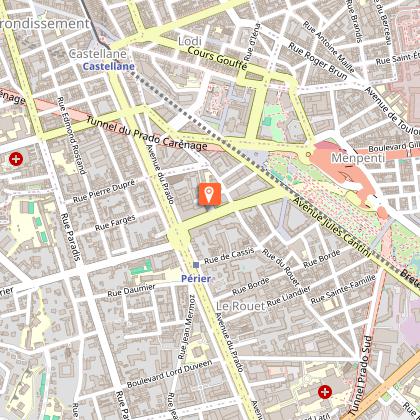
It is the work of the Swiss architect Charles-Edouard Jeanneret, better known as Le Corbusier. It is the work of the Swiss architect Charles-Edouard Jeanneret, better known as Le Corbusier. This impressive structure, 165 meters long, 24 meters wide and 56 meters high, was built between 1947 and 1951. Its layout is intended to suggest an urban steamboat anchored in a park. Powerful elements such as the unsurfaced exposed concrete, pilings and blank gable walls are combined with other more sophisticated aspects, such as the subtle arrangement of the multi-coloured loggias, or the superstructures on the terrace roof. This plastic richness, typical of the great architect, associates visual effects with technical organisation that was exceptional at the time. This laboratory for a new "housing system" comprises 337 flats, with 23 different layouts, providing comfortable living spaces for between one and 10 people. The most typical layout is designed for 4 people. It is a duplex on two levels. On one level it takes up the whole width of the building, with a large volume for the living room. A glass panel opens the double height living room onto a balcony. In addition to these technical refinements, numerous extensions of the living space were introduced, designed to induce a new way of living in collective housing: an indoor street with shops, and a hotel for resident's visitors and family members. On the top level is a nursery school and gymnasium. Finally, the terrace roof provides an area for relaxation with a children's paddling pool, play areas and a stage sheltered by a wind-break for open air shows. Ignoring the mockery summed up by the term "Maison du Fada” (The Crackpot's House), its inhabitants adore the Cité Radieuse. Several flats are still inhabited by the original residents of 1952, and many others have attracted a clientele of well-to-do teachers and architects. It even gained acceptance, since Le Corbusier built other “cités radieuses” in the 1950s based on the Marseille model.

280 Boulevard Michelet 13008 Marseille
Book from 0 €Book
Show

What to visit in NOVOTEL MARSEILLE CENTRE PRADO VELODROME

See more suggestions
Engage in outdoor activities in NOVOTEL MARSEILLE CENTRE PRADO VELODROME.
See more suggestions
The Velodrome Stadium
634 m

The Velodrome Stadium

The first French stadium built in concrete, the Stade Vélodrome was built for the 1938 Football World Cup. The first stone was laid in 1935 and the official inauguration took place during the "OM-Torino" match in 1937. The Velodrome stadium originally hosted other sporting events, including ten finishes of the Tour de France cycling race and the world track cycling championships (hence its name), but also athletics, gymnastics, boxing and rugby competitions. In anticipation of the European Football Championship in 1984, the stadium underwent modifications, the Velodrome track disappearing little by little. At that time, it still covers a part of the South and North curves. Later on, it was totally destroyed for the construction of bleachers. In July 1992, the executive committee of FIFA (Fédération Internationale de Football Association) entrusted France with the organization of the XVIth World Cup of Football. Since some of the matches were to take place in Marseille, it was decided to enlarge the stadium. A comfortable stadium for an exceptional atmosphere! The coverage of all the stands, the optimization of the comfort of the seats and the visibility, allow the new Velodrome to benefit from the 5***** label of the FIFA. The stadium now has the necessary qualities to host a UEFA Champions League final. With its 67,000 seats, the new Velodrome is the largest soccer stadium in France. The atmosphere will certainly be unique and incredible, the songs from the stands will resonate and thrill all the spectators. Unique VIP areas! If the real luxury is space, the new Velodrome is a real jewel thanks to its 5,000 VIP seats, its 57 boxes and its 8,500 m2 of lounges. Spread over 6 levels, the VIP services will allow each company, whatever its size, its sector of activity and its clientele, to find THE ideal B to B product to build customer loyalty, attract prospects, animate its network or reward its employees. 5 VIP formulas for all budgets and for all companies! Designed to be THE stadium of the next 30 years, it will offer to all a privileged place for business exchanges. The Table des Légendes has a panoramic view of the Velodrome pitch. Enjoy a gastronomic buffet in the heart of the Olympic history, in the presence of former players who wrote the legend of the club. At the "Comptoir M" buffets, you will find all the Mediterranean cuisines that make Marseille a unique city. Marseilles has become more beautiful with extraordinary places such as the MUCEM and the Villa Méditerranée, but also thanks to the transformation of the Vieux Port and the Velodrome... Soccer is to Marseille what the Pub is to England! Combine the two, and you get a friendly and festive place... Unique in Ganay, this lounge of more than 1,700m2 is the ideal place to replay the game with your guests. The Tourist Office offers a guided tour: ask for information online or by phone. *** Translated with www.deepl.com/translator (free version) ***

3 Boulevard Michelet 13008 Marseille
Show

Where to eat in NOVOTEL MARSEILLE CENTRE PRADO VELODROME

See more suggestions
Chefs in NOVOTEL MARSEILLE CENTRE PRADO VELODROME will delight you.
See more suggestions
Where to sleep in NOVOTEL MARSEILLE CENTRE PRADO VELODROME

See more suggestions
Book your stay at one of NOVOTEL MARSEILLE CENTRE PRADO VELODROME's accommodations.
See more suggestions
Corbusier
850 m

Corbusier

A unique place in an exceptional setting, the Le Corbusier hotel opens its doors to a man's utopia that became reality: the Cité Radieuse in Marseille. Heritage classified as a Historic Monument, nothing has changes: organization of spaces, clarity of places, park, facades, furniture. The spirit and the matter are there. It is the only hotel in Marseille located in a monument classified as a World Heritage of UNESCO, The Cité Radieuse, a true temple of 20th century architecture. Designed from the outset by the architect, Le Corbusier hotel located in the heart of this vertical city offers a wide range of services: cabin type rooms, studios with sea view, large rooms with sea or park view, mini design suite for people with disabilities. Located 10 minutes from the Orange Velodrome Stadium, with free parking. The Housing Unit has a cinema club, library, services, a tennis club and a solarium. Inside the hotel is a surprising gourmet address: the restaurant Le Ventre de L'Architecte, suspended in front of the sea. The cuisine is creative and inspired. Talended chef Andriy Bondarenko runs this open kitchen from Tuesday to Saturday. Private access to the roof terrace is open until midnight in summer and 10 pm in winter. We can also offer a beautiful seminar room for up to 50 people: why not combine work, culture and gastronomy... and finish with the visit of MAMO, the art center created by Oraito on the roof of the building?

Immeuble le Corbusier 280 Boulevard Michelet 3e. Rue 13008 Marseille
Show
Caution!
We have no information on the difficulty of this circuit. You may encounter some surprises along the way. Before you go, please feel free to inquire more and take all necessary precautions. Have a good trip! 🌳🥾