Tours
Activities
Places of interest
Where to eat
Where to sleep

Discover unique Donchery, Ardennes, Champagne-Ardenne

Are you in charge of the destination?
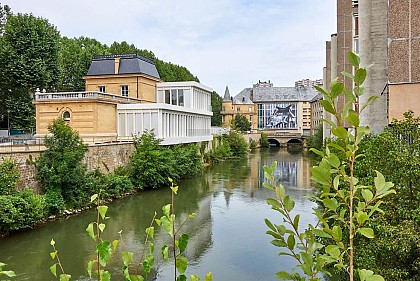
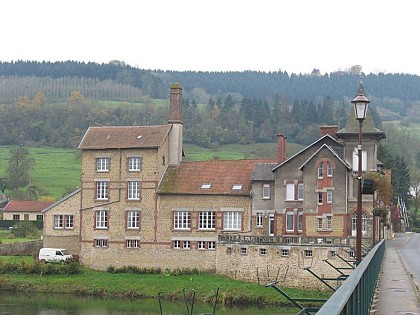
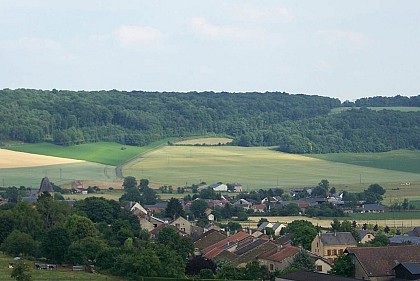
Nestled in the heart of the Champagne-Ardenne region, Donchery, in the Ardennes, is a fascinating destination for nature and history enthusiasts. With its breathtaking landscapes and rich culture, Donchery offers a plethora of activities and attractions not to be missed.

Start your adventure with a stroll along the Meuse, where the natural setting invites relaxation. Hiking trails will guid...
See more

Walking around Donchery

See more suggestions
Discover the walking paths of Donchery.
See more suggestions
What to do in Donchery

See more suggestions
The best experiences in Donchery are just a click away, book now.
See more suggestions

What to visit in Donchery

See more suggestions
Attend events organized in Donchery.
See more suggestions
Church of Saint-Onésime in Donchery
70 m

Church of Saint-Onésime in Donchery

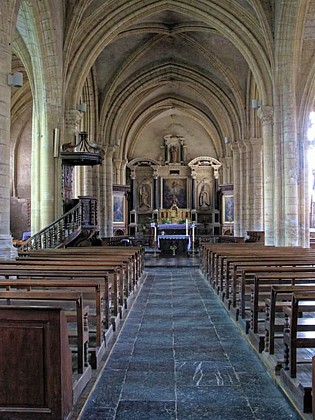
The church of Saint-Onésime, located in the heart of the village, has an elongated floor plan with a nave with three aisles and a double transept. The chancel is rectangular and the sacristy is located at the corner of the transept. A wooden staircase leads to the organ loft, while a second stone staircase leads to the attic. The square timber-framed bell tower is located at the ridge of the transept. The building is built of Dom-le-Mesnil ashlar, except for the north side, which is limestone rubble. The nave floor is paved with black marble and bluestone, and the walls are pierced with pointed-arched windows. The interior vaults are ribbed and the whole building has a slate roof. The transepts and choir were built in the second half of the 12th century, as indicated by the capitals, some of which have been restored. The east and south bays of the choir and the south portal were built in the 14th century. A major reconstruction campaign took place in the early 16th century, with the date 1514 visible on the nave vault. The sacristy dates from 1693. Several works were carried out in the 19th century: removal of the gargoyles in 1849, reconstruction of the gable wall in 1865, and restoration of the south portal in 1875. The church was seriously damaged during the First World War, leading to restoration work between 1919 and 1935, and again between 1956 and 1958 after the Second World War. In 887, Donchery was given to the Abbey of Saint-Médard in Soissons to establish a priory.

46 Pl. de la République 08350 DONCHERY
Show
Corps de Garde - remnant of 14th century ramparts
210 m

Corps de Garde - remnant of 14th century ramparts

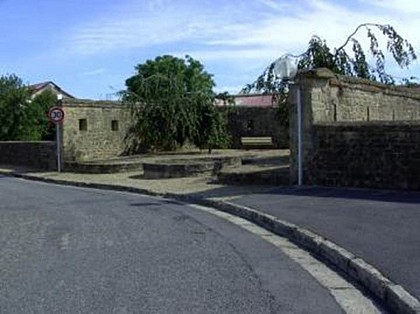
The length of the ramparts, their rectangular layout and the layout of the streets suggest the presence of a Roman post. Originally, there must have been a ditch, easily fed by the Meuse, an embankment and a wooden palisade. In the 14th century, the archives make several references to the authorisation or obligation imposed on the inhabitants to sell wood cuttings to repair the fortifications. (1331, 1st mention, then 1348, 1358). In 1328, Louis Count of Rethel, the vow of Donchery, had the town fortified at the expense of the inhabitants and neighbouring villages. These fortifications protected the town: in 1348, bands of ‘Jacques’, together with the English, roamed and pillaged the country, burning Attigny and a village very close to Donchery: Pont à Bar. In 1414, at the time of Joan of Arc, the Burgundians attacked Donchery:‘From an inscription in beautiful Latin verse, now lost, it emerged that the Burgundian phalanxes were frightened by a miraculous appearance on the ramparts of Donchery of a troop of numerous warriors with gleaming weapons. With their horses panicking, the enemies had to flee, often falling victim to the fury of their mounts. The inhabitants attributed this extraordinary event to the favourable intervention of Saint Onésime, their patron saint. In 1641, following the defeat of Marshal de Chatillon at La Marfée by the Duke of Bouillon, Frédéric Maurice, Prince of Sedan, and the Imperials, Donchery was besieged for 6 days before the governor, Antoine de Saulieu, capitulated. 1676 Donchery and its outbuildings are united with Sedan. Donchery's fortifications are demolished. 1690 the town was authorised to build a new enclosure flanked by half bastions, and the land bordering the fortifications was leased to the inhabitants. On the night of 13-14 August 1940, the Germans used the moats of the ramparts to build a boat bridge before launching it over the Meuse and invading France. The Corps de Garde, near the Porte de Bourgogne, bears witness to the importance of the ramparts.

22 Rue Charles Chardenal 08350 DONCHERY
Show
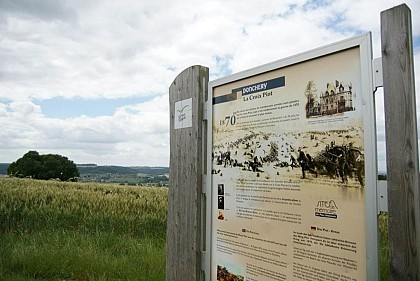
"La Croix Piot" viewpoint
1.4 km

"La Croix Piot" viewpoint

In 887, this carolingian residence was given to the Abbey Saint Medard in Soissons by the Emperor Charles le Gros who founded a priory at this place. Near the triple confluence of the Meuse, of the Bar and of the Vrigne rivers, Donchery controlled an important road and was at the foot of the strategic massif of the Marfee at the Croix Piot. The 1870 war was the one which caused the least damage to the town was out-of-the- way of the battle of Sedan, although the 5th. and the 11th. Prussian army corps had crossed the Meuse river here to participle in the surrounding of the Chalons Army. It was at the Croix Piot that the King of Prussia took position, but on the following morning, he descended with his officers to the place known as “the small trees” in order to better follow the battle. On the 2nd of September, the town of Donchery was the theatre in the house of the mayor and in the “Weaver’s House” of the preliminary meetings for the capitulation of Napoleon III in the castle of Bellevue. 1914 was the worst year for the town of Donchery, of which 98% was destroyed at the end of August. The general withdrawal of the French forces towards the Meuse on the 25th of August meant that the 4th. Army had to assure the defense of the Sedan-Donchery sector. The following day, the Germans bombed the town for several hours and set it on fire, a fire which lasted for days. The enemy tried to cross the Meuse on two wooden bridges, but were prevented from doing so all morning by the French artillery, who was firing from the Croix Piot. On the 27th of August, the order for a general withdrawal given by Joffre obliged our troops to withdraw to the Marne still fighting. The germans then terrorized the population with their exactions and shot many inhabitants... On the 10th of May 1940, not only was the system of fortification of Montmedy-Sedan in a deplorable state by lack of preparation, but also a void existed between the two neighbouring armies, the 2nd commanded by the General Huntziger, contested, responsible for the defense of Sedan- Donchery, and the 9th commanded by the General Corap. 48 hours after having violated Belgian neutralite, the Panzer Division of the 19th Armoured Corps of General Guderian reached the Meuse on the 12th of May in late afternoon, entering Floing and Sedan.

Rue de Moscou 08350 DONCHERY
Show

Where to eat in Donchery

See more suggestions
Restaurants in Donchery are ready to welcome you.
See more suggestions

Where to sleep in Donchery

See more suggestions
Explore hostels and hotels in Donchery.
See more suggestions
Caution!
We have no information on the difficulty of this circuit. You may encounter some surprises along the way. Before you go, please feel free to inquire more and take all necessary precautions. Have a good trip! 🌳🥾