Alert
Alerts
Church of Saint-Onésime in Donchery
Description
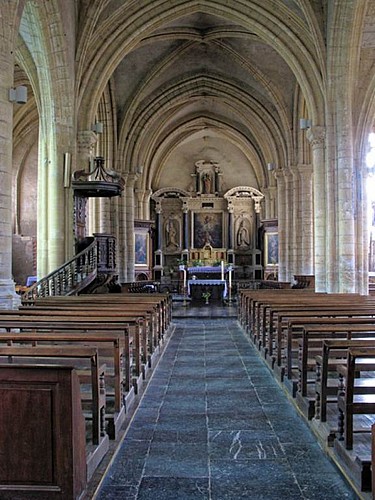
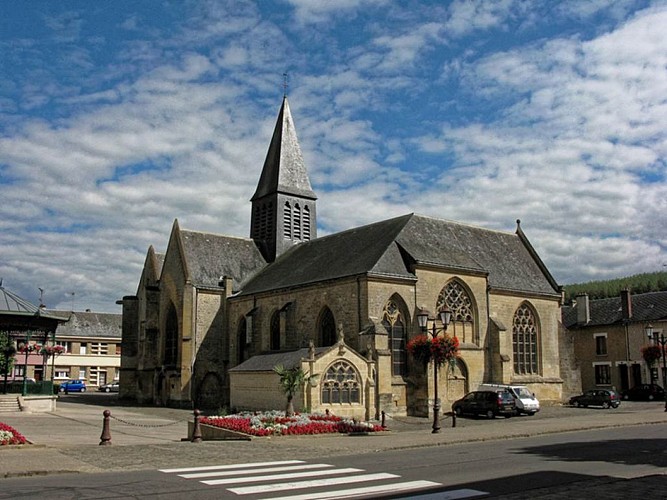
The church of Saint-Onésime, located in the heart of the village, has an elongated floor plan with a nave with three aisles and a double transept. The chancel is rectangular and the sacristy is located at the corner of the transept. A wooden staircase leads to the organ loft, while a second stone staircase leads to the attic. The square timber-framed bell tower is located at the ridge of the transept. The building is built of Dom-le-Mesnil ashlar, except for the north side, which is limestone rubble. The nave floor is paved with black marble and bluestone, and the walls are pierced with pointed-arched windows. The interior vaults are ribbed and the whole building has a slate roof.
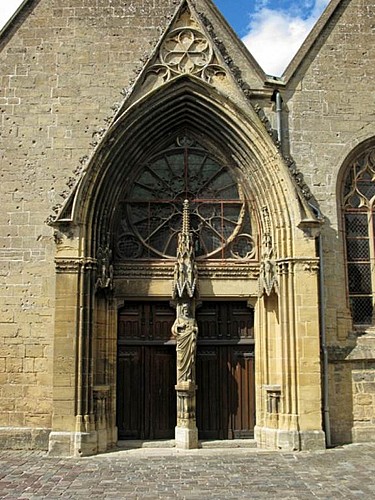
The transepts and choir were built in the second half of the 12th century, as indicated by the capitals, some of which have been restored. The east and south bays of the choir and the south portal were built in the 14th century. A major reconstruction campaign took place in the early 16th century, with the date 1514 visible on the nave vault. The sacristy dates from 1693. Several works were carried out in the 19th century: removal of the gargoyles in 1849, reconstruction of the gable wall in 1865, and restoration of the south portal in 1875. The church was seriously damaged during the First World War, leading to restoration work between 1919 and 1935, and again between 1956 and 1958 after the Second World War. In 887, Donchery was given to the Abbey of Saint-Médard in Soissons to establish a priory.
Technical Information
Altimetric profile
Additional information
Équipements
Parking
Chapô
Open from 8.30 a.m. to 4.30 p.m. every day
Data author
