Tours
Activities
Places of interest
Where to eat
Where to sleep

Explore Paris-8e-arrondissement with HPVA HOTELS

Are you the owner?
Welcome to Paris-8e-arrondissement, a district brimming with wonders to discover during your stay at HPVA HOTELS. Begin your exploration with the Champs-Élysées, renowned for its luxurious shops, charming cafés, and monuments such as the Arc de Triomphe. Just a few steps away, visit the Grand Palais, which hosts world-class art exhibitions. Art lovers will not want to miss the Jacquemart-André Mus...See more

Walking around HPVA HOTELS

See more suggestions
Hiking routes in HPVA HOTELS.
See more suggestions

What to do in HPVA HOTELS

See more suggestions
Plan a perfect day in HPVA HOTELS with our bookable activities.
See more suggestions
The Paris Pass®: Activities, guided visits & Attractions – Valid 2 or 3 days (by Go City)
1.1 km

The Paris Pass®: Activities, guided visits & Attractions – Valid 2 or 3 days (by Go City)

For a duration of 2 or 3 consecutive days from the day of first use, you can benefit from free entry to over 60 of the most renowned tourist sites and attractions in Paris. WITH THE PARIS PASS, YOU'LL NEVER BE SHORT OF IDEAS! For a duration of 2 or 3 consecutive days, you will benefit from free entry to over 60 of the most renowned museums, tourist sites and attractions in Paris. As well as entry to the capital's most prestigious sites, take advantage of other activities: discover Paris with a hop-on, hop-off city tour by double-decker bus, exploring the city's most beautiful districts and admiring the monuments at your leisure; experience a cruise on the River Seine; take part in a wine-tasting session... All this and more is included on the pass (see full list below)! Save on time and money thanks to the Paris Pass, which offers unbeatable value plus fast-track entry for numerous activities! On top of all this, your pass comes complete with a user guide to help you choose and organize your activities, and also gives you special offers on shopping and dining out. You will be asked to indicate a provisional date for your stay, but please remember that the validity of your 2 or 3-day pass will only begin from the day you first activate it. * LINK OF DIGITAL GUIDE [https://parispass.com/en-us/guidebook/great-pass]

Avenue de l'Opéra 75001 Paris
Book from 90 EURBook
Show

What to visit in HPVA HOTELS

See more suggestions
Learn the history of HPVA HOTELS through its museums.
See more suggestions
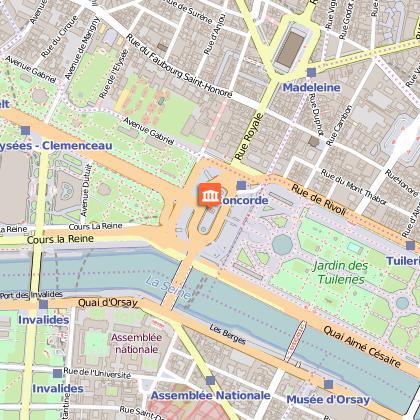
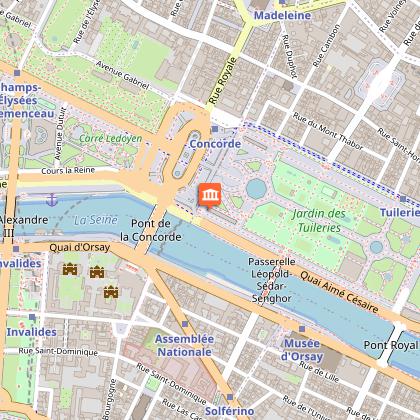
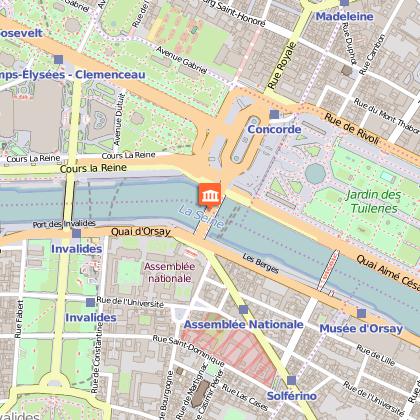
Pont de la Concorde
1.1 km

Pont de la Concorde

The Pont de la Concorde is an arch bridge across the River Seine in Paris connecting the Quai des Tuileries at the Place de la Concorde (on the Right Bank) and the Quai d'Orsay (on the Left Bank). It has formerly been known as the Pont Louis XVI, Pont de la Révolution, Pont de la Concorde, Pont Louis XVI again during the Bourbon Restoration (1814), and again in 1830, Pont de la Concorde, the name it has retained to this day. It is served by the Metro stations Assemblée nationale and Concorde. HistoryThe architect Jean-Rodolphe Perronet was commissioned in 1787 with this new bridge. It had been planned since 1755, when construction of place Louis XV (now place de la Concorde) began, to replace the ferry that crossed the river at that point. Construction continued in the midst of the turmoil of the French Revolution, using the dimension stones taken from the demolished Bastille (taken by force on 14 July 1789) for its masonry. It was completed in 1791. In 1810, Napoléon I placed along the sides of the bridge the statues of eight French generals killed in battle during the campaigns of the First French Empire. On the Bourbon Restoration these were replaced with twelve monumental marble statues, including four of the "grands ministres" (Suger, Sully, Richelieu, Colbert), four royal generals (Du Guesclin, Bayard, Condé, Turenne) and four sailors (Duguay-Trouin, Duquesne, Suffren, Tourville). However, this collection of statues proved too heavy for the bridge, and Louis-Philippe I had them removed and transferred to Versailles. Traffic across the bridge became very congested and the bridge had to be widened on both sides between 1930 and 1932, doubling the width of the original bridge. The engineers Deval and Malet nevertheless took care to preserve the neoclassical architecture of the original. It was renovated one last time in 1983. Today, this bridge bears the brunt of Paris's road traffic (except for those of the Boulevard Périphérique). Source : Wikipédia – Reproduction of extracts of original text. Creative Commons Attribution-ShareAlike License. Photo : Créative Commons

84 Pont de la Concorde 75008 Paris
Show
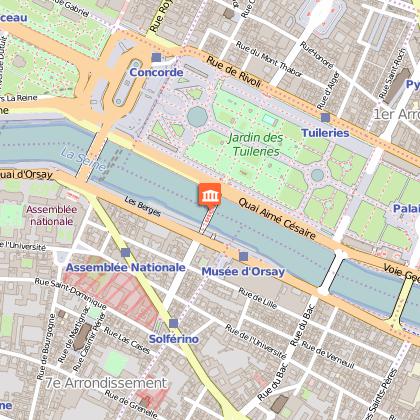
Passerelle Léopold-Sédar-Senghor (Solférino)
1.3 km

Passerelle Léopold-Sédar-Senghor (Solférino)

The passerelle Léopold-Sédar-Senghor, formerly known as passerelle Solférino (or pont de Solférino), is a footbridge over the River Seine in the VIIe arrondissement of Paris. It is served by the Metro station Assemblée Nationale. The first bridgesFor a century, it was the cast iron bridge inaugurated by Napoleon III in 1861 which allowed vehicles to cross between quai Anatole-France and quai des Tuileries. Built by the engineers of the Pont des Invalides, Paul-Martin Gallocher de Lagalisserie and Jules Savarin, it was named after the June 1859 French victory of the Battle of Solferino. Having weakened over time (particularly due to barges crashing into it), it was demolished and replaced in 1961 with a steel footbridge, demolished in its turn in 1992. The present bridgeThe new passerelle de Solférino linking the Musée d'Orsay and the Jardin des Tuileries (Tuileries Gardens) was built between 1997 and 1999 under the direction of the engineer and architect Marc Mimram. Crossing the Seine with a single span and no piers, this metallic bridge is architecturally unique and covered in exotic trees (Tabebuias, a Brazilian tree also used for outdoor flooring at the Bibliothèque nationale de France) which gives it a light and warm appearance. Its solidity is, however, never in doubt - at either end, its foundations are in the form of concrete pillars extending 15m into the ground, and the structure itself is made up of six 150 tonne components built by the Eiffel engineering company, Eiffel Constructions métalliques. Its innovative architecture brought Marc Mimram the award "Prix de l'Équerre d'Argent" for the year 1999. The bridge also has benches and lampposts for promenaders who can reach the Jardin des Tuileries through a subterranean passage on the Rive Droite.The bridge was renamed after Léopold Sédar Senghor on 9 October 2006 on the centenary of this birth. Source : Wikipédia – Reproduction of extracts of original text. Creative Commons Attribution-ShareAlike License. Photo : Créative Commons

Léopold Sedar Senghor 75007 Paris
Show

Where to eat in HPVA HOTELS

See more suggestions
Explore the culinary traditions of HPVA HOTELS.
See more suggestions

Where to sleep in HPVA HOTELS

See more suggestions
Book a pleasant stay in HPVA HOTELS.
See more suggestions
Caution!
We have no information on the difficulty of this circuit. You may encounter some surprises along the way. Before you go, please feel free to inquire more and take all necessary precautions. Have a good trip! 🌳🥾