Tours
Activities
Places of interest
Where to eat
Where to sleep

Uncover Local Treasures at Camping du Brouzel

Are you the owner?
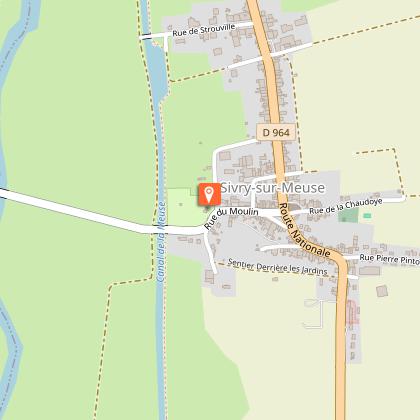
Welcome to Camping du Brouzel, your perfect starting point for exploring the wonders of Sivry-sur-Meuse and its surroundings. Located in the picturesque Lorraine region, the campsite is close to many iconic attractions.

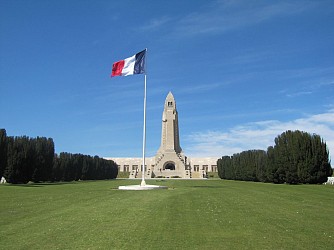
Start with a visit to the Verdun Memorial, a poignant site that chronicles the events of World War I. Continue with a tour of Fort Douaumont, a remarkable testament to the regio...
See more

Walking around CAMPING DU BROUZEL

See more suggestions
Embark on a hike in CAMPING DU BROUZEL.
See more suggestions

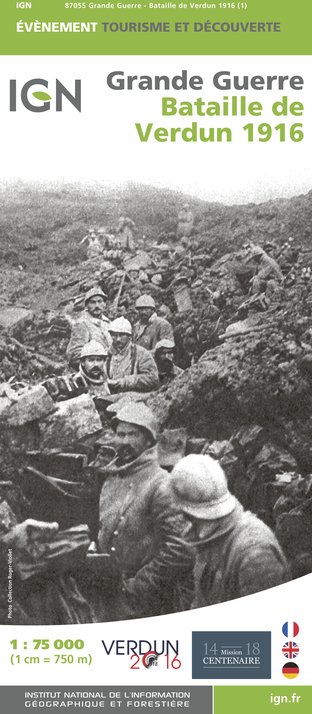
HIGHLIGHTS OF THE BATTLE OF VERDUN
20 km

HIGHLIGHTS OF THE BATTLE OF VERDUN

In 1920 the Government decided to create a Red Zone at Verdun, to mark the soil rendered sterile by shell fragments and polluting chemicals. Ten years later, it received its first covering of some 10 million black pines, sent from Austria. The nine destroyed villages included in this Red Zone will never again see the light of day, but the Prefect of the Meuse assures they will be maintained as memorials, by continuing to nominate a mayor to each one. Starting from the Tourism Office, join the Green Way Cycle Path in the Parc Japiot opposite. 4.5 miles. Continue straight on, as far as the Canal Lock at BRAS-SUR-MEUSE. Cross the bridge to reach the opposite bank and follow the canal as far as the next bridge. Leave the Cycle Path, join the road and turn left, to reach the Stop sign opposite the Boulangerie. Turn right onto the main road, then left opposite the restaurant 8.2 miles. Follow the main road and climb up to the Tranchée des Baïonnettes. 8.75 miles. Continue to climb, then after passing the restaurant, turn right and arrive at the Ossuaire de Douaumont. If you climb on foot the 204 steps inside the tower, you will have a 360 degree panoramic view of the entire battlefield 9.25 miles. Retrace your route to the Stop sign. To visit the disappeared village of Douaumont, go left and then immediately right and take the dead-end road to the disappeared village of Douaumont, then return to the main road. Alternatively, to go direct to the Fort de Douaumont, at the Stop sign turn right and descend to the next turning. At the Monument to the Unknown Soldier, turn left, towards the Fort de Douaumont. 9.7 miles. On the road to the Fort de Douaumont, you will cross over the Boyau de Londres. 10 miles. On reaching the Fort de Douaumont, dismount and climb on foot onto the roof of the Fort, where you will have a panorama view of the horizon which in 1916 marked the German frontier. You can also take the path on the left between the shell craters, which in 300 yards leads you to the lookout point. 10.3 miles. Return back to the Monument to the Unknown Soldier and turn left. On your left you will pass Abri (Shelter) 320 and on your right the National Cemetery. 11.8 miles. At the crossroads, turn left and pedal as far as the disappeared village of Fleury-devant-Douaumont. 12.2 miles. Continue straight on and pass the Mémorial de Verdun, dedicated to the Great War 1914-1918. 12.4 miles. Carry on to the Souville Lion, the monument which marks the nearest point to Verdun reached by the Germans in 1916, and where they were finally stopped. 12.75 miles. At the crossroads turn right and descend towards Verdun. You can visit the Souville fortified plateau by taking the small path on the left. There you can visit the unique Bussière twin turret, the Pamart machine gun casemates, and the ammunition shelters. 12.9 miles. On the road descending to Verdun, stop to admire the Maginot Monument on the left. A little further along there is a picnic area in the forest where you can rest. 15.3 miles. After crossing the railway bridge, at the Stop sign, cross over and pass by the Faubourg Cemetery. At the next Stop sign turn right, then immediately left, and pass the Braquier Dragée factory. At the roundabout, turn right and pass the Parc de Londres. Then at the next roundabout, turn left towards the Tourism Office.

4 h
35 km
Medium
1 Place de la Nation 55100 Verdun
Show
Left bank : through the walking and cycling path
20 km

Left bank : through the walking and cycling path

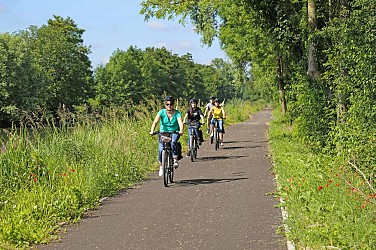
This tour allows you to discover the Left Bank and the beauty of the landscapes of the Meuse Valley along the canal. Dead man’s hill (Le Homme-mort) has suffered some of the most deadliest combats just as much as those on the right bank. Today, it is a pleasant wooded mound that you can enjoy visiting. This course is perfect for a first try of the electric bike. Easy and with little difference in altitude, it will be perfect for a nice stroll with family or friends ! Limited in supply and manpower, the Kronprinz army cannot attack simultaneously on both banks of the Meuse. In order to obtain better results on the right bank, C.Q.G. German prepared the second phase of its offensive whose main objective was to take control of the hills of Mort-Homme (Dead man’s hill) and the Côte 304. These two natural observatories regulated the fires of the French artillery; it is in fact a crucial stake for the offensive continuation. The fighting raged on there for weeks, destroying villages of Esnes-EN-ARGONNE and Chattancourt. Rapidly, the battle peaks became untenable volcanoes; suicidal assaults fade to move on to countless murderous gunshots . To protect themselves from bombing, both sides took refuge on the hillside, digging tunnels. On August 20, 1917, the generals Guillaumat and Pétain begin a to put victorious offensive which has the effect four German divisions attached to the sector Mort-Homme-cote 304 to flight. To the thousands of prisoners, material and armaments captured, must also be added more than twenty thousand victims whose units appear on the current monuments. In this inferno, the village of Cumières will disappear completely and will never be rebuilt.

4 h
48 km
Easy
1 Rue René Panau 55100 Verdun
Show

What to do in CAMPING DU BROUZEL

See more suggestions
Plan your leisure time in CAMPING DU BROUZEL by booking activities that suit your preferences.
See more suggestions

What to visit in CAMPING DU BROUZEL

See more suggestions
Visit the museums and galleries of CAMPING DU BROUZEL.
See more suggestions
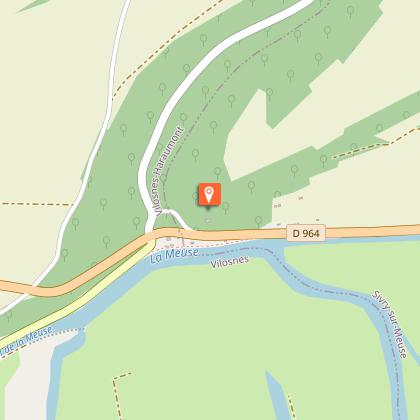
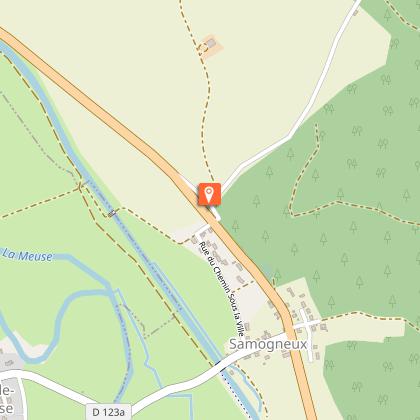
Destroyed village of Haumont près Samogneux
8.2 km

Destroyed village of Haumont près Samogneux

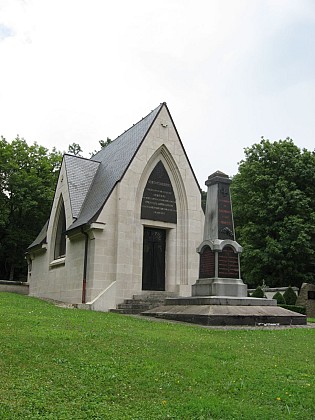
Before it was even a village, Haumont near Samogneux was first a site of Gallic celebration of the Sun God through an altar erected in the 1st century AD on its heights. Later, the Roman army established a fortified camp there. Towards the end of the Thirty Years' War, which pitted Catholics against Protestants, the village was completely ruined by the incessant passage of troops who ransomed and even tortured the inhabitants unable to satisfy them. From 300 inhabitants in 1850, its population dropped to 139 in 1914. The population was evacuated shortly after the start of the war, due to its location in the far north, too close to the front which had stabilized a few kilometers away, thanks to the success of the Battle of the Marne. However, it suffered a first bombardment on February 7, 1915, which damaged part of its church. But this was nothing compared to what it would endure a year later, on February 20, 1916, at the very beginning of the great German offensive on Verdun. On February 22, 1916, the valiant defense of the village by the 362nd Infantry Regiment forced the German assault troops to retreat... This brief respite for the soldiers resulted in a deluge of iron and fire unleashed by the powerful German artillery. During this violent bombardment, the village literally collapsed, burying 80 brave soldiers under its stones and rubble. The German advance on the French lines moved the village away from the intense fighting taking place further south until October 1918, when the French army's offensive push returned to the area. Its ruins were indeed recaptured on October 8, 1918, by the 67th Infantry Regiment and the 66th and 68th Senegalese Tirailleurs Battalions, a little over a month before the end of hostilities. Between the two wars, Haumont near Samogneux was declared a "destroyed village" in 1919, a unique status shared by eight other villages in the Meuse. On March 15, 1921, it was cited in the army's order to mark the Nation's recognition for the supreme sacrifice of the commune. On August 28, 1928, its war memorial was inaugurated, and in 1932, its Saint Nicolas shelter chapel was built, then furnished and decorated in 1933, proving the determination of its former inhabitants, the "Sachots," to make it a respected place of remembrance. In 1940, the beginning of the Second World War saw new battles on its territory, during the inevitable push of the German army overwhelming the few remaining valiant French troops desperately trying to stop them. The occupation of the country that followed led to the effective abandonment of the maintenance of this place of remembrance, from 1940 until 1968. Nature reclaimed its rights, and the chapel was even swallowed by vegetation... But in 1971, under the impetus of its mayor, Charles Renversez, extensive cleaning and restoration work was undertaken. And now, Haumont near Samogneux and the "Sachots" continue this essential work of remembrance every year, so necessary for future generations. To see: The Saint-Nicolas chapel (triptych painting by Lucien Lantier, representing the village in 1914, 1915, and 1916); The war memorial; Remnants of the village.

55100 HAUMONT PRES SAMOGNEUX
Show

Where to eat in CAMPING DU BROUZEL

See more suggestions
Savor culinary specialties in CAMPING DU BROUZEL.
See more suggestions

Where to sleep in CAMPING DU BROUZEL

See more suggestions
Discover available accommodations around CAMPING DU BROUZEL.
See more suggestions
Caution!
We have no information on the difficulty of this circuit. You may encounter some surprises along the way. Before you go, please feel free to inquire more and take all necessary precautions. Have a good trip! 🌳🥾