Tours
Activities
Places of interest
Where to eat
Where to sleep

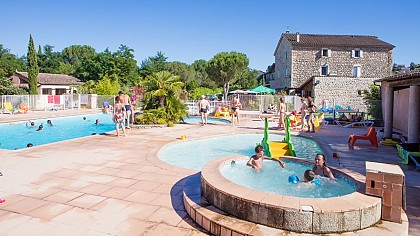
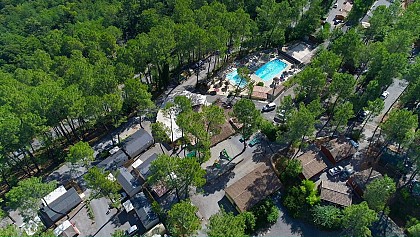
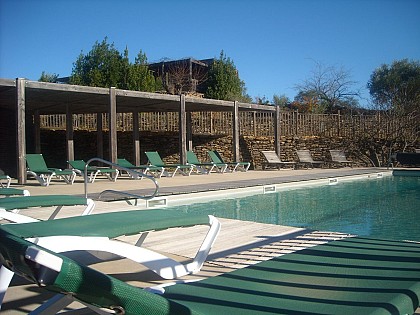
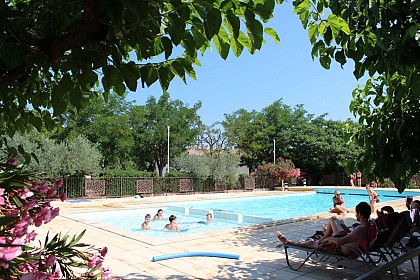
Camping Les Sous Bois du Lac de Naussac ***: Adventure and Relaxation in Chastanier

Are you the owner?
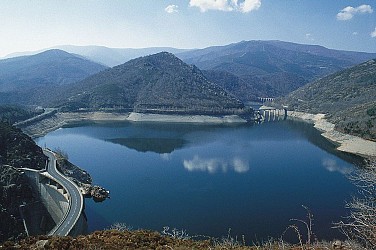
Embark on a journey through the natural and cultural wonders surrounding Chastanier in Lozère from Camping Les Sous Bois du Lac de Naussac ***. Enjoy the charms of Lake Naussac with various water activities such as canoeing, kayaking, and windsurfing. Hiking enthusiasts can rejoice in exploring the numerous marked trails crisscrossing the region, offering exceptional panoramic views of the Margeri...See more

Walking around CAMPING LES SOUS BOIS DU LAC DE NAUSSAC ***

See more suggestions
Stroll through the walking routes of CAMPING LES SOUS BOIS DU LAC DE NAUSSAC ***.
See more suggestions
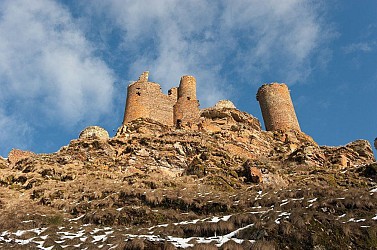
Montselgues blockfield
30 km

Montselgues blockfield

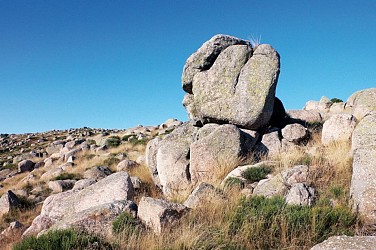
The Montselgues blockfield path makes its way through a wild landscape dominated by the mineral element : granite. This beautiful hike evokes granitic Britanny with a whiff of legend. First, take the road that goes north out of the village, in the direction of Teste Rouge and Pradon. After about 100 m, turn right on a stony path leading to la Borie, 2 km away. You will first have to confront a difference in height of 90 m uphill, then the equivalent douwnhill, and you will see how unlike those two slopes are. On the first part, you will not find any blockfields but, on the contrary, a quiet landscape, very green, with gentle shapes and a moderatly steep gradient. Stone buildings bear witness to old developments : the rocks and walls along the way, the cross, the small bridge, the calade (cobblestone path), the paving on the path made out of grey, pink, yellow granite stones... Once you reach the road leading to la Borie, follow it uphill on your left for about 100 m, then pass the tight bend of the road, leaving the shed on your left. After 20 m, the path leaves the road and passes between the two houses on the right to climb among rocks up to Petit Paris, perched on the top. Go through the hamlet. Just out of Petit Paris, a bench carved out of stone invites you to sit down for a while. The walk continues on a path lined with rocks. After 1 km, you will see on your right one of the most beautiful granite blockfields in the area. A natural treasure less unusual in Brittany or the Auvergne, not to mention the numerous places around the world where the old basement rises to outcrop, on every continent. 500 m after the blockfield, you will go through the Cayres hamlet, a toponym that could mean either angle or remote place. You can pick the meaning you like. Carry on after the farm and take the road (yellow markings) on your left, follow it to the end of the downhill gradient, then take the track suitable for vehicles in front of you towards the ridge. The way back to the village will take you on the ridge of one of the plateau de Montselgues' corrugations, first called Pierre plantée, then Serre de Teste Rouge. The word serre means, depending on the place, an elongate mountain or a high point with gentle or rounded slopes. Once on the road, at the pass, take the tarmacked road that goes directly down to Montselgues, your starting point.

4 h
11 km
Easy
Show
Chesnut discovery trail (sentier découverte de la châtaigne)
31 km

Chesnut discovery trail (sentier découverte de la châtaigne)

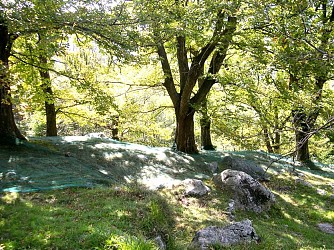
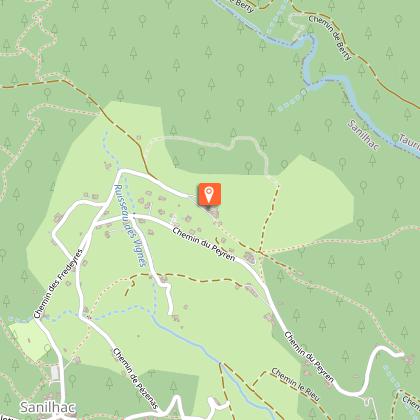
The first part of the trail is contemplative with only the red wooden viewing frames placed along the path to highlight some key elements of the landscape. Then, 7 illustrated explanatory panels give information on the elements observed. P - At the start sign in the hamlet of Féreyrolles, take the path that climbs to the right. This path leads to a track, turn left, then 250m further on, turn right onto the canal path. Follow the chestnut trail signs. In this first section, continue straight on for 1km. With the 5 red frames, use your sense of observation to identify traces of human intervention in the landscape. At the “Sardoune” theme panel, the path continues downhill to a small road. Turn right and walk 300m. Go down the path on the left until you reach the canal. Turn left and you’ll see a sign marked “le Béal”. Cross the canal and continue along the path on the left. Walk through the chestnut orchards and then a meadow where there’s a third panel with a 19th century illustration of a landscape of the Borne valley. At the end of the meadow, continue on the track, turning left to reach another theme sign entitled “l’arbre à pain” (Europe’s version of the breadfruit tree). After 50m, take the road. To continue along the initial trail, take the road left then, at the crossroads, go right. Walk along this small road for 350m. (For the return trip, you can take the road on your right to get to the Geopark site. If you take this 600m detour, you’ll discover a geological curiosity – “balls” of polished granite that fell onto the riverbed several million years ago).  Take the path on the right to reach a chestnut orchard. Continue straight ahead on the path past the information panel “les châtaignes d'Ardèche”. At the end of the trail, take the road again and head left to return to the hamlet of  Féreyrolles. You can also carry straight on by following the road then taking a small path on your right. This additional 1.5km loop, which takes about half an hour, takes you past a goat farm. Cross the road when you get to the stone cross, climb up to the old canal and go left to return to Féreyrolles.

2 h
4.5 km
Very easy
Show
The Ferjasses trail
32 km

The Ferjasses trail

This trail on the crest of the Tanargue plateau, which rises to over 1,300 m, offers superb views of the Ardèche mountains and beyond. P – Take the tarmac road towards Loubaresse. Just after the fire station, take the steps leading down to the left (). The path continues under the chestnut trees then across old terraces to the hamlet of Saint Martin above you.   Saint Martin - Follow Le Chalas 1,2 km, Croix de Bancillon. Go under an archway and turn right up the steps (). Take the main road on the left and cross it in front of the phone box. Take the tarmac road on the right, and cut down along the stone path to reach Le Derlay. Le Derlay - Follow Le Chalas 0,9 km, Loubaresse 8 km. The path climbs through the meadows then curves left in front of the houses and joins a tarmac road. Follow the road to the left for a few dozen metres, paying attention to the signs to leave the road by a path that heads left. It then joins the road, which you have to cross. Turn right and go up between the chestnut trees, then join a track between two walls that leads to the hamlet of Chalas. Cross the path and continue between the houses to reach the Chalas crossroads. Le Chalas - Follow La Grangette 15,8 km, La Croix de Beauzon 18,3 km. Go right of the house, cross the road and take the path opposite, between two stone walls.  The path re-emerges a little higher up the road. Go straight on and turn right onto the road. Leave the road and take the small path that goes up on the left. Follow the signs to Méjean. Méjean - Follow La Grangette 1,4 km, Loubaresse 10 km ().Continue along the ridge until you reach a track to the right. Follow it to the La Grangette hairpin bend. La Grangette - Follow Loubaresse 8,2 km by the main path that takes you to L’ Escoufour. L'Escoufour - Follow Le Chalas 3,2 km, Valgorge 5,7 km along the yellow and white marked track. When the track turns right at a right angle, leave it and take a path down to Le Ségur. Follow the signs. Le Ségur - Follow Valgorge 3,1 km. The track takes you to a stream; cross the stream and continue on the opposite side. Cross over a second stream before heading towards the fields and then to the houses in the hamlet of Chalas. Enter the small hamlet of Chalas du Haut, turn right after the first house onto the yellow and white marked path that descends between low walls. At the bottom of the descent, turn left to reach Chalas du Bas. Le Chalas - Follow Valgorge 2,2 km. Cross the road then take the steps opposite. The path goes down between two low walls then through the chestnut trees before reaching a road. Cross the road and head towards the houses before returning to the road and following it right. Leave the road by going right before the last houses and go down to Le Derlay. Le Derlay - Follow Valgorge 1,6 km. The path runs along the slope before turning right and going under some trees, then continues straight on before winding past some houses. In Valgorge, turn right on the main street and return to the start point.

6 h
15 km
Easy
Show

What to do in CAMPING LES SOUS BOIS DU LAC DE NAUSSAC ***

See more suggestions
Find bookable activities in CAMPING LES SOUS BOIS DU LAC DE NAUSSAC *** for an unforgettable experience.
See more suggestions
La Seigneurie de Naves
46 km

La Seigneurie de Naves

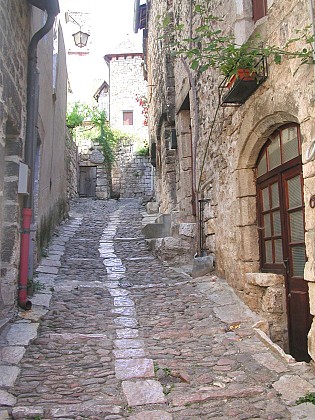
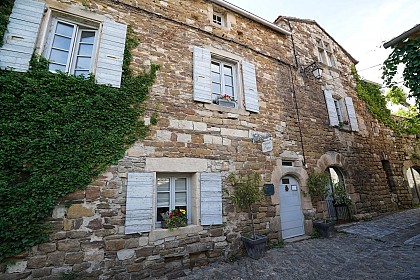
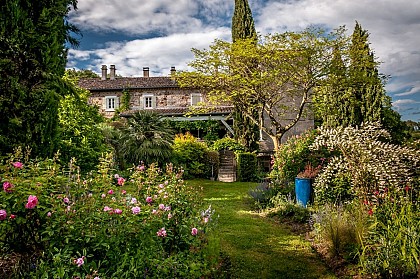
To stay at the Seigneurie de Naves, is to find a place of peace and charm. You are guaranteed the time to step back, relax and enjoy a different pace of life away from everyday stresses. Located on a rocky spur, Naves is a quiet medieval village that is officially designated as a “Village de Caractère”. The lively town of Les Vans is located in the valley 2 km away – or just over 1 km if hiking! Located on a rocky spur, Naves is a quiet medieval village that is officially designated as a “Village de Caractère”. The lively town of Les Vans is located in the valley 2 km away – or just over 1 km if hiking. Naves has maintained its atmosphere into the 21st century thanks to the sympathetic restoration of the properties by the residents. It is a collection narrow cobbled streets that lead to village square with an 11th century church and views across the typical terrain of the southern Ardèche. Situated between two lanes, the house can be accessed by the lower road for the Blanche de Paysac and the Pitcholine rooms. From the upper road, via a lovely vaulted ceiling, you can access the Rougette and the Frantoio rooms. A particular feature is a beautiful stone spiral staircase that serves the family suite and the dining room. In the central part of the house is the Library lounge and Wellness area. At this level, under a high canopy, there is a fountain and access to all parts of the house. Then cross a small stone bridge that spans the lane, to gain access to the pool and gardens. As soon as you cross this little bridge, you will fall under the charm of this green haven of peace. You will first encounter a small covered seating area where you can to sit quietly enjoy a drink, read or just contemplate life – regardless of the vagaries of the weather. Next is a lovely arbour offering protection from the sun when the shade of the centuries-old mulberry trees is insufficient. Breakfast and dinner served here. A little further on there is the boulodrome where you can test your skills at pétanque. The best teams can compete to win an appetizer on the House! A pool of 12 x 5 m will allow you to do a few laps, relax and freshen up after your muscles have been stretched by one or the other sports activities offered in the surrounding area. For a quieter time, you can wander through the rest of the garden where over 500 carefully chosen plants delight the senses. Or merely sit a while under an olive tree and enjoy the views across the roofs of the old village to the distant horizons.

44, place Chastelas Le Village de Naves 07140 Naves
Book from 0 €Book
Show
Medieval town of Largentière
47 km

Medieval town of Largentière

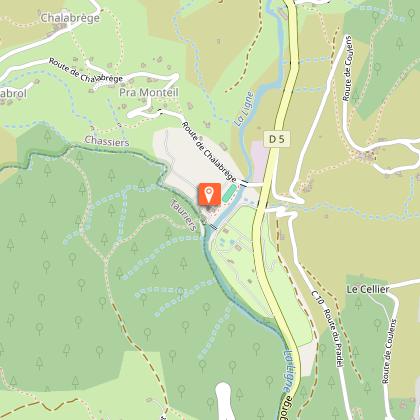
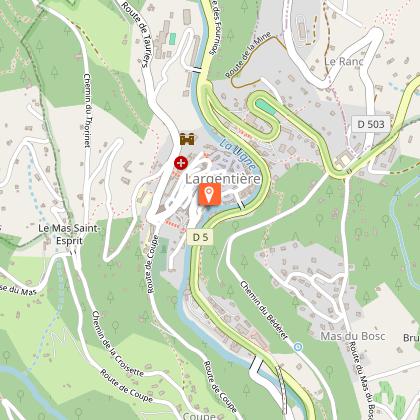
Largentière was named after "Argentaria", the silver mining area. It was founded in the11th cent. The 12th century is a period of great development thanks to Emporor Conrad who allowed to town to issue coins. The town It was founded in the 11th century. The Counts of Toulouse, the Bishops of Viviers, and the Lords of Anduze, Poitiers and Balazuc owned the silver mines. In the 12th century, this medieval city retained great cultural and economic development thanks to Emperor Conrad who granted them the right to mint coins. In 1208, Largentière was placed under the authority of the Counts of Toulouse who succeeded the Bishops of Viviers. In 1730, Bishop François Renaud de Villeneuve sold the castle and the Barony of Largentière to the Marquis François de Beauvoir du Roure de Brison. In the 1830s the silk industry reached its peak, and silkmills flourished all around. Take time to explore this medieval city whilst wandering through the picturesque streets. You will discover the sandstone facades, the arcades, the mullioned windows and beautiful ancient doors. The castle overlooks the town. In 1716 the Bishop of Viviers sold it to the Count of Brison who decided to renovate the building in order to make it more comfortable. In the middle of the castle, the square dungeon also known as Bastide de Bonnegarde was built in the 12th century. It was left intact during the Revolution, and it became a Court of justice and a prison, and a local hospital later on. Notre Dame des Pomiers church (from the latin “pomerium” which means “limit”) was built between the end of the 12th century and the beginning of the 13th century. It was extended in the 15th and 19th century. Inside Roman influences can be seen, such as a 13th century sarcophagus and a 15th century pulpit. An interesting detail: there lies the skull of the Count of Saillans who fought against the revolutionaries and was beheaded in 1792. The stairs of the Montée Mazon, which lead to the church, were built of stone from the remparts in 1888. The 16th century Recollets city gate is part of the medieval ramparts as well as the bridge over the river Ligne. They are both well preserved. From the bridge, you can see the canal, which would have brought water to the city shops, as well as the 19th century Court of justice, on the hill opposite, which looks much like a Greek temple. Don't miss the town hall: the back of this building is typically Renaissance.

07110 Largentière
Book from 0 €Book
Show

What to visit in CAMPING LES SOUS BOIS DU LAC DE NAUSSAC ***

See more suggestions
Enjoy the green spaces of CAMPING LES SOUS BOIS DU LAC DE NAUSSAC ***.
See more suggestions
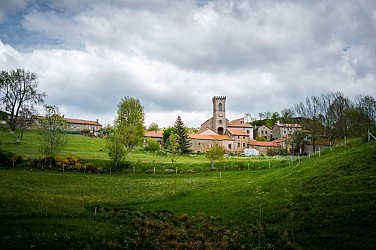
Where to eat in CAMPING LES SOUS BOIS DU LAC DE NAUSSAC ***

See more suggestions
A wide selection of restaurants awaits you in CAMPING LES SOUS BOIS DU LAC DE NAUSSAC ***.
See more suggestions
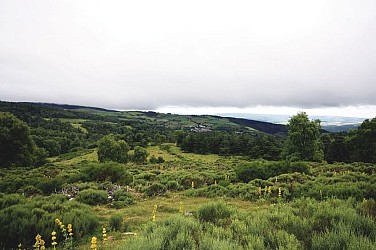
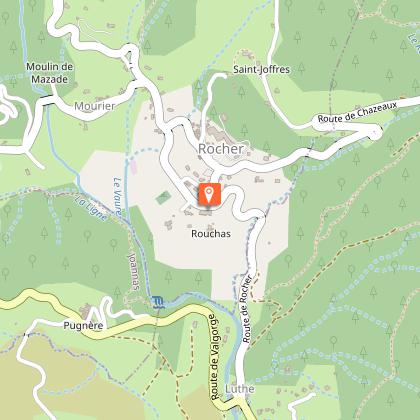
Where to sleep in CAMPING LES SOUS BOIS DU LAC DE NAUSSAC ***

See more suggestions
Book your stay at one of CAMPING LES SOUS BOIS DU LAC DE NAUSSAC ***'s accommodations.
See more suggestions
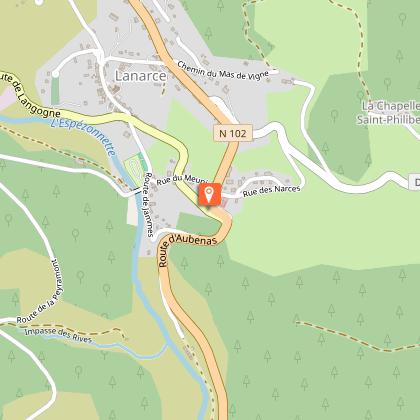
Caution!
We have no information on the difficulty of this circuit. You may encounter some surprises along the way. Before you go, please feel free to inquire more and take all necessary precautions. Have a good trip! 🌳🥾