Tours
Activities
Places of interest
Where to eat
Where to sleep

Mirande, Gers, Midi-Pyrénées

Are you in charge of the destination?
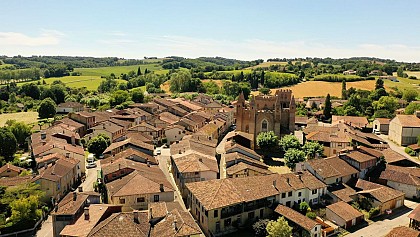
Nestled in the heart of the Gers department in the Midi-Pyrénées region, Mirande is a charming French town that takes you back in time. Founded in 1286 by Bernard IV of the d'Armagnac family, this medieval bastide is a gem of architecture. Its cobbled streets, half-timbered houses, and picturesque squares create an authentic and warm atmosphere. Mirande is also famous for its international country...See more

Walking around Mirande

See more suggestions
Hiking trails in the Mirande area.
See more suggestions

What to do in Mirande

See more suggestions
Make your stay in Mirande special by booking activities.
See more suggestions

What to visit in Mirande

See more suggestions
Enjoy the green spaces of Mirande.
See more suggestions
Artistic Structures with Vegetable Use
28 km

Artistic Structures with Vegetable Use

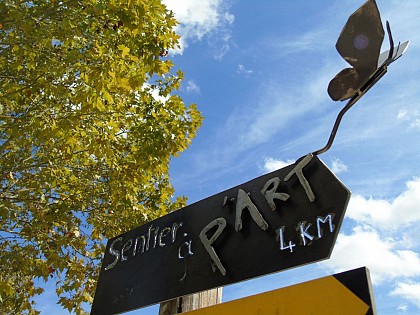
This artistic project was born out of the desire of the ‘Food’ collective of the Bouche A Oreille cooperative to bring art to the ‘village kitchen garden’. The idea was not just to bring gardeners, villagers and visitors into contact with artistic works, but for them to be a vehicle for questioning and reflecting on the environment in which they are displayed: the kitchen garden. The artistic work of Coline Vergez, scenographer, is always a witness to the environment in which it takes place. She seeks to highlight and question it, while integrating her pieces within it. In this way, the works fit into a logic of harmony between materials, images that make sense and/or their utility. She created her first work ‘MMMMH!’ in the village of Simorre, as well as 5 ½uvres that make up the Sentier à p'Art - a 4km walking trail starting from Simorre based on the principle of Land'Art. ‘In this project, I want to remain faithful to this way of working and propose works that are fully integrated into the intention of the vegetable garden; that respect its gesture, reveal it and serve it. My artistic approach is intended to be accessible to everyone, in a language that is clear and easy to understand, and that does not compartmentalise. I want to speak to everyone and I want my work to speak to everyone". A little corner of the kitchen or...behind the scenes of life. This first work, installed in May 2020, highlights a central element of the kitchen that plays as essential a role in the processing of food as it does in that of the people who live there: its table. ‘I chose it for its most basic function. It's the heart of the kitchen, the place where food is cut and chopped, de-boned, sorted, cleaned, weighed, pressed... The place where food becomes a meal. But it's also the place where people reveal themselves, alone or to each other. I love the idea that a single edge of the kitchen table could have witnessed the birth of love, the passing of culinary or family secrets, the tearing apart of people, the making of major decisions, the creation of projects, the growth of children, the sharing of desires... No matter how insignificant, this little corner of the table works on living things, transforms them and makes them evolve. Its scale has been enlarged to emphasise its importance, but also to make it a useful structure in the vegetable garden. Both the chair and the table can accommodate climbing plants and cucurbits, and their heights allow the gardener to pick fruit with ease, while creating a shady spot in summer. In winter, the table is covered in strips of woollen fabric coloured with plants from the garden or picked nearby. Artistic structures for kitchen use. Un petit coin de cuisine ou...les coulisses de la vie’ is part of an overall concept that will see other installations created in the same spirit. The idea is that each artistic installation should be made up of three essential elements: it should provoke questioning, it should be useful and it should be legible. These elements will be developed in different ways for each piece. In this context, Coline's work will question what is not visible to the naked eye: the purpose of market gardening (for what purpose do we cultivate, how do we transform what grows there, what is the future of what we create there? etc.) or will highlight the invisible but essential players in the life of the vegetable garden (its microcosm: earthworm, beetle, lucanus, dragonfly, etc.). The works will all have a real function within the garden, whether in the gardening process, in providing amenities for native flora or fauna, or in improving the living spaces for gardeners or visitors. This work will be aimed at a lay audience and is intended to speak to everyone. Each person will interpret the works in their own way, depending on who they are and what their artistic background is, but the creations will use a very direct and clear visual language. To facilitate this, humour and paradox will be used to demystify art and make it accessible to everyone.

Place de la mairie 32420 Simorre
Show
Bouche a Oreille kitchen garden
28 km

Bouche a Oreille kitchen garden

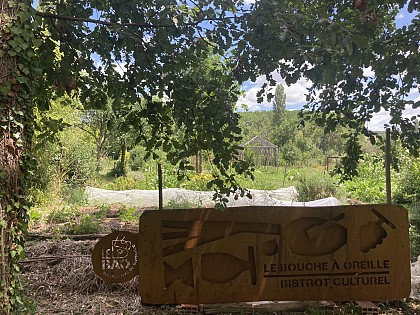
You can visit the vegetable garden at Le Bouche à Oreille restaurant, to the delight of young and old alike! Le Bouche à Oreille (‘BAO’ for those who are used to it) is a SCIC, a not-for-profit structure, bringing together more than 120 cooperators around 4 colleges: 1- Food, from the vegetable garden to the plate. 2- Culture and popular education. 3- Development of local economic initiatives. 4- Ethics and transmission, which drives the project's democracy. In addition to delicious meals and cultural events throughout the year, Le Bouche à Oreille has created its own vegetable garden in the village of Simorre. Situated along the footpaths, the kitchen garden is open to the public and allows visitors to discover the many and varied vegetables, herbs and edible flowers that have been carefully cultivated to create the sublime menus proposed by chef Séverine. The kitchen garden is accessible by a few wooden steps from a footpath, and is open to the curious. The names and varieties of the plants are listed on small slates that sometimes reveal surprises. Take your time on site, as wooden chairs and tables have been set up for resting, picnicking, chatting, watching the frogs or admiring the portraits of the women vegetable gardeners! The ‘Structure artistique à utilité potagère’ project was born out of a desire on the part of the BAO's ‘Alimentation’ collective to bring art to the ‘village kitchen garden’. The idea was not just to bring gardeners, villagers and visitors into contact with artistic works, but to use them as a vehicle for questioning and reflecting on the environment in which they live: the vegetable garden. Trained as a scenographer, Coline Vergez's artistic work always bears witness to the environment in which it is set. She seeks to highlight and question it, while integrating her pieces within it. In this way, the works fit into a logic of harmony between materials, in images that make sense and/or in their utility. The first work, ‘Un petit coin de cuisine ou...les coulisses de la vie’, is part of an overall concept that will see other installations created in the same spirit. Coline Vergez has also created an installation in the heart of the village and, in 2019, the ‘Sentier à p'Art’, a 4km walking trail made up of 5 works based on the principle of Land'Art, starting in Simorre. To get to the kitchen garden, ask for directions at the Bouche à Oreille in the village square, or from the Foirail car park, follow the signposted footpaths and the artistic signposts of the Sentier à p'Art to find the kitchen garden (100m on your left).

32420 Simorre
Show
Village of Simorre
28 km

Village of Simorre

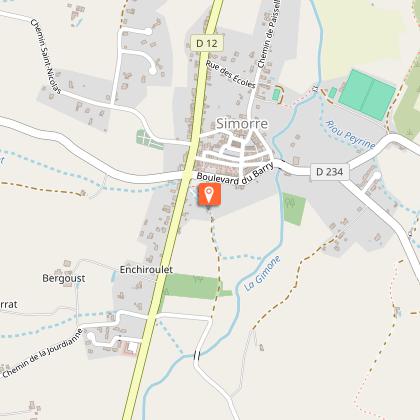
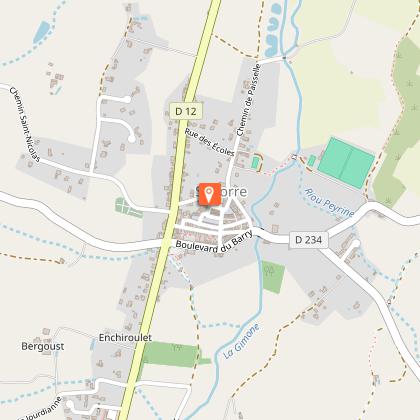
A charming village, with its fortified church, its old central market hall, its museum, its half-timbered and corbelled houses, its foirail and shady squares that invite you to visit. Simorre surprises and amazes. The atmosphere of this small village is pleasant, as are the friendly musical nights in the square opposite the Bouche à Oreille. A little history: The village's picturesque narrow streets are particularly striking for their impressive fortified church, which rises up between the roofs of the houses and gives the impression of taking a trip back to the heart of the Middle Ages. After a devastating fire in 1141, the village, formerly the capital of Astarac, was rebuilt around the abbey, and the whole complex was fortified in the 12th century. To resist the Count of Astarac, the abbots constantly improved their abbey, which was given a cloister, an octagonal bell tower and extended to the west. The Abbey Church, an architectural jewel: A masterpiece of brickwork lost in the Astarac of stone. Dedicated to Notre Dame, it was built on the site of the previous church, which may have extended further west, as work carried out in 1900 uncovered remains of the construction in the extension of the current nave. Major restoration work was carried out between 1844 and 1858 under the direction of Viollet-le-Duc. The roof, which covered the walls, was lowered so that it rested directly on the vaults, and a crenellation was built around the building. ‘Simorre, a slow and committed commune! It belongs to the network of the national Cittaslow label’.

32420 Simorre
Show
Notre-Dame Abbey Church
28 km

Notre-Dame Abbey Church

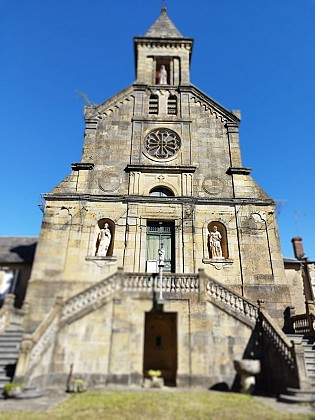
The Church of Simorre is a 14th-century abbey church built on a 5th-century oratory created by Cérats, who became the patron saint of Simorre. This church was linked to the Benedictine abbey, which has now completely disappeared. Built in the shape of a Latin cross, it has an octagonal tower at the junction of the nave and transept, which should have been a bell tower like Lombez cathedral. The nave has only two and a half bays and is finished off by a stone wall. Almost the entire building is in pink brick. The stained glass windows are remarkable for their age, colour and design (14th, 15th and 16th centuries). The 16th-century choir stalls have beautiful and moving sculpted details, particularly on the cheeks. In 1964, during restoration work in the sacristy, some very fine 14th-century wall paintings were discovered. Today, you can admire many religious objects, both simple and sumptuous, dating from the 17th and 18th centuries. There are 4 statues to admire: a wooden piéta from the early 8th century, a stone piéta from the 7th century, a statue of St Cérats from the 15th century and a processional cross from the 14th century. In the 19th century, Violet le Duc undertook the restoration of the building, changing its appearance and transforming it into a fortified church. A document with historic details is available inside as well as signs on the walls. An audio tour in French has been recorded and is available in the church.

32420 Simorre
Show

Where to eat in Mirande

See more suggestions
Establishments in Mirande offer dishes for all tastes.
See more suggestions

Where to sleep in Mirande

See more suggestions
Discover popular accommodations in Mirande.
See more suggestions
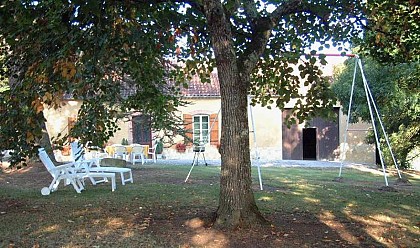
LE PIED DU RIST
34 km

LE PIED DU RIST

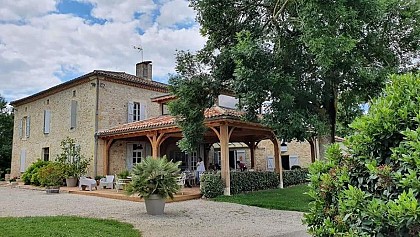
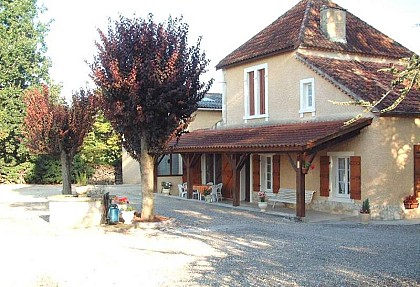
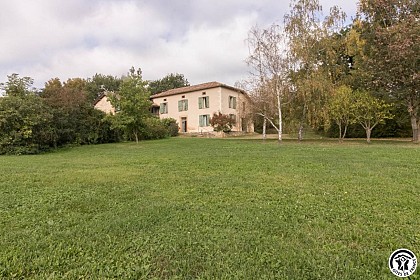
Renovated old farmhouse away from the village with swimming pool, in the middle of meadows, on the edge of a wood with a private garden, 15km from the Gimone swimming lake, at the gateway to the Hautes-Pyrénées. Group gîte with character, combining traditional materials (stone, earth, wood) with contemporary features (large picture windows, staircases, fireplaces, metal...). Good tips nearby : swimming at the Gorges de la Save 5km away, Boulogne-sur-Gesse 6km away (restaurants, shops, market), Gallo-Roman village and museum at Montmaurin 8km away, restaurant inn at Escanecrabe 13km away, Cardeilhac forest arboretum 14km away, Gimone swimming lake 15km away, 25km north of Saint-Gaudens (train station, Garonne river), Montréjeau 27km away (swimming lake, train station, golf course), Saint-Bertrand-de-Comminges (France's favourite village and Grand Site Occitanie) 36km away, Auch (Gers department) 52km away, Tarbes (Hautes-Pyrénées department) 65km away, Bagnères-de-Luchon (skiing and thermal baths) 67km away and Toulouse 90km away. Gîte on 2 levels: - Ground floor: traditional kitchen with separate washing-up area (dishwasher and washing machine) and large fireplace. Dining room of 85 m² with fireplace and TV/reading area for 40 people, with access to the outside. 2 bedrooms, each with 2 twin beds (90*200cm). Spacious toilets for communal areas (2 washbasins, 2 WCs, 2 mirrors, 1 shower). Accessible to the disabled. - Upstairs, under-roof function room with ping-pong table, exposed roof frame (meetings, seminars, parties...), accessible from the ground floor dining room, direct access to the swimming pool. 4 bedrooms (1 bed 140*190cm)(1 bed 140*190cm)(1 bed 140*190cm and 1 bed 90*190cm on the mezzanine, steep staircase and low ceiling)(1 bed 140*190cm and 2 beds 90*190cm, bunk beds). Each bedroom has a shower and washbasin opening onto the sleeping area, and a separate closed WC. 5 foldaway beds are also available.

Route de Lannemezan 31350 BLAJAN
Show
Caution!
We have no information on the difficulty of this circuit. You may encounter some surprises along the way. Before you go, please feel free to inquire more and take all necessary precautions. Have a good trip! 🌳🥾