Alert
Alerts
Notre-Dame Abbey Church
Description
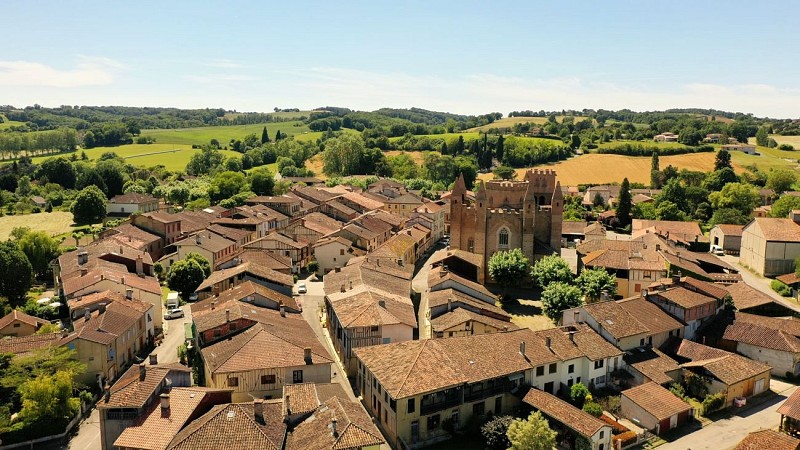
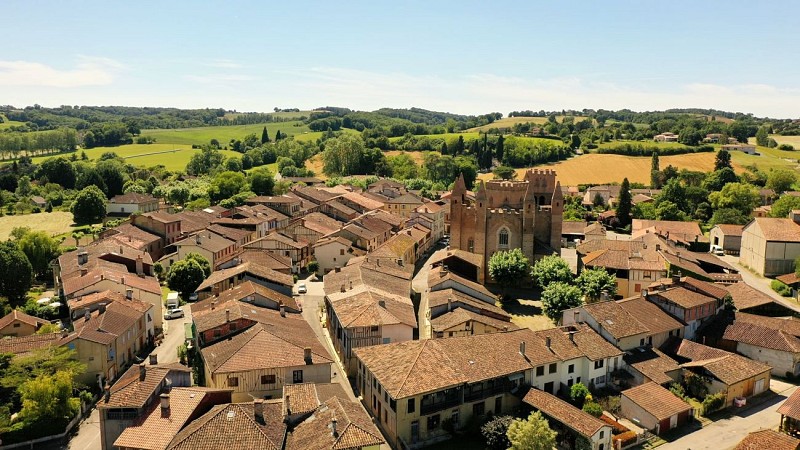
The Church of Simorre is a 14th-century abbey church built on a 5th-century oratory created by Cérats, who became the patron saint of Simorre.
The History of the Abbey Church:
Founded, according to tradition, in 507 by Clovis, the Benedictine abbey of Simorre was one of the most important in the region. The convent buildings, once attached to the north of the church, disappeared after being sold as national property during the French Revolution.
At the end of the 13th century, a conflict between the Abbot of Simorre and the Count of Astarac, with the support of King Philip IV the Fair, enabled the church's reconstruction to be financed. Construction began around 1290, and the building was consecrated in 1309, which explains its remarkable architectural unity.
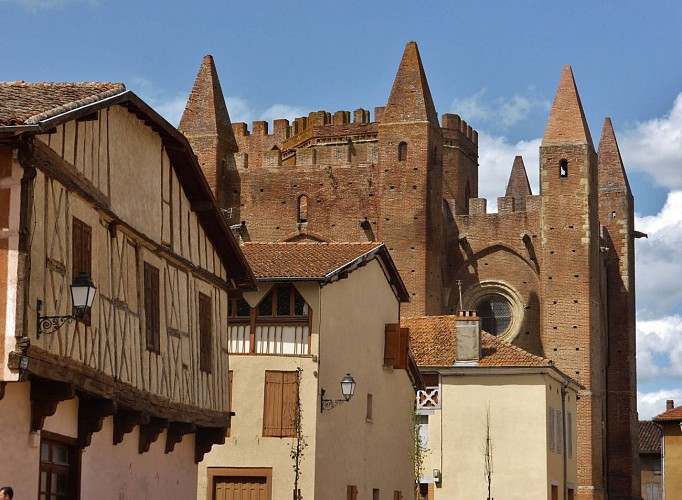
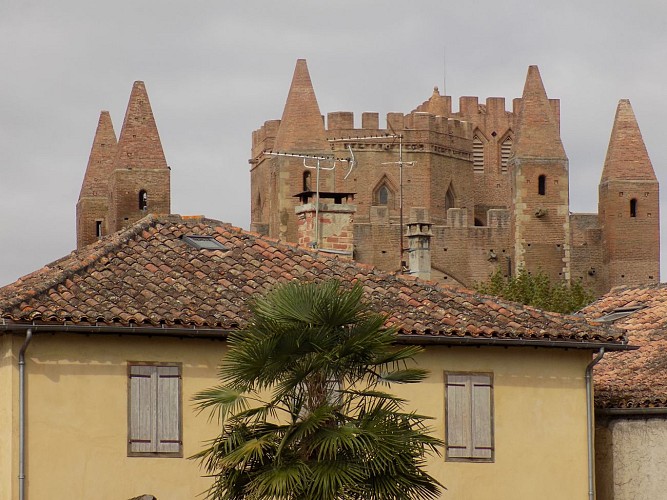
Built primarily of brick, the church adopts a Latin cross plan, typical of Toulouse Gothic architecture, with a flat apse inspired by Cistercian architecture. Its finely sculpted Gothic stone portal is protected by a fortified porch, recalling the monument's defensive role in the Middle Ages.
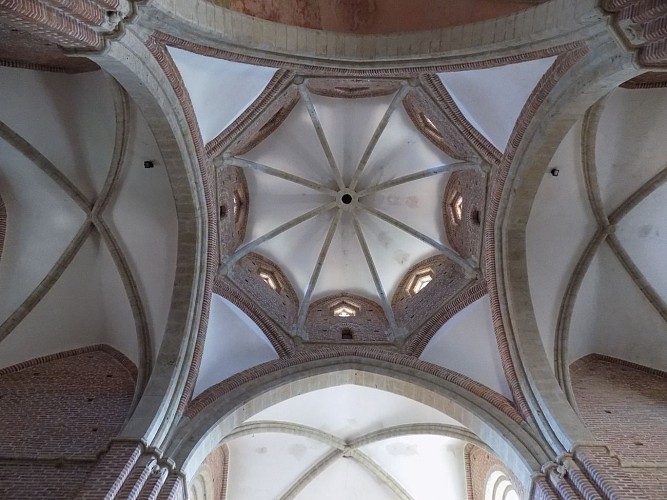
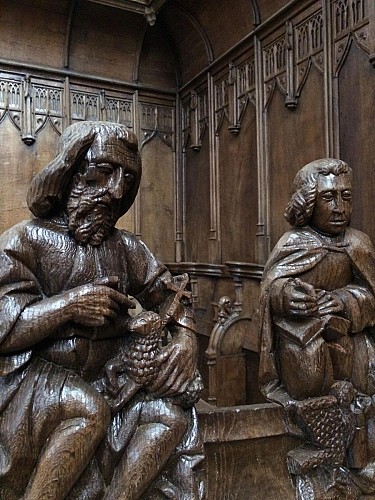
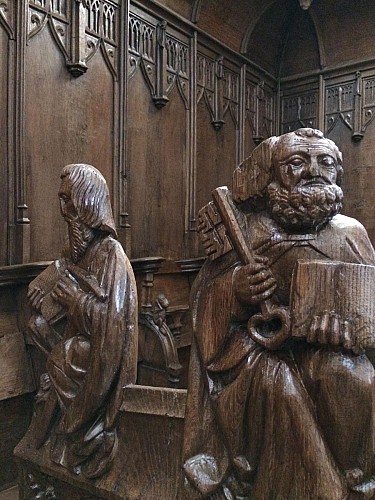
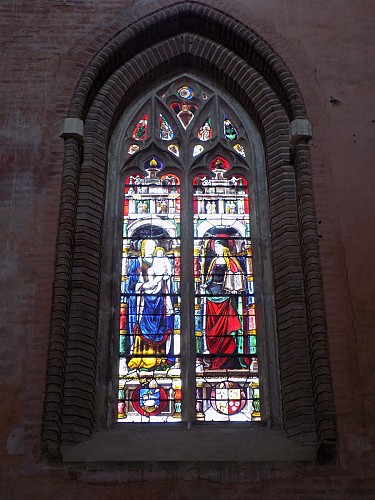
Inside, admire the octagonal vault surmounted by a lantern tower, the 14th-century murals in the former sacristy, the stained-glass windows dating from the 14th to the 19th centuries, and the choir stalls dating from the early 16th century.
Classified as a Historical Monument in 1843, the abbey church was restored by the architect Eugène Viollet-le-Duc, who gave it its current fortified appearance. Restoration campaigns in the 20th century enhanced the brickwork and interior decorations.
The stained-glass windows:
The abbey church preserves a remarkable collection of stained-glass windows from the 14th to the 19th centuries. Nine windows, dating from 1357, depict, among other things, the Crucifixion, Saint Sernin, Benedictine monks, and Saint Louis. Their style, devoid of perspective, is comparable to that of the medieval stained-glass windows of Narbonne Cathedral.
Other 15th-century stained-glass windows introduce perspective and warmer colors. They depict the martyrdom of Saint Catherine and Saint James as a pilgrim.
At the beginning of the 16th century, Renaissance-style stained-glass windows appeared, representing Saint Cérats, the evangelizing bishop and patron saint of Simorre, as well as the Virgin and Child and Saint Dode, likely influenced by the workshops of Auch Cathedral. 19th-century stained-glass windows complete the ensemble.
The choir stalls:
The 38 choir stalls, dating from the early 16th century, are in the Flamboyant Gothic style, restrained and elegant. Donated by Bishop Jean Marre, a native of Simorre, they feature a rich sculpted program blending biblical scenes (Genesis, baptisms, martyrs) with more secular, sometimes humorous, motifs. The abbot's stall, adorned with an Annunciation scene, occupies the central position.
The Sacrament Room:
This 14th-century vaulted room housed the relics venerated by pilgrims. Its murals, rediscovered in 1964, depict, among others, Saint Benedict and Saint Scholastica, Saint Michael slaying the dragon, a Crucifixion, and Saint Sernin.
The Crossing and Architectural Details:
At the crossing of the nave and transept, an impressive octagonal dome illustrates Gothic craftsmanship and a spiritual symbolism evoking the ascent to the heavenly Jerusalem.
On the walls, one can also see putlog holes, remnants of the scaffolding used during construction.
The church is open during the day for self-guided visits.
A descriptive document is available on site, as well as information panels installed inside the church. An audio tour is also available to visitors free of charge (press the button on the wall to the left upon entering)
Technical Information
Altimetric profile
Additional information
Updated by
Office de Tourisme Coteaux Arrats Gimone - 28/08/2026
Report a problem
Open period
All year round daily.
Contact
Phone : 05 62 67 77 87
Website : https://www.simorre.com/patrimoine/leglise-de-simorre/
Animals
Yes
