Tours
Activities
Places of interest
Where to eat
Where to sleep

Discover Logny-bogny in picturesque Ardennes

Are you in charge of the destination?
Nestled in the lush heart of the Ardennes, Logny-bogny embodies the tranquil charm of the Champagne-Ardenne region. Visitors can delve into a variety of activities that highlight both the area's natural beauty and cultural heritage. Begin your adventure with a hike in the surrounding verdant fields and forests, perfect for nature enthusiasts. Logny-bogny offers marked hiking trails that weave thro...See more

Walking around Logny-bogny

See more suggestions
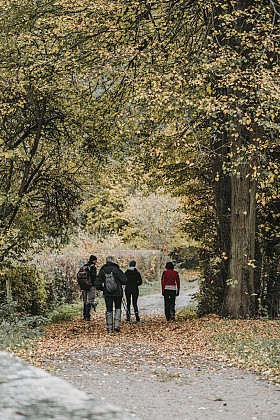
Embark on a hike in Logny-bogny.
See more suggestions

What to do in Logny-bogny

See more suggestions
Organize your days in Logny-bogny with bookable activities for the whole family.
See more suggestions
What to visit in Logny-bogny

See more suggestions
Discover the local markets of Logny-bogny.
See more suggestions
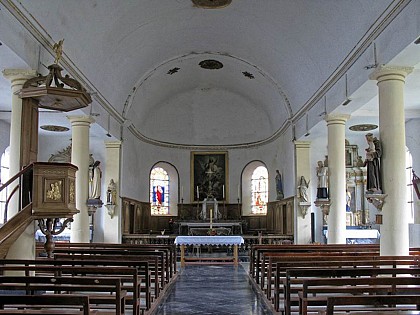
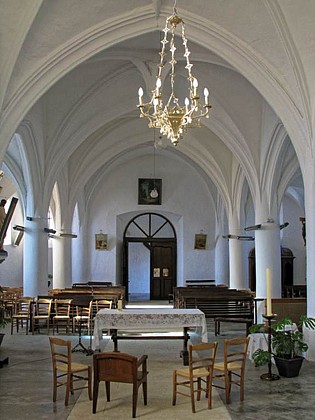
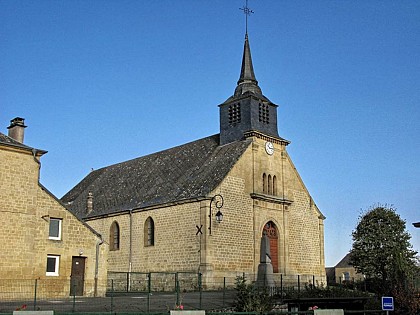
Church of Saint Arnould d'Haudrecy
16 km

Church of Saint Arnould d'Haudrecy

The church was rebuilt according to plans drawn up on 20 April 1844 by the departmental architect Delerue. However, the first third of the porch of the old church was replaced as a forebuilding, but its portal was still rebuilt; this part must date from the 18th century. In an initial project dated 16 March 1844, Delerue wanted to retain the old building and enlarge it by adding side aisles and a new choir. The church of Saint Arnould is located in the centre of the village and is westernised. It has an elongated plan. The four-bay, three-vessel nave is preceded by a forecourt, the ground floor of which is occupied by the timber-framed spiral staircase, the first floor by a gallery supported by two cast-iron columns and the ridge by the square timber-framed bell tower. The choir consists of a straight bay, framed by two sacristies, and a three-sided apse. The building is built of limestone rubble with a Dom-le-Mesnil ashlar chain. The floor of the nave's central aisle is covered with black marble tiles and the rest with concrete, and the choir with a black and white marble chequerboard. The walls are pierced with semicircular arched windows and the western doorway has a flat band and is topped by a triangular pediment supported by two brackets. The side aisles have ceilings, the central nave and the right choir bay are covered by a false barrel vault and the apse by a barrel vault. The nave and right choir bay are covered in synthetic material, while the apse and bell tower are covered in slate. The central nave and the right choir bay are covered with a pitched roof, the side aisles with shed roofs, the sacristies with gable roofs and the bell tower with a polygonal spire.

13 Grand rue 08090 HAUDRECY
Show
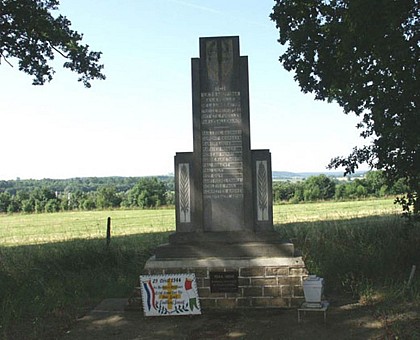
Bois de la Rosière - Resistance 2nd world war
18 km

Bois de la Rosière - Resistance 2nd world war

The Bois de la Rosière monument stands on the edge of the wood from which it takes its name, in the commune of Tournes near Charleville-Mézières (Ardennes), where thirteen Resistance fighters were executed without trial on 29 August 1944. On 29 August 1944, a few hours before their departure, the Germans resigned themselves to releasing the patriots held in Charleville prison, Place Carnot, around fifty men and women. But at the insistence of the Gestapo and the French Militia, they decided to shoot some of the hostages beforehand. So it was that the thirteen unfortunates, chosen at random, were taken from their cell and transported by lorry to Rosière Wood (in the commune of Tournes), where they were immediately shot. They had been led to believe that they were going to be freed; among them were two women. The Bois de la Rosière monument was inaugurated on 30 August 1947 in the presence of many prominent members of the Ardennes Resistance and Pierre Schneiter, deputy for the Marne and brother of André Schneiter. The monument was erected on the site of the massacre at the initiative of the commune of Tournes, which had called for public subscriptions. It was designed by Gustave Maily, a sculptor from Reims. It consists of a marble stele erected on the site of a wooden Cross of Lorraine erected the day after the Liberation. Above the names of the thirteen Resistance fighters executed are engraved a Cross of Lorraine and the inscription : ‘Here on 29 August 1944, on the eve of the Liberation, thirteen patriots were shot by the Germans’.

12 rue d'Arreux 08090 TOURNES
Show
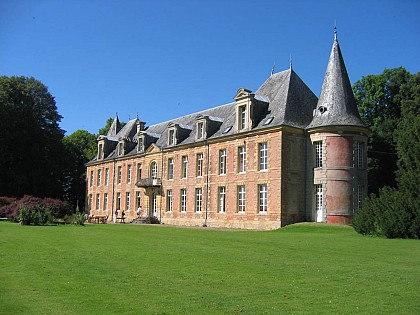
Septfontaines Abbey, former property of the Vendroux family - Charles de Gaulle's family-in-law
18 km

Septfontaines Abbey, former property of the Vendroux family - Charles de Gaulle's family-in-law

Founded in 1129, the architecture of Notre-Dame de Septfontaines abbey dates back to this period. It was built by the Seigneur de Mésière, whose first name was Hélie. It underwent a number of architectural changes between the French Revolution and the 1st World War, and today has the structure of a 3-storey château flanked by 2 turrets, in the classical 17th century style inspired by François Mansart (high slate roofs, harmonious proportions). At the start of the First World War, General Joffre set up his headquarters in the abbey, but the rapid advance of the Germans forced him to leave very quickly. In September 1914, Kaiser Wilhelm II moved to Charleville: the Château de Septfontaines was transformed into a casino by the Kaiser, who came here every day for tea, accompanied by his senior officers. The waltz of generals continued into the thirties.In the early 20th century, it became the property of the Vendroux family, Charles de Gaulle's family-in-law, who regularly stayed here to relax and recharge their batteries between the wars. The future general enjoyed horse riding, croquet, badminton and, in autumn, hunting. He also worked on some of his books. The estate was not just a place of pleasure. It was also a farm, run by farmers, with fields and orchards. The Vendroux family left in May 1940, as the château was very close to the German breakthrough on the Meuse. In May 1978, before moving to the retirement home of the Sisters of the Immaculate Conception in Paris, Yvonne de Gaulle, who had been widowed a few years earlier, made a final pilgrimage to the château, where her sister-in-law Madeleine, the widow of Jean Vendroux, still lived. Around 1985, the property was bought by the Prince de Mérode, who completely renovated the château and turned it into a prestigious hotel-restaurant. Stéphane Dupuis, François and Quentin Clarin bought the abbey of Sept Fontaines at the end of 2018 out of a passion for the place. This monument is 10 minutes from Charleville-Mézières and has been listed as a Historic Monument since 1980.

Abbaye de Septfontaines 08090 FAGNON
Show

Where to eat in Logny-bogny

See more suggestions
Enjoy delicious dishes at Logny-bogny's restaurants.
See more suggestions
The Ardwen brewery
17 km

The Ardwen brewery

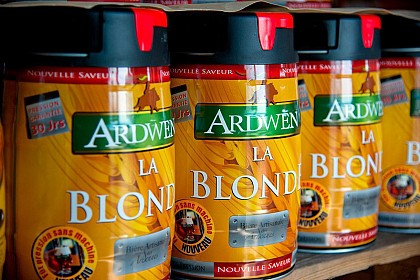
This pretty road crosses the southern Ardennes countryside to Launois-sur-Vence, a rural village far from the hustle and bustle of towns and cities. The location of the Ardwen brewery is no trivial matter. The Champagne region is close by, its subsoil brimming with pure water, the basis of all high-quality beers. And the Woinic beer can claim its right to be described as such, since it has been nominated eight times at the Paris Agricultural Show. Recognition like this owes nothing to chance. The young but talented master brewer, Geoffrey Stevenin, loves his work and his range of beers, all made using natural ingredients. “The barley is from Champagne and the malt is from Belgium. But we will never add artificial flavouring to our beers”. The brewery produces a wide range of beers, all different, with very definite characters, just like the Ardennes! The Ardwen Blonde is refreshing and fresh; the Blanche is more lemony, with hints of coriander; the Ambrée is typical of caramelised malts. The Cerise or cherry beer is characterised by a lovely roundness, based on pure Morello cherry juice; the Hop’s Cure is strong in malts and hops. The Bleue has a pronounced bitterness, compared to the Rouge, which is beautifully round, with a fruity taste calling to mind kirsch, while the special Christmas beer, Ardwen de Noël, is more complex, with a subtle blend of spices. The Ardwen logo depicts the goddess Arduinna, protector of the forest, astride a wild boar: we’ll wager she protects this brewery like treasure, as the worthy heir of Ardennes brewing know-how.

20 Avenue Roger Ponsart 08430 Launois sur vence
Show

Where to sleep in Logny-bogny

See more suggestions
Choose from a variety of lodgings in Logny-bogny.
See more suggestions
Caution!
We have no information on the difficulty of this circuit. You may encounter some surprises along the way. Before you go, please feel free to inquire more and take all necessary precautions. Have a good trip! 🌳🥾