Tours
Activities
Places of interest
Where to eat
Where to sleep

Discover Saint-jean-d'heurs, Puy-de-Dôme, Auvergne

Are you in charge of the destination?
Nestled in the picturesque Puy-de-Dôme department in Auvergne, Saint-jean-d'heurs serves as a gateway to a plethora of fulfilling activities and scenic landscapes. Hiking enthusiasts will delight in the trails that weave through the surrounding hills and mountains, offering spectacular panoramas of the region's unspoiled nature. Its proximity to the Auvergne Volcanoes Regional Natural Park present...See more

Walking around Saint-jean-d'heurs

See more suggestions
Discover the walking paths of Saint-jean-d'heurs.
See more suggestions
What to do in Saint-jean-d'heurs

See more suggestions
Plan your leisure time in Saint-jean-d'heurs by booking activities that suit your preferences.
See more suggestions
Le Creux de l'Enfer - Contemporary art center of national interest
8.8 km

Le Creux de l'Enfer - Contemporary art center of national interest

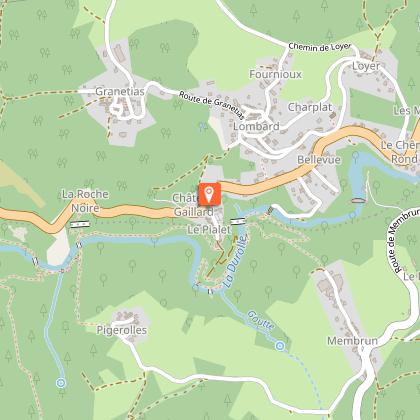
Located in the emblematic Vallée des Usines site in Thiers, Le Creux de l'Enfer is spread over two exceptional industrial buildings above the Durolle River. For more than 30 years, the art center has showcased the best of both national and international contemporary art and has invited artists to create works through immersive residencies, collaborating with local stakeholders. Through an annual program of solo and group exhibitions, a series of talks and conferences closely tied to these exhibitions, as well as outreach initiatives and special public events, the art center also aims to create the most favorable conditions for bringing art and the public together. A case in point is “Samedis d’enfer,” scheduled during each exhibition, which brings together a multitude of artistic offerings, including workshops for children, guided exhibition tours, and concerts, performances, and other public events. Drawing on a wide range of influences—spanning industry and nature, action and thought—Le Creux de l’Enfer embodies a project that is as experimental as it is accessible, as demanding as it is generous, and as cutting-edge as it is welcoming. A contemporary art center housed in the former Creux de l’Enfer cutlery factory—which closed permanently in 1956—it traces its origins to the cultural decentralization policy launched under the leadership of Jack Lang in 1985. It opened in 1988, three years after the National Symposium on Monumental Metal Sculpture, organized by the municipality of Thiers, several of whose works remain scattered throughout the city and its surroundings. Le Creux de l’Enfer is one of fifty French contemporary art centers accredited by the Ministry of Culture, modeled after the German “Kunsthallen”—spaces in which artists are deeply involved: Le Creux de l’enfer devotes its entire space to a program of temporary exhibitions (renewed twice a year) and events, developed in collaboration with guest artists. Since October 2019, it has held the designation “contemporary art center of national interest,” making it the first contemporary art center in the Auvergne-Rhône-Alpes region to receive this designation. At the helm of this “vessel” on the Durolle River is Sophie Auger-Grappin, who, after more than 20 years in the Île-de-France region, chose to leave Paris and an art center in the Yvelines for Thiers, bringing with her artistic projects of national scope for this “other capital”—the capital of cutlery. Since 2025, the Creux de l’Enfer has been renovated, expanded, and has also extended its artistic and cultural program to the May factory, connected to the Creux de l’Enfer factory by a covered walkway. Thanks to this work, a brand-new visitor route has been created, featuring new spaces open to the public (a lower hall right next to the river, an observation deck with an unmissable view of the valley, a small workshop where visitors can enjoy activities and hands-on sessions...) and an exhibition space of nearly 1,000 m². The project was managed by the Fabre/Speller architectural firm—which had previously overseen the transformation of the Creux de l’Enfer in 1988—and was further enriched by the collaboration with architect-engineer Alexandre Bagros-Murat and designer Olivier Vadrot for the furniture and interior design.

83 - 85 avenue Joseph Claussat - Vallée des Usines 63300 Thiers
Book from 0 €Book
Show
Le chalet de Cervières
25 km

Le chalet de Cervières

Come and relax in this beautiful wooden chalet with a 35 m2 terrace with jacuzzi and an incredible view of the surrounding countryside. Situated at less than 4km from the motorway exit ‘’Les Salles’’ (42), between the historic village of Cervierres and the village of Noiretable with its Casino game, lac and all shops near by The chalet is made using only the local wood and built by an artisan from the area who uses old methods with a respect for modern architecture The chalet is build on poles which provide an amazing view. There is 20m2 inside with all the necessary comfort, fully equipped kitchen, also made by a local manufacture and a bathroom with a shower and toilets with a modern design. You will also find a very comfortable sofa bed which you can fold during the day to optimise the space A large 3m door window will allow you to wake up in front of this incredible view. Also giving access to a 35m2 terrace which was thought to maximise your own comfort in the country side The 24 jet SPA is placed in the center, there is 2 laying space and 1 seat. Still looking at the view you will be able to get a relaxing water or air massage hoping to maybe spot some wild animal passing through the land across On one side of the terrace you will find and outdoor living area where you can relax, read a book or simply listen the birds singing. On the other side you will find a dinning space where you can enjoy your breakfast and try the local specialities while looking at the forest in this beautiful part of France This Chalet is suitable for 2 adult only

8, route du Gontey 42440 Cervières
Book from 0 €Book
Show

What to visit in Saint-jean-d'heurs

See more suggestions
Take a boat tour around Saint-jean-d'heurs.
See more suggestions
Le Creux de l'Enfer - Contemporary art center of national interest
8.8 km

Le Creux de l'Enfer - Contemporary art center of national interest

Located in the emblematic Vallée des Usines site in Thiers, Le Creux de l'Enfer is spread over two exceptional industrial buildings above the Durolle River. For more than 30 years, the art center has showcased the best of both national and international contemporary art and has invited artists to create works through immersive residencies, collaborating with local stakeholders. Through an annual program of solo and group exhibitions, a series of talks and conferences closely tied to these exhibitions, as well as outreach initiatives and special public events, the art center also aims to create the most favorable conditions for bringing art and the public together. A case in point is “Samedis d’enfer,” scheduled during each exhibition, which brings together a multitude of artistic offerings, including workshops for children, guided exhibition tours, and concerts, performances, and other public events. Drawing on a wide range of influences—spanning industry and nature, action and thought—Le Creux de l’Enfer embodies a project that is as experimental as it is accessible, as demanding as it is generous, and as cutting-edge as it is welcoming. A contemporary art center housed in the former Creux de l’Enfer cutlery factory—which closed permanently in 1956—it traces its origins to the cultural decentralization policy launched under the leadership of Jack Lang in 1985. It opened in 1988, three years after the National Symposium on Monumental Metal Sculpture, organized by the municipality of Thiers, several of whose works remain scattered throughout the city and its surroundings. Le Creux de l’Enfer is one of fifty French contemporary art centers accredited by the Ministry of Culture, modeled after the German “Kunsthallen”—spaces in which artists are deeply involved: Le Creux de l’enfer devotes its entire space to a program of temporary exhibitions (renewed twice a year) and events, developed in collaboration with guest artists. Since October 2019, it has held the designation “contemporary art center of national interest,” making it the first contemporary art center in the Auvergne-Rhône-Alpes region to receive this designation. At the helm of this “vessel” on the Durolle River is Sophie Auger-Grappin, who, after more than 20 years in the Île-de-France region, chose to leave Paris and an art center in the Yvelines for Thiers, bringing with her artistic projects of national scope for this “other capital”—the capital of cutlery. Since 2025, the Creux de l’Enfer has been renovated, expanded, and has also extended its artistic and cultural program to the May factory, connected to the Creux de l’Enfer factory by a covered walkway. Thanks to this work, a brand-new visitor route has been created, featuring new spaces open to the public (a lower hall right next to the river, an observation deck with an unmissable view of the valley, a small workshop where visitors can enjoy activities and hands-on sessions...) and an exhibition space of nearly 1,000 m². The project was managed by the Fabre/Speller architectural firm—which had previously overseen the transformation of the Creux de l’Enfer in 1988—and was further enriched by the collaboration with architect-engineer Alexandre Bagros-Murat and designer Olivier Vadrot for the furniture and interior design.

83 - 85 avenue Joseph Claussat - Vallée des Usines 63300 Thiers
Book from 0 €Book
Show
Meanders's Allier
12 km

Meanders's Allier

Some fifteen kilometers downstream from the Bec de Dore ENS, the Allier valley from Joze to Maringues is one of the most interesting areas of the Puy-de-Dôme in terms of river dynamics and natural environments. This is one of the most interesting sectors of the Puy-de-Dôme department, where river dynamics and interesting natural environments still exist, but it is also one of the most complex to manage due to the presence of certain micro-parcel developments and the multiplicity of stakeholders. The Allier axis is a corridor of refuge for remarkable flora and fauna in the face of the vast expanses of cultivated land along its banks. An area of unprecedented richness, populated by hundreds of species of saproxilophagous insects (which feed on dead wood), which in turn feast on fish and birds such as the kingfisher, while a beautiful heron waddles along the riverbank. The vegetation is not to be outdone, and the place remains truly enchanting, with a veritable symphony of colors. And as a bonus, volcanoes can be seen on the horizon. The main outstanding natural habitats are : - natural eutrophic lakes (duckweed communities), - annual vegetation of exposed riverbanks (pioneer communities of wet mudflats), - pioneer lawns on rock domes (sedum lawn), - a residual alluvial forest (salix abla willow grove), - and a mixed forest of large rivers (Quercus robur alluvial oak grove). The main species of note are : - Purple loosestrife, Micheli nutsedge, smooth elm, - Atlantic salmon, pike, shad, sea lamprey, - European otter, European beaver - European beaver, great murin, eared vespertilion, - kingfisher, black-crowned night heron, bank swallows, common tern, - agrion mignon, dwarf agrion, marsh copper... The site, and more broadly the Allier axis, is considered a "refuge" or "green and blue corridor" through which remarkable flora and fauna pass.

Creux Bérau / La Bresle 63350 Maringues
Show
The bridge
15 km

The bridge

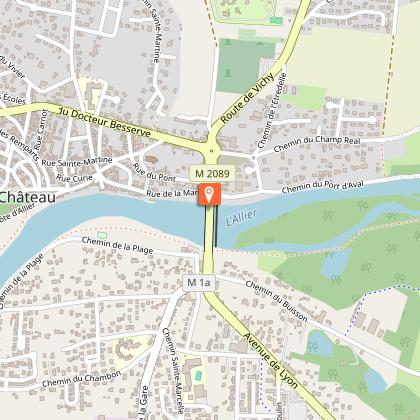
At Pont-du-Château, several different bridges have crossed the river Allier, but did not withstand the river floods. The present-day bridge is from the 18th century. Criss-crossed by a multitude of waterways, the Clermont Auvergne metropolitan area retains many bridges, some of them dating back to Antiquity, such as the Beneilh bridge at Aubière. At Pont-du-Château, it is said that Caesar’s troops crossed the Allier river on foot to reach the Sarliève plain and the Gergovie plateau in the year 52 BCE. Over the centuries, several bridges were built but none survived the river floods. A wooden bridge existed in 1566 when Charles IX took it with his mother Catherine de Medici after dining at the château with Charlotte de Vienne, lady-in-waiting and governess to the royal children. The bridge disappeared in 1586 in the flood that also destroyed the Chapelle de la Recluse. After the bridge was destroyed, the Allier river had to be crossed by boat. The present-day bridge was built at the request of Monsieur de Regemortes, the King’s engineer and designer of the bridge bearing his name at Moulins. He gave the plans to architect François-Charles Dijon (1705-1785), who built it between 1765 and 1773. The bridges were preceded by a wooden dam that cut across the river to bring up its level, supply the mills and facilitate fishing, over which the King had a monopoly. Colbert, Louis XIV’s Secretary of State, ordered that the river Allier be navigable from Brioude to Pont-du-Château, with the need to open the dyke for boats to pass. The dyke was finally destroyed in 1792. Two fish passes allowing salmon in the Allier to pass were built in 2013 at the foot of the bridge.

63430 Pont-du-Château
Show
Port d'Amont
15 km

Port d'Amont

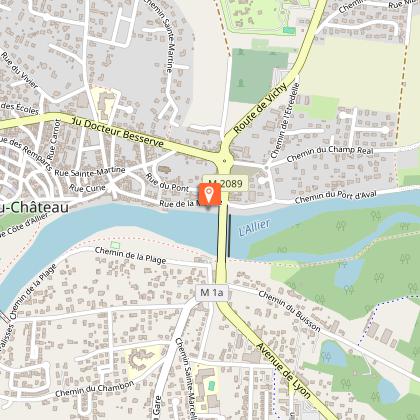
The Port d’Amont is the last port to have been built that is still visible at Pont-du-Château. It bears witness to the former importance of river trade on the Allier. The source of the River Allier (425 km) is in Lozère, and it flows into the River Loire at the Bec d’Allier near Nevers. The River Allier provided a route to Nantes and later to Paris via the Briare Canal (1642). From the early modern period until the 19th century, Pont-du-Château was a major river trading town on the Allier, with its sailors’ neighbourhood known as 'Little Marseille'. The town boasted five ports: la Vortille, les Palisses, des Bouères, la Borde Saint-Aventin and d’Amont. The last of these, built between 1835 and 1838, is the only one still standing. River traffic was intense, with 1,334 boats recorded in 1749 and 1,694 in 1750. Two types of vessel were used: rafts made from 5 to 15 fir trees, and 'sapinières' — small, disposable boats measuring 17 to 23 metres in length, built from around 10 fir trees. They could carry up to 20 tonnes of goods, including coal, wine, Volvic stone, paper, wood and hemp to Paris or Nantes. Once they reached their destination, the sapinières were dismantled and sold as timber for heating or construction. The sailors would return on foot, their anchor on their shoulder, while the wealthier among them settled in Paris as 'bougnats', Auvergne specialists in 'wine, wood and coal'. By the late 19th century, the arrival of the railway marked the end of waterborne trade. Today the river is used by leisure boats, and its banks have been redeveloped with greenways and parks. The Musée de la Batellerie, on Place de l’Aire, retraces this history.

Rue de la Marine 63430 Pont-du-Château
Show

Where to eat in Saint-jean-d'heurs

See more suggestions
Explore the culinary traditions of Saint-jean-d'heurs.
See more suggestions
Where to sleep in Saint-jean-d'heurs

See more suggestions
Stay in unique accommodations in Saint-jean-d'heurs.
See more suggestions
Le chalet de Cervières
25 km

Le chalet de Cervières

Come and relax in this beautiful wooden chalet with a 35 m2 terrace with jacuzzi and an incredible view of the surrounding countryside. Situated at less than 4km from the motorway exit ‘’Les Salles’’ (42), between the historic village of Cervierres and the village of Noiretable with its Casino game, lac and all shops near by The chalet is made using only the local wood and built by an artisan from the area who uses old methods with a respect for modern architecture The chalet is build on poles which provide an amazing view. There is 20m2 inside with all the necessary comfort, fully equipped kitchen, also made by a local manufacture and a bathroom with a shower and toilets with a modern design. You will also find a very comfortable sofa bed which you can fold during the day to optimise the space A large 3m door window will allow you to wake up in front of this incredible view. Also giving access to a 35m2 terrace which was thought to maximise your own comfort in the country side The 24 jet SPA is placed in the center, there is 2 laying space and 1 seat. Still looking at the view you will be able to get a relaxing water or air massage hoping to maybe spot some wild animal passing through the land across On one side of the terrace you will find and outdoor living area where you can relax, read a book or simply listen the birds singing. On the other side you will find a dinning space where you can enjoy your breakfast and try the local specialities while looking at the forest in this beautiful part of France This Chalet is suitable for 2 adult only

8, route du Gontey 42440 Cervières
Book from 0 €Book
Show
Caution!
We have no information on the difficulty of this circuit. You may encounter some surprises along the way. Before you go, please feel free to inquire more and take all necessary precautions. Have a good trip! 🌳🥾