Tours
Activities
Places of interest
Where to eat
Where to sleep

Explore Mauzun, Puy-de-Dôme, Auvergne

Are you in charge of the destination?
Nestled within the Puy-de-Dôme department, Mauzun is a charming village that attracts nature and history enthusiasts. Start your visit by exploring the impressive ruins of the Château de Mauzun, a medieval gem offering stunning views over the Auvergne landscapes. The hiking trails around the village lead you through lush countryside, offering exceptional panoramas of the region's volcanoes.
Don't...
See more

Walking around Mauzun

See more suggestions
Explore the hiking trails around Mauzun.
See more suggestions
What to do in Mauzun

See more suggestions
Organize your days in Mauzun with bookable activities for the whole family.
See more suggestions
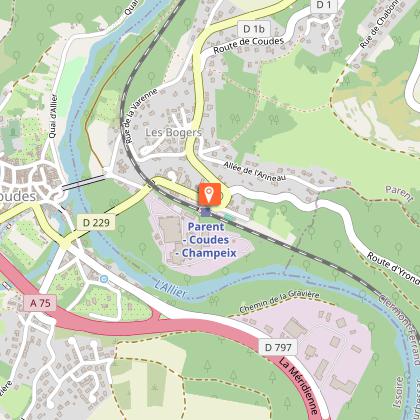
Le Creux de l'Enfer - Contemporary art center of national interest
19 km

Le Creux de l'Enfer - Contemporary art center of national interest

Located in the emblematic Vallée des Usines site in Thiers, Le Creux de l'Enfer is spread over two exceptional industrial buildings above the Durolle River. For more than 30 years, the art center has showcased the best of both national and international contemporary art and has invited artists to create works through immersive residencies, collaborating with local stakeholders. Through an annual program of solo and group exhibitions, a series of talks and conferences closely tied to these exhibitions, as well as outreach initiatives and special public events, the art center also aims to create the most favorable conditions for bringing art and the public together. A case in point is “Samedis d’enfer,” scheduled during each exhibition, which brings together a multitude of artistic offerings, including workshops for children, guided exhibition tours, and concerts, performances, and other public events. Drawing on a wide range of influences—spanning industry and nature, action and thought—Le Creux de l’Enfer embodies a project that is as experimental as it is accessible, as demanding as it is generous, and as cutting-edge as it is welcoming. A contemporary art center housed in the former Creux de l’Enfer cutlery factory—which closed permanently in 1956—it traces its origins to the cultural decentralization policy launched under the leadership of Jack Lang in 1985. It opened in 1988, three years after the National Symposium on Monumental Metal Sculpture, organized by the municipality of Thiers, several of whose works remain scattered throughout the city and its surroundings. Le Creux de l’Enfer is one of fifty French contemporary art centers accredited by the Ministry of Culture, modeled after the German “Kunsthallen”—spaces in which artists are deeply involved: Le Creux de l’enfer devotes its entire space to a program of temporary exhibitions (renewed twice a year) and events, developed in collaboration with guest artists. Since October 2019, it has held the designation “contemporary art center of national interest,” making it the first contemporary art center in the Auvergne-Rhône-Alpes region to receive this designation. At the helm of this “vessel” on the Durolle River is Sophie Auger-Grappin, who, after more than 20 years in the Île-de-France region, chose to leave Paris and an art center in the Yvelines for Thiers, bringing with her artistic projects of national scope for this “other capital”—the capital of cutlery. Since 2025, the Creux de l’Enfer has been renovated, expanded, and has also extended its artistic and cultural program to the May factory, connected to the Creux de l’Enfer factory by a covered walkway. Thanks to this work, a brand-new visitor route has been created, featuring new spaces open to the public (a lower hall right next to the river, an observation deck with an unmissable view of the valley, a small workshop where visitors can enjoy activities and hands-on sessions...) and an exhibition space of nearly 1,000 m². The project was managed by the Fabre/Speller architectural firm—which had previously overseen the transformation of the Creux de l’Enfer in 1988—and was further enriched by the collaboration with architect-engineer Alexandre Bagros-Murat and designer Olivier Vadrot for the furniture and interior design.

83 - 85 avenue Joseph Claussat - Vallée des Usines 63300 Thiers
Book from 0 €Book
Show
Castle of La Batisse
27 km

Castle of La Batisse

Château de la Batisse, located in Chanonat, is classified as a Historic Monument, as is the entire estate, and is surrounded by a garden that has been awarded the "Jardin Remarquable" label. Originally built in the 13th century as a defensive tower, the Château de La Batisse became a fortified castle in the 14th century. In the 18th century, it was transformed into a true pleasure estate, which is admired today for its rich history, its remarkable architecture, and its gardens—unique in the Auvergne region. Open year-round, the castle hosts both private and professional events, all while coming alive with an inspiring cultural program. Unique exhibitions, exceptional events, and timeless experiences make the site a space for creativity and cultural transmission. Contemporary art, historical reenactments, performances, concerts, and immersive evenings invite visitors to rediscover the château in a new light. Whether you’re a history buff, an art lover, or simply curious, everyone can enjoy unique experiences in the heart of this place steeped in history. Events From June 20 to August 30, 2026, set amid 19 hectares of nature and gardens designated as “Jardin Remarquable” (Remarkable Garden) and traversed by the Auzon River, the estate offers visitors a true respite of freshness and discovery. Shady woods, French-style gardens, waterfalls, orchards, a maze, wooden play structures, and art installations punctuate the visitor experience: Gallery of Auvergne portraits in the maze — Denis Pourcher Lava stone sculptures integrated into the gardens — Thierry Courtadon Floral sculptures in the Roseraie pond — Alexis Boyer “In Search of the Enlightenment”: busts of great philosophers hidden in the grove along the Allée des Cascades Summer 2026 Program Music Festival – June 20, 2026: storytelling during siesta time in the orchard, a costumed procession in the style of Napoleon III, and a free festive evening at the Moulin du Château starting at 6:30 p.m. (in partnership with Auzon Collectif), featuring concerts by local artists, food, and a friendly atmosphere. Concert Evening – July 13: concert featuring Les Frères Maulus followed by a barbecue. Guided Tours of the Château: starting July 8, Wednesdays and Sundays at 3:00 p.m. Napoleon III-themed costumed processions (afternoon): June 20, July 8, August 9 Storytelling tours (afternoon): July 8, August 5 “The Musketeers & Milady” event (July 15–August 13, every Wednesday): performances and fencing workshops.

Route de Varennes 63450 Chanonat
Book from 0 EURBook
Show

What to visit in Mauzun

See more suggestions
Enjoy the green spaces of Mauzun.
See more suggestions
The Shire Forest
12 km

The Shire Forest

Recognized as one of the richest forests in Auvergne, the Comté forest is a Sensitive Natural Area, unique for the diversity of its flora and fauna. Hiking trails are available to discover these natural treasures. Recognized as one of the richest forests in Auvergne, the Comté forest is an Espace Naturel Sensible (ENS - ens.puy-de-dome.fr/nos-actions.html), unique for the diversity of its flora and fauna. Hiking trails are available to discover these natural treasures. This emblematic forest, the largest lowland oak grove in Auvergne, is also the first and largest site acquired by the Département when it set up its Espace Naturel Sensible policy, and now covers more than 610 ha. The Comté forest covers a total area of 1,500 ha. Bordered to the west by the Allier valley and to the east by the granite plateaux of the Livradois, it is one of the most diverse and floristically rich massifs in France. The Comté massif stretches across several buttes belonging to Europe's oldest volcanic complex (-25 million years), such as the Pic du Cheix Blanc (817 m altitude), the Pic de Dimond (734 m) and the Pic des Fleurides (676 m). The area's geographical location and geological and historical past are factors that explain the great diversity of habitats (varied forest stands, gully forests, residual alluvial forests, pioneer grasslands on rocky domes....). In fact, the Comté forest is home to a wealth of flora: for example, the knotty cranesbill, a mountain species that reaches its northern limit on national territory in this forest. And four protected species: the martagon lily, the superb carnation, the pulsatilla anemone and the red cephalanthemum. The forest's wealth of flora is matched by a remarkable wealth of fauna, including large wild animals (deer, wild boar, foxes), small mammals (bats: Daubenton's murin), birds (buzzard, red kite, pileated woodpecker), insects and amphibians, with emblematic species such as the spotted salamander and yellow-bellied sounder, both considered rare and threatened in France. The Conseil Départemental offers a program of events, some of which take place at the Forêt de la Comté with the ENS.

Maison des espaces naturels Route départementale 225 63270 Sallèdes
Show
The bridge
17 km

The bridge

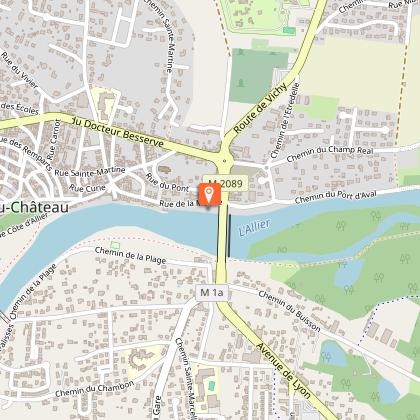
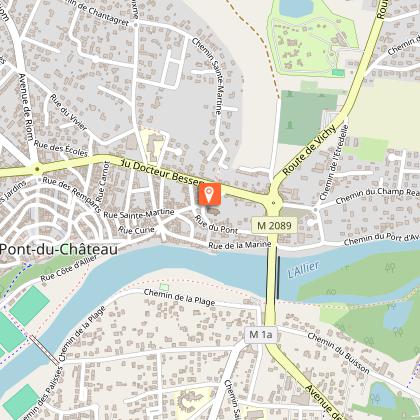
At Pont-du-Château, several different bridges have crossed the river Allier, but did not withstand the river floods. The present-day bridge is from the 18th century. Criss-crossed by a multitude of waterways, the Clermont Auvergne metropolitan area retains many bridges, some of them dating back to Antiquity, such as the Beneilh bridge at Aubière. At Pont-du-Château, it is said that Caesar’s troops crossed the Allier river on foot to reach the Sarliève plain and the Gergovie plateau in the year 52 BCE. Over the centuries, several bridges were built but none survived the river floods. A wooden bridge existed in 1566 when Charles IX took it with his mother Catherine de Medici after dining at the château with Charlotte de Vienne, lady-in-waiting and governess to the royal children. The bridge disappeared in 1586 in the flood that also destroyed the Chapelle de la Recluse. After the bridge was destroyed, the Allier river had to be crossed by boat. The present-day bridge was built at the request of Monsieur de Regemortes, the King’s engineer and designer of the bridge bearing his name at Moulins. He gave the plans to architect François-Charles Dijon (1705-1785), who built it between 1765 and 1773. The bridges were preceded by a wooden dam that cut across the river to bring up its level, supply the mills and facilitate fishing, over which the King had a monopoly. Colbert, Louis XIV’s Secretary of State, ordered that the river Allier be navigable from Brioude to Pont-du-Château, with the need to open the dyke for boats to pass. The dyke was finally destroyed in 1792. Two fish passes allowing salmon in the Allier to pass were built in 2013 at the foot of the bridge.

63430 Pont-du-Château
Show
Port d'Amont
17 km

Port d'Amont

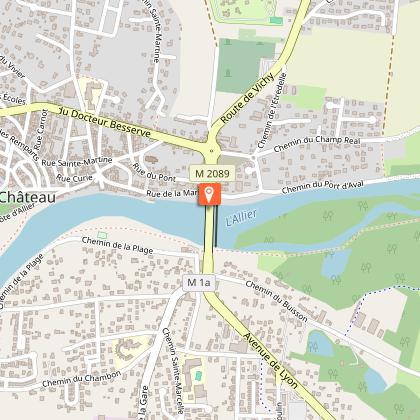
The Port d’Amont is the last port to have been built that is still visible at Pont-du-Château. It bears witness to the former importance of river trade on the Allier. The source of the River Allier (425 km) is in Lozère, and it flows into the River Loire at the Bec d’Allier near Nevers. The River Allier provided a route to Nantes and later to Paris via the Briare Canal (1642). From the early modern period until the 19th century, Pont-du-Château was a major river trading town on the Allier, with its sailors’ neighbourhood known as 'Little Marseille'. The town boasted five ports: la Vortille, les Palisses, des Bouères, la Borde Saint-Aventin and d’Amont. The last of these, built between 1835 and 1838, is the only one still standing. River traffic was intense, with 1,334 boats recorded in 1749 and 1,694 in 1750. Two types of vessel were used: rafts made from 5 to 15 fir trees, and 'sapinières' — small, disposable boats measuring 17 to 23 metres in length, built from around 10 fir trees. They could carry up to 20 tonnes of goods, including coal, wine, Volvic stone, paper, wood and hemp to Paris or Nantes. Once they reached their destination, the sapinières were dismantled and sold as timber for heating or construction. The sailors would return on foot, their anchor on their shoulder, while the wealthier among them settled in Paris as 'bougnats', Auvergne specialists in 'wine, wood and coal'. By the late 19th century, the arrival of the railway marked the end of waterborne trade. Today the river is used by leisure boats, and its banks have been redeveloped with greenways and parks. The Musée de la Batellerie, on Place de l’Aire, retraces this history.

Rue de la Marine 63430 Pont-du-Château
Show
Cournon Bridge
17 km

Cournon Bridge

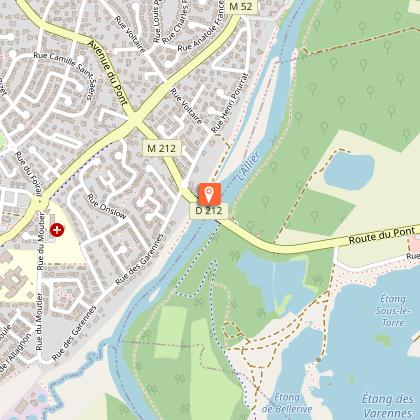
At Cournon-d’Auvergne, several different bridges have crossed the river Allier since the 1st century BCE. Some vestiges of former bridges are still visible. From the first century BCE, under Agrippa (62-12 BCE), a Roman bridge crossed the river Allier at Cournon d’Auvergne, along which the military route ran from Lugdunum (Lyon) to Saintes via Augustonemetum (Clermont-Ferrand). This was a strategic route that crossed the Cournon territory from east to west. Starting at the present-day SNCF train station in Clermont-Ferrand, it more or less followed the railway line to the heights of the Le Cendre train station and passed close to the Ribeyre before joining the Allier. Depending on the level of the river Allier, you can sometimes see a few remains of the piers of this Roman bridge. A bridge was subsequently mentioned in the 13th century in several texts. It was apparently swept away in the early 15th century and, for close to four centuries, it was replaced by a ferry which became the sole means of transport across the Allier. In 1833 the Cournon d’Auvergne town council decided to build a suspension bridge to replace the ferry. Construction began in 1837 and the bridge was inaugurated on 27 June, 1839. This first suspension bridge was designed by the engineer Kermaingant. Various landowners from Cournon d'Auvergne and Pérignat-lès-Allier carried out the construction work in exchange for a 60-year toll franchise. One of these owners was the musician Georges Onslow (1784-1853), who owned the Château de Bellerive (La Roche-Noire). Lava stone piers from this bridge remain clearly visible close to the current bridge. It underwent several major renovations, including after an accident caused by American trucks in 1918, a dramatic event that remains etched in local memory. The suspension bridge was replaced in 1959 by a bridge with a metal arch and reinforced concrete deck. This bridge is still in service today and was widened in 2023.

Avenue du Pont 63800 Cournon-d'Auvergne
Show

Where to eat in Mauzun

See more suggestions
Savor culinary specialties in Mauzun.
See more suggestions

Where to sleep in Mauzun

See more suggestions
Explore hostels and hotels in Mauzun.
See more suggestions
Caution!
We have no information on the difficulty of this circuit. You may encounter some surprises along the way. Before you go, please feel free to inquire more and take all necessary precautions. Have a good trip! 🌳🥾