Tours
Activities
Places of interest
Where to eat
Where to sleep

Discover Bogeve, Haute-Savoie, Rhône-Alpes

Are you in charge of the destination?
Nestled in the heart of the beautiful Haute-Savoie region, Bogeve invites you to explore a charming village surrounded by breathtaking landscapes. During your stay in Bogeve, immerse yourself in the authentic Savoyard experience with plentiful activities awaiting nearby. Start by exploring the picturesque trails that wind through the surrounding hills. Ideal for hikers, these paths guide you throu...See more
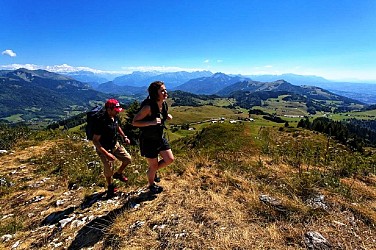
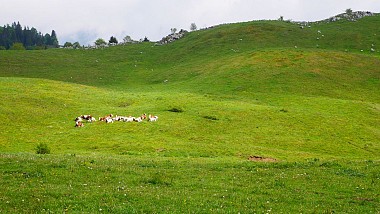
Walking around Bogeve

See more suggestions
Walks and hikes around Bogeve.
See more suggestions
Hiking trail - Alpine pasture secrets
3.1 km

Hiking trail - Alpine pasture secrets

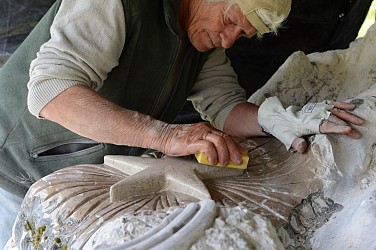
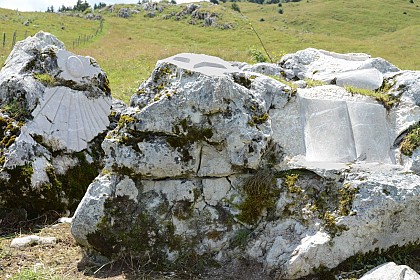
An easy walk to discover the sculptures of the Plaine-Joux Plateau, carved from monolithic blocks of marble limestone and arranged in a semicircle 100 meters apart from each others. During the first Plaine-Joux Plateau Sculpture Symposium in July 2012, four sculptors traveled to the plateau to work on their masterpieces, chiseling, polishing, and bringing them to life... in monolithic blocks of marble limestone placed 100 meters apart from each others. Roger Dunoyer's project: He began his work on the first block, whose meteorite shape inevitably suggested to him the birth of the world. A shooting star and its light cross the surface of the block, ending up at the center of the earth to put down a human fetus. Janpol's project: Since it was discovered X million years ago in the Baré cave, Janpol worked on a rock with a cave cat skull where it lived during the Paleolithic era, and on the second rock, a few engravings (in relief) that lead us to this more recent ancestor, the Homo sapiens. Isabelle Milleret's project: Her work was to highlight the symbolism of a place like Plaine-Joux : to create a crossroads in the form of a star or intersection of lines. Eventually indicating the north-south and east-west axes (compass rose) or the location of the four surrounding municipalities (Bogève, Mégevette, Onnion, Villard). Yann Narzabal's project: His work consists of expressing the sedentarization and settlement of humans from ancient times to the present day : the era when humans acquired the knowledge and techniques to build their homes as we know them today in the traditional architecture of our region. Carving a block of stone into a work of art, a phenomenal feat accomplished in a single day by these four sculptors ! Walkthrough available by clicking on the printer icon.

1 h
2.5 km
Very easy
Plateau de Plaine-Joux 74490 Onnion
Show
Miribel hike
3.6 km

Miribel hike

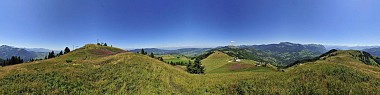
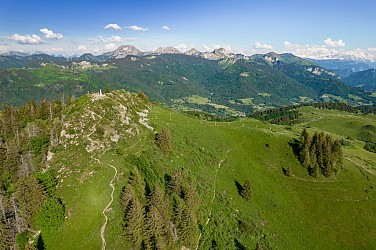
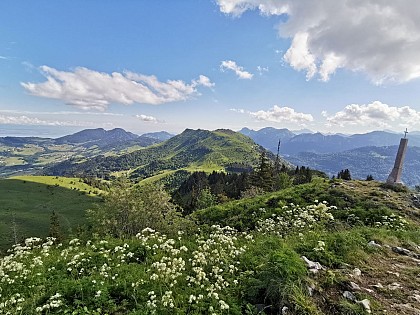
Hiking to the 1581m peak of the Pointe de Miribel takees you into the heart of the Valley's mountain pastures. A relatively level path with 360° views from Mont Blanc to Lac Léman and views of the Vallée Verte. Duration: 2.5 hours Difference in altitude: +150m Altitude at start point: 1200m Altitude at end point: 1581m Map reference: IGN TOP 25 - 3429 ET map Signage: PDIPR signs Difficulty: easy In toponymy, Miribel means "Beautiful view". In addition to the stunning views, this trail also has fascinating religious heritage. In 1774, Pointe de Miribel received an oak crucifix and neighbouring parishes came on pilgrimages here. The crucifix was knocked down during the French Revolution. In 1808, following a vow made during the French invasion of Russia, Joseph-Marie Félisaz from Villard sculpted 17 columns from blocks of red marble brought to him on site. Each column symbolising the Miribel cavalry, is topped by an iron crucifix. There’s a statue of the Virgin Mary at the top. Many pilgrims still travel this path during ceremonies. From Glappaz car park take the path up to Col du Creux. Then walk up to the Auberge de la Combe for a break. Walk up towards the hamlets of Frangles and Ajon. There’s a path to Pointe de Miribel on your right when you come to the first chalet in Ajon. Go back down the northern ridge to the Martinet meadow then the hamlet of Replan. The woodland path then takes you to the hamlets of Ervines and Combasseran before taking you back to the car park.

3 h
7.9 km
Medium
Alpage d'Ajon 74420 Villard
Show

What to do in Bogeve

See more suggestions
Organize your days in Bogeve with bookable activities for the whole family.
See more suggestions
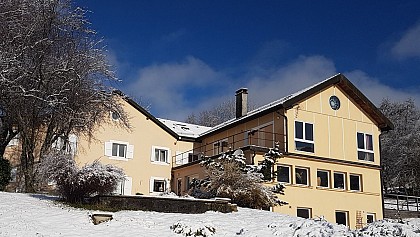
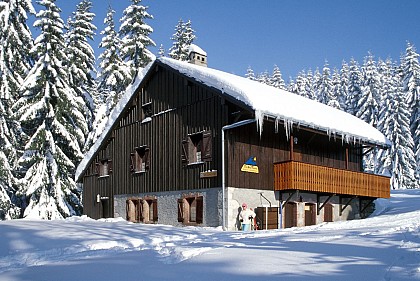
What to visit in Bogeve

See more suggestions
Experience the annual festivals of Bogeve.
See more suggestions
Sculpture symposium
4 km

Sculpture symposium

You may be wondering what these stone blocks carved on the Plateau de Plaine Joux? It is in this green oasis, that took place the first sculpture symposium of Plaine-Joux plateau July 2012. During the first Plaine-Joux Plateau Sculpture Symposium in July 2012, four sculptors traveled to the plateau to work on their masterpieces, chiseling, polishing, and bringing them to life... in monolithic blocks of marble limestone placed 100 meters apart from each others. Roger Dunoyer's project: He began his work on the first block, whose meteorite shape inevitably suggested to him the birth of the world. A shooting star and its light cross the surface of the block, ending up at the center of the earth to put down a human fetus. Janpol's project: Since it was discovered X million years ago in the Baré cave, Janpol worked on a rock with a cave cat skull where it lived during the Paleolithic era, and on the second rock, a few engravings (in relief) that lead us to this more recent ancestor, the Homo sapiens. Isabelle Milleret's project: Her work was to highlight the symbolism of a place like Plaine-Joux : to create a crossroads in the form of a star or intersection of lines. Eventually indicating the north-south and east-west axes (compass rose) or the location of the four surrounding municipalities (Bogève, Mégevette, Onnion, Villard). Yann Narzabal's project: His work consists of expressing the sedentarization and settlement of humans from ancient times to the present day : the era when humans acquired the knowledge and techniques to build their homes as we know them today in the traditional architecture of our region. Carving a block of stone into a work of art, a phenomenal feat accomplished in a single day by these four sculptors !

Plateau de Plaine-Joux 74490 Onnion
Show
Mount Vouan
4 km

Mount Vouan

Mont Vouan is a small mountain range with an altitude of 978 metres. Located between Les Brasses and Les Voirons, it is part of the Chablais Pre-Alps. Its distinctive feature lies in the siliceous nature of its soil, which has enabled nearly 600 plant species (some of them rare) to grow there. Its fauna is equally diverse: more than 200 species have been recorded, including mammals, birds, reptiles, fish, amphibians and insects. Historically, the site is famous for its millstones, a place where millstones were extracted for use in grinding rye, barley and other grains into flour. A one-tonne millstone could produce several hundred kilos of flour every day. It should be remembered that our ancestors ate more than a kilo of bread a day ! In the past, a millstone was worth the price of a house, so places were highly sought after. While not everyone could afford to cut a millstone, finding a place to cut it was even more difficult! The extraction of a millstone took place as follows: The millstone was marked out on the wall and a groove was dug around it. Fir wedges were driven into the groove and regularly wetted. The swelling of the wood detached the millstone by breaking the stone. The millstone extraction site at Mont Vouan was extremely important, as it was one of the largest in south-eastern France, producing more than 200,000 millstones from 72 quarries. At the foot of the Vachat millstones quarry lies the Pierre aux Morts or ‘Gouille aux Morts’ marsh, which serves as a reminder of how difficult it was to cut millstones, as the stonecutters often took great risks. The pond was named after the fall of two stonecutters while they were working on a Sunday (the Lord's Day !). Mount Vouan was also crossed by a smugglers' path. The smugglers brought wheat from the Pont Morand mill to Geneva and returned with alcohol, tobacco and other goods. Today, you can still see large round holes nearly 2 metres high in the rock where the millstones were extracted. They are part of the ancient Meulières à Vachat and Grand'Gueule sites, which have been classified as a ‘Historic Monument’ since 2009 and a ‘Sensitive Natural Area’ since 2017. PAYSALP offers tours for groups throughout the year. Information and reservations: www.paysalp.fr

74250 Viuz-en-Sallaz
Show

Where to eat in Bogeve

See more suggestions
The restaurants of Bogeve await you.
See more suggestions

Where to sleep in Bogeve

See more suggestions
Book a pleasant stay in Bogeve.
See more suggestions
Caution!
We have no information on the difficulty of this circuit. You may encounter some surprises along the way. Before you go, please feel free to inquire more and take all necessary precautions. Have a good trip! 🌳🥾