Alert

Alerts

To see around
See more
Open
Close
Show
Show
Show
Show
Show
Show
Show
Show
Show
Show
Show

Oups... It would appear that Cirkwi does not have permission to use your location.

Presentation
Description
Map
Steps
Points of interest
Ratings and reviews
See around

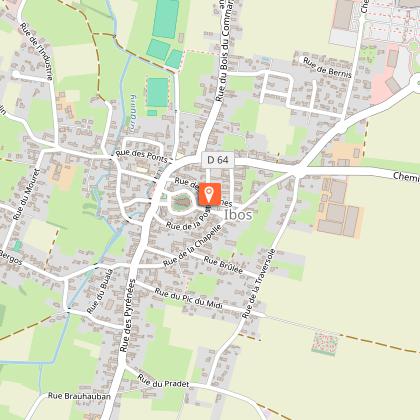
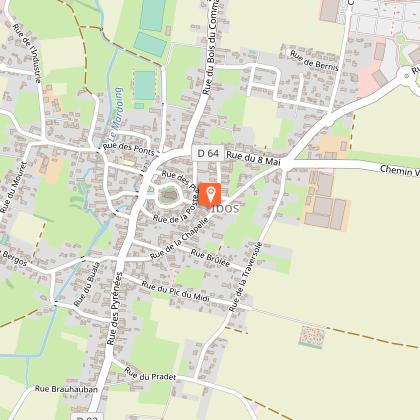
La villageoise: heritage trail in Ibos

Description

This trail enables wheelchair users and families with children in pushchairs to explore Ibos’s main heritage sites. At each point of interest, a signboard provides information on the heritage features in three languages, with a section specifically for children.

Technical Information

Walking
Difficulty
Very easy
Duration
1h (1d)
Dist.
1.1 km
Show more

Altimetric profile

Starting point

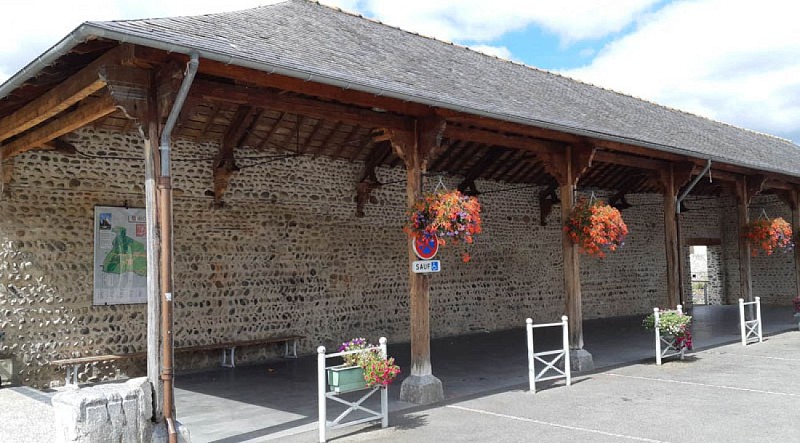
2 Rue de la Halle , 65420   Ibos
Lat : 43.23368Lng : 0.00123

Points of interest

image du object

The Hosanna Cross

The Cross of the Missions, known as the ‘Hosanna Cross’, erected in 1848 and restored in 2008, is the Christian symbol of the Passion of Christ. It features: - The cockerel, symbolising the denial of the Apostle Peter - The chalice bearing the monogram IHS (Iesus Hominum Salvator = Jesus, Saviour of mankind) - The inscription affixed to the cross by Pilate: INRI (Iesus Nazarenus Rex Iudaerum = Jesus of Nazareth, King of the Jews) - Veronica’s veil bearing the imprint of Christ’s face - The crown of thorns encircling a flaming heart, symbolising the love of Christ who died to save mankind - The sun, recalling that the sun was darkened at the very moment of Jesus’ death, and the moon, symbolising the eclipse that followed - The purse containing 30 pieces of silver given to Judas as payment for his betrayal - The hammer, the three nails of the crucifixion and the tongs used to take the body down from the cross - The hand of the guard who struck Jesus - Jesus’ tunic, and the dice with which the Roman soldiers cast lots for it - The ladder used to bring down the body of the crucified man - The sword with which Peter cut off the ear of the high priest’s servant; the spear that pierced Jesus’ side to ensure his death; the hyssop branch bearing, fixed to its end, the sponge soaked in vinegar intended to moisten the lips of the crucified man - The rope with which Judas hanged himself On the left arm of the cross, next to the hand, the basin with which Pontius Pilate washed his hands has disappeared. Source: Ginette Gaye

1bis Place de Verdun 65420 Ibos
- Mairie Ibos -
Consulter
image du object

St Lawrence Collegiate Church

The History of the Collegiate Church In the 11th and 12th centuries, there were several churches within the Ibos area, but Saint-Laurent was to become the most important and the centre of the parish. From that distant era, the church has retained a circular cemetery at its foot, a fossilised remnant of a churchyard that was exceptionally large for its time. Within this space, surrounded by walls and moats, the population could seek refuge in times of war. The last traces of the moats disappeared in the 19th century, but their presence explains the name ‘castle’ or ‘fortress’ once used to describe Ibos. This Romanesque church was very quickly replaced by a larger building, part of which remains in the nave. The six chapels, still visible today and situated between buttresses, make this church a collegiate church, that is to say, a place of worship served by a college of priests known as ‘prebendaries’. They derived their income from prebends, a collection of revenues derived from land and bequests made in wills. In Ibos, the date of this college’s foundation is unknown, but many such colleges appeared in market towns across the region during the 13th and 14th centuries. In 1342, Ibos became the seat of an archpriesthood, a religious district comprising numerous parishes. Around the same time, work began on the present choir with the aim of rebuilding the entire church.  Only the chancel was completed, with its large openings allowing for the installation of immense stained-glass windows. In the 15th and 16th centuries, the upper sections were rebuilt and fortified with a parapet walk. In 1569, during the Wars of Religion, the Catholic region of Bigorre was devastated by Protestant troops from Béarn, which was itself ravaged. The collegiate church of Ibos was set on fire and looted. In 1592, it was taken over by ultra-Catholic members of the League, who turned it into their fortified camp. When they were driven out, part of the vaults and defences were destroyed to prevent the site from being occupied again. The church was subsequently restored. The imposing bell tower, resembling a keep, actually dates only from the 1690s. During the Baroque period, a significant amount of furnishings was commissioned, of which a few elements remain. During the Revolution, the prebendary priests left the collegiate church, which subsequently became a simple parish church. During the 19th century, the Collegiate Church was restored with neo-Gothic elements; it was one of the first buildings in the Hautes-Pyrénées to be listed as a Historic Monument, in 1862. It still retains its former name of ‘Collegiate Church’ in memory of a prestigious past that lives on in its architecture.  The architectural features of the Collegiate Church The building is typical of the Languedoc Gothic style, with a very wide nave and buttresses between which chapels are situated; these chapels could have featured large windows divided by mullions and stone tracery. These openings, at the chancel end of the collegiate church, had largely been bricked up; all were restored in the 19th century. The cobblestone pavement Before entering the Collegiate Church, visitors can admire the forecourt, adorned with a cobblestone pavement (a pattern formed by multicoloured pebbles) signed by Guy ‘le Paveur’ and dating from 1875 (at that time, people still signed with their first names). The restoration of this paving was carried out in 1994 by the Adriana Agricultural Vocational College, which is located in our town, under the guidance of Mr Andrey Trey d’Ibos, a stonemason, using white and black pebbles collected from the River Adour by engineering students from ENIT in Tarbes. "Inside, the following features are worth noting: - The keystone of the choir, decorated with the figure of Saint Lawrence and coats of arms. - The imposing, curved high altar, crafted from various types of marble, created in the 19th century by the Bordeaux artist Jaboin. It is flanked by two adoring angels. - The numerous seats lined up along the choir walls and topped with wood panelling (17th–18th centuries). These were occupied by the archpriest, the priests of the Collegiate Church, other priests, choirboys and cantors… hence their large number.  The walls are adorned with several large 19th-century paintings, some of which are copies of well-known works based on engravings. They were painted by Lataste, an art teacher in Tarbes, and Father Pibou, a priest from Garaison. A smaller painting depicts the face of Christ on a cloth (the Holy Face). - The remarkable set of stained-glass windows featuring figures and architectural motifs, produced in the 1850s by the Goussard workshop in Condom (Gers). - The statue of Saint Lawrence, carved from wood, painted and gilded (17th century). Lawrence was a deacon in Rome under Pope Sixtus II (the statue is situated opposite). This saint was of Spanish origin; his veneration in Ibos highlights the importance of relations across the border. - The pulpit, carved from wood and gilded, adorned with medallions. It is attributed to Marc Ferrère, a member of a prominent dynasty of master sculptors from Asté. - The baptismal font, formerly a holy water font, made of Campan marble. - Each of the six chapels has an altar dedicated to a different saint (as do the stained-glass windows), which sometimes refers to the former trade guilds that existed in Ibos. Sources: Association Demain la Collégiale, Heritage class at Paul Éluard Secondary School, Stéphane Abadie, Thibaut de Rouvray. VISITS During town hall opening hours (Monday to Friday: 8.00 am–12.00 pm and 1.15 pm–6.00 pm), ask for the key at the town hall reception desk

2 Rue de la Collégiale 65420 Ibos
- Mairie Ibos -
Consulter
image du object

The churchyard

On a map or aerial view of Ibos, one can see the layout of the houses, arranged in a circle around the collegiate church and its oval cemetery, indicating a former ecclesiastical enclosure. Church enclosures first appeared in the 11th and 12th centuries in areas where rural communities and their property (such as livestock) could not be protected by the Count of Bigorre or his vassals. These enclosures, which also housed the cemetery, were inspired by the ‘Peace of God’ movement, which sanctified the space around churches by prohibiting armed men from entering them. In Saint-Laurent d’Ibos, the cemetery extends to a radius of around forty metres around the Collegiate Church. It is thought to correspond to an early form of the church enclosure, which was subsequently enlarged. The streets currently surrounding the site were originally ditches (featuring a filtration well that collected some of the water), which were only filled in during the 19th century. Here, in an exceptional case for Bigorre, the enclosure proved so attractive that it had to be enlarged on several occasions to accommodate an ever-growing population. A second circle was thus added to the edge of the first enclosure, consisting of two rows of houses separated by an inner lane, and which was itself fortified and surrounded by a moat. In the 13th century, Ibos was referred to as a *castrum* – a castle or fortress. In 1304, mention is made of a ‘barbican’, an advanced fortification defending access to the church enclosure and the church itself. It was large enough to accommodate the community’s meetings, where deliberations took place. These defences were destroyed from the 16th century onwards. Ibos is a special case in Bigorre: whilst many communities had an ecclesiastical enclosure (Azereix, Juillan, Lagarde… to name but a few neighbouring villages), Ibos is the only one whose town planning developed around its ecclesiastical enclosure.

16 Rue de la Collégiale 65420 Ibos
- Mairie Ibos -
Consulter

Data author

Image Mairie Ibos
proposed by Mairie Ibos
Place Verdun 65420 IBOS France

Ratings and reviews

To see around
See more
Open
Close
Show
Show
Show
Show
Show
Show
Show
Show
Show
Show
Show
Caution!
We have no information on the difficulty of this circuit. You may encounter some surprises along the way. Before you go, please feel free to inquire more and take all necessary precautions. Have a good trip! 🌳🥾