Alert
Alerts
Marseille City Hall
Description
🏛️ Marseille City Hall
The Seat of Local Power Overlooking the Sea Since the 17th Century
I. 📍 Location and Symbolism
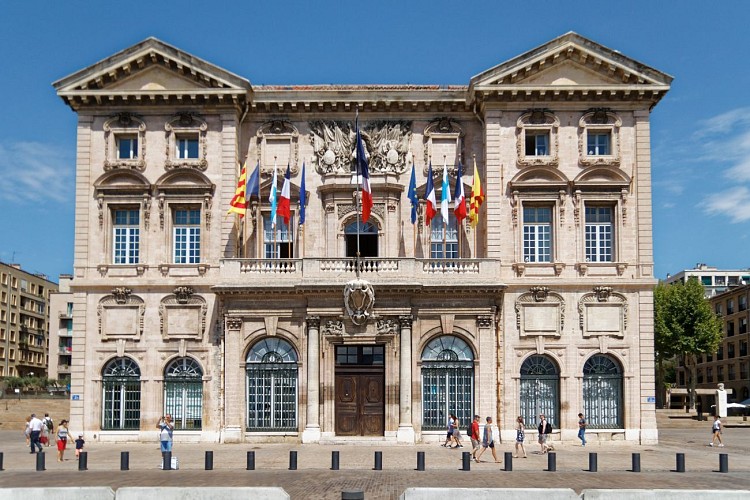
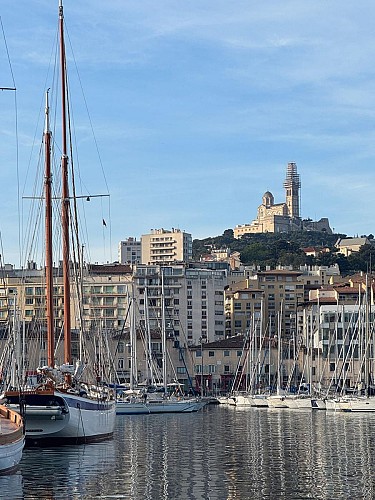
Marseille's City Hall is located on Place Bargemon, at the foot of the historic Le Panier district, directly facing the Old Port.
This was no random placement: its orientation was a deliberate political statement. Built starting in 1653, it was designed to mirror and rival the Arsenal des Galères—a military structure representing royal authority on the opposite side of the harbor.
Thus, the City Hall asserts the autonomy and pride of Marseille, a city often rebellious yet influential.
II. 🕰️ Site History: From Medieval “Loge” to Civic Palace
🏛 Before 1653: The “Maison de Ville”
As early as the 13th century, the site was occupied by the city's consular house, known as the “Maison de Ville” or “La Loge”.
It was both a commercial hub and a municipal office:
The ground floor served as grain storage to feed the population,
The upper floor hosted archives and council meetings.
📅 1653: Laying the First Stone
Gaspard de Villages, first consul of Marseille, proposed the construction of a new civic building.
The first stone was blessed on October 25, 1653 by Bishop Étienne de Puget.
🛠 Delays and Architectural Drama
Initial works were overseen by engineer Bilondelle, then taken over by Gaspard Puget (brother of famed sculptor Pierre Puget) and Mathieu Portal.
The project was plagued by political unrest and budget overruns, delaying its completion. The building was finally occupied in 1673, twenty years later.
III. 🎨 The Puget Pavilion: Genoese Façade, Marseillaise Identity
⚜️ Style and Materials
The Puget Pavilion, the main body of the building, is a prime example of Provençal Baroque influenced by Genoese architecture:
Façade built in pink stone from La Couronne,
Marble columns and balcony balustrades,
A large ceremonial balcony, often used for public proclamations.
Did you know? Although famous, Pierre Puget only contributed one element: the marble coat of arms beneath the balcony. The original now resides at the Museum of Fine Arts.
🏛 A Façade of Political Propaganda
Facing the sea, the City Hall's majestic façade was designed to showcase civic authority to arriving ships—equal in prestige to the King’s arsenal across the port.
IV. 🧩 A Stairless City Hall: The Mystery of the Suspended Bridge
🏗 Two Buildings, One Office
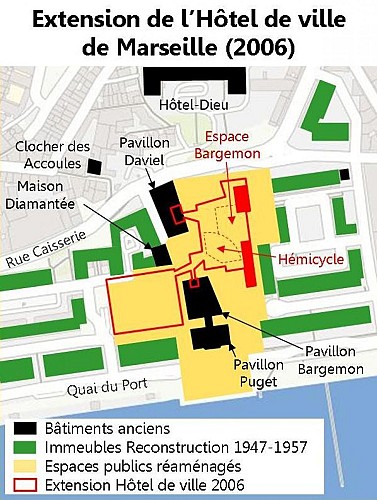
The City Hall comprises two separate structures:
The Puget Pavilion (facing the port),
The Bargemon Pavilion (facing the square).
There is no internal staircase in the Puget Pavilion. To reach the mayor’s office upstairs, one must climb the grand staircase in the Bargemon Pavilion and cross a covered stone bridge, built between 1782 and 1786 by architect Esprit-Joseph Brun.
Originally a wooden bridge, it reflects the old layout where the ground floor was commercial and the upper level administrative, with no direct connection.
V. 💥 Resisting Time and Conflict
🔥 Revolution and WWII
In 1794, suspected of hosting federalist rebels, the City Hall narrowly avoided demolition during the French Revolution.
In 1943, while Nazi occupiers razed the Old Port district, the City Hall was one of the few buildings to survive, along with the Maison Diamantée and Daviel Pavilion.
Fun fact: during the 1720 plague, the building served as a coordination center for the crisis.
VI. 🧱 The Bargemon Pavilion: Monumental from Within
Built in 1782, the Bargemon Pavilion was also designed by Esprit-Joseph Brun, but with a different approach:
Focus on interior monumentality,
Grand staircase made from Saint-Rémy stone,
Sculptures by Botinelli, Garbeille, and Chardigny,
Napoleon-era marble decorations (the “N” monogram was later erased during the fall of the empire in 1870).
Its exterior is made from Ponteau limestone, and the foundations from hard Cassis stone.
VII. 🛠️ 21st-Century Expansion: Underground City Hall
In 2006, architect Franck Hammoutène completed a massive underground extension of the City Hall:
Over 8,300 m² of space: council chamber, meeting rooms, exhibition halls.
A new public esplanade planted with 26 centuries-old olive trees, symbolizing Marseille’s 2,600-year history.
Integrated Roman thermal stone blocks unearthed during archaeological digs.
VIII. 👑 Political Nerve Center: Council Chamber and Mayor’s Office
💼 The Council Chamber (Puget Pavilion)
Displays the names of every mayor since 1789,
Historic red mayoral chair, once used by President François Mitterrand,
Sculptures of the four seasons, prestigious decorative arts, museum loans.
🖋 Mayor’s Office
A unique space for work and representation, furnished by the Mobilier National and adorned with both classical and modern art.
The desk was designed by Andrée Putman and Isabelle Hebey, and the decor includes works by Pierre Puget, Gilles Aillaud, John Levee, and more.
Anecdote: In 1965, a young Jean-Claude Gaudin celebrated his first wedding here. Thirty years later, he returned—as Mayor of Marseille.
IX. 🤓 Lesser-Known Facts
In 1747, Jacques Hardouin-Mansart de Sagonne (grandson of the architect of Versailles) proposed a new civic palace—never built.
The City Hall's twisted interior layout is due to a patchwork of 17th-century buildings gradually merged together. Even staff get lost sometimes!
The red chair of Gaston Defferre remains in the council room and is still used for ceremonial occasions.
Technical Information
Altimetric profile
Data author
