Alert
Alerts
Saint-Victor Abbey
Description
Saint-Victor Abbey
The Mystical Fortress of Marseille
Imagine an abbey built on an ancient quarry, transformed into a necropolis, then a spiritual beacon, a Revolutionary prison, a hay storage site, and finally a basilica… Welcome to Saint-Victor Abbey, one of Marseille’s most fascinating landmarks!
🏛️ Deeper Roots Than the Old Port
Before monks settled here, this site already teemed with life… and death. In ancient times, it was a Greek open-air quarry, later turned into a necropolis in the 2nd century BC. Located outside the city walls (as was required for burials), it became the final resting place of Victor, a Christian Roman soldier.
His fate was brutal: drawn, crushed under a millstone, then thrown into the port. And yet, his memory endured. A local cult grew around his tomb—and that was just the beginning.
✝️ Jean Cassian, Desert Monk and Spiritual Father
In the early 5th century, a monk from Egypt named John Cassian arrived in Marseille. Welcomed by Bishop Proculus, he founded a monastery near Victor’s tomb and introduced the monastic traditions of the Desert Fathers. Marseille became one of the earliest Christian centers in the entire Mediterranean.
The original church, built in 440, laid the foundations for the network of chapels, sarcophagi, and crypts we see today—although calling them “crypts” is actually a misnomer. They're the remains of that first basilica, carved into the bedrock.
🧱 An Abbey That Looks Like a Fortress
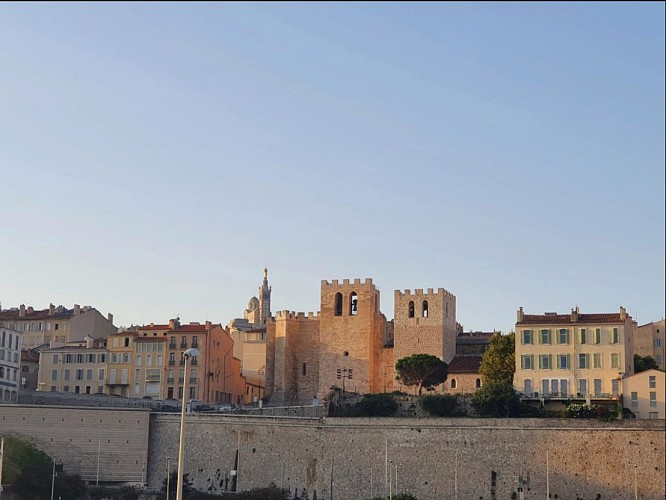
In the 11th century, the Catalan monk Isarn built the upper church and the now-famous Isarn Tower, which became an essential landmark for sailors entering the Old Port. The entire abbey was rebuilt in the Romanesque style during the 12th and 13th centuries. Later, under Abbot Guillaume de Grimoard—who would become Pope Urban V—the abbey was fortified and integrated into Marseille’s defense system.
👉 Fun fact: Saint-Victor Abbey once held spiritual and political power stretching from Catalonia to Liguria, making it a major monastic hub in medieval Europe.
💀 A Unique Underground World
Beneath the abbey lies its most haunting treasure: the crypts. These are the remains of the original basilica—and an ancient necropolis stacked with up to seven levels of sarcophagi, some of which have never been opened.
Must-see features:
The tomb of Saint Victor,
The mysterious Black Madonna, shown only once a year,
Ancient pillars, cut from the original quarry,
6th-century graffiti etched by pilgrims—some depicting little boats!
⚔️ Revolution, Ruin… and Revival
During the French Revolution in 1794, the abbey was stripped of its treasures, its relics burned, and its golden ornaments melted down to mint coins. It became a prison, a hay depot, and a barracks. Ironically, these roles helped save it from destruction.
Restored under Napoleon I, it was classified as a historic monument in 1997, and today, it's considered one of France’s most significant sites of Early Christian art, alongside the Louvre and the Museum of Ancient Arles.
🕊️ Candlemas: A Very Marseillais Tradition
Every February 2nd, Marseille celebrates Candlemas at Saint-Victor. At dawn, a procession leaves the Old Port, walks up Rue Sainte, and gathers on the abbey's forecourt.
There, the Black Madonna, dressed in her green cloak, is revealed and blessed by the archbishop—who also blesses the entire city. After mass, he visits the nearby Four des Navettes, where the city’s famous orange-blossom boat-shaped biscuits are blessed and shared.
🎶 And There's More…
The current church was designated a minor basilica in 1934.
Its organ, partly made of pipes from the 17th and 18th centuries, was lovingly restored in 1974.
Masses are celebrated daily.
The current priest is Father Bernard Lucchesi.
A nearby public parking garage (Corderie) makes visiting easy—even if you're on a NAVIA bike!
❤️ Final Thought
“Notre-Dame watches over the city, but it’s Saint-Victor that guards its soul.”
Saint-Victor Abbey isn’t just a monument—it’s a living root, a stone soaked in centuries, and a place where time stands still.
Technical Information
Altimetric profile
Data author
