Alert
Alerts
Laon Cathedral | Western facade
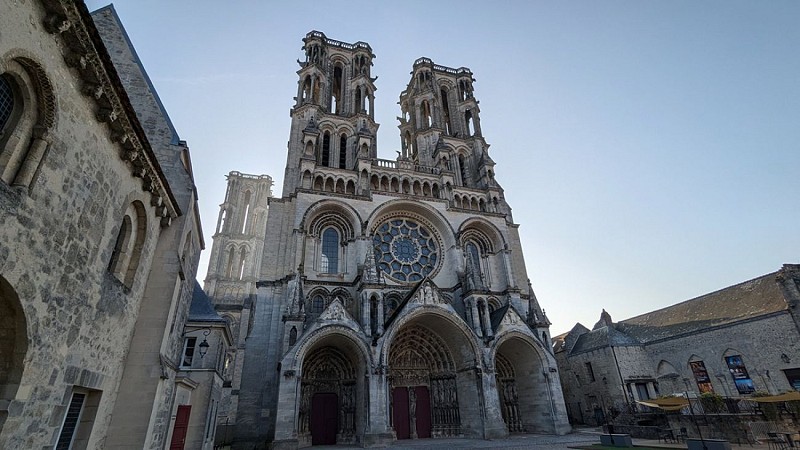
Description
The early Gothic age: the example of Laon
When work began on the Gothic cathedral of Notre-Dame de Laon in the early 1150s, other towns in Picardy had already started construction. These included Noyon and Senlis, which, after the abbey church of Saint-Denis, were the first to adopt the rules of Gothic architecture.
So what are these rules? They were characterised by a new desire for lightness, clarity and height. From then on, the architecture was based on the use of the ribbed crossing, which directs the thrust of the vault towards the pillars. As these pillars were themselves consolidated on the outside by buttresses and arches, the walls no longer supported the entire structure on their own. This makes it possible to create very high windows to let in the light.
Work on this cathedral began with the choir, completed in its first version around 1170, and the transept. It then progressed to the nave, and the western façade was completed, most probably before 1200.
The three portals on this façade are topped by sculpted triangular pediments known as ‘gâbles’. This is one of Laon's most original features, and one that cannot be found in any other cathedral of this period. It is also the only early Gothic building to have been designed with three facades with double towers, which served as a model for Chartres cathedral. In Germany, the cathedrals of Bamberg and Naumburg were also inspired by it.
Technical Information
Altimetric profile
Data author
