Alert
Alerts
Le Château de Princé
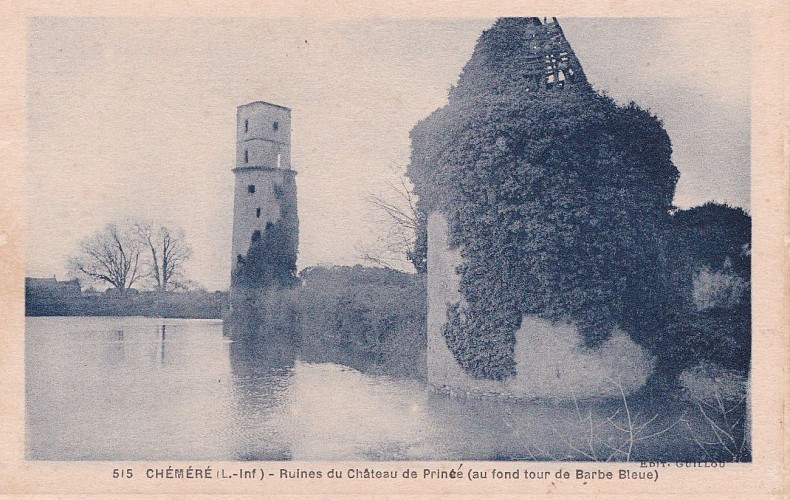
Description
In the seigneury of Rais
An early wooden fortification is thought to have been burnt down by the Vikings. Harscoët 1er de Sainte-Croix (circa 1010- circa 1070), Lord of Rais, founded the parish of Chéméré in the 11th century, and built a feudal fortress surrounded by a stone rampart.
The feudal castle surrounded by a moat belonged to Gilles de Rais (circa 1405-1440), who gave his nickname to one of the castle's five-storey towers, "Bluebeard's Tower", the ruins of which disappeared in the mid-twentieth century.
After Gilles de Laval, Baron de Rais, Princé became a residence and hunting lodge for the Sires de Rais. The Chauvigny, Tournemine and d'Annebault families also stayed here.
The fame of Princé
Claude Catherine de Clermont (1543-1603), Baroness of Rais, young and pretty widow of Jean d'Annebault (1527-1562), married Albert de Gondi (1522-1602) in 1565, with the consent of the French Queen Catherine de Médicis. The Barony of Rais became the County of Retz. The latter became the Duchy of Retz in 1581.
The Gondi family had a new Renaissance-style château built at Princé on the site of the old fortress.
In this new layout, the following will find their place:
vegetable garden,
fruit garden and orchard,
apothecary garden.
Henri de Gondi (1590-1659), Duke of Retz and Beaupréau, heir and grandson of Albert and Catherine, continued the development of the surrounding area with the gardens of the Enchanted Islands.
The ravages of war
At the end of the 18th century, the château was bought by Jean Guillon, equerry and secretary to the King, and rebuilt and modernised. A quadrangular belvedere was built over the high tower.
The building was partially burnt down by Republican troops during the Vendée Wars in May 1793 and left to rot.
A corner tower, known as "la chapelle", is still visible in the grounds.
As for the five-storey tower, it was destroyed during the Second World War by Resistance fighters for fear that it would be used as a landmark by German soldiers.
The estate is privately owned and cannot be visited. Only the ruins of the main building can be seen from the dead-end road.
Main source: "Châteaux et manoirs en Pays de Retz" by Emile Boutin, published by Siloë in 1995.
Technical Information
Altimetric profile
IGN cards





Data author
