Tours
Activities
Places of interest
Where to eat
Where to sleep

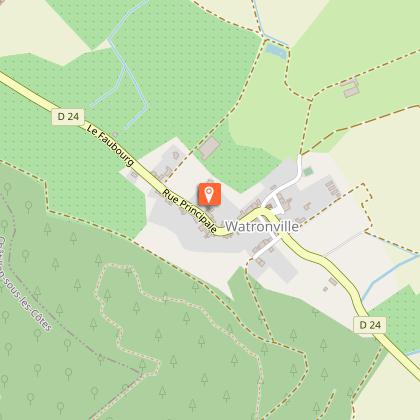
Discover Damloup, Meuse, Lorraine and its attractions

Are you in charge of the destination?
Nestled in the heart of Lorraine, Damloup is a charming destination where history and nature meet harmoniously. Nearby, visitors can explore the renowned Verdun battlefield, a historical site offering a profound dive into the past. Nature lovers will enjoy peaceful walks along the surrounding forest trails, perfect for hiking, cycling, or family picnics. Birdwatching enthusiasts will be pleased wi...See more

Walking around Damloup

See more suggestions
Explore the hiking trails around Damloup.
See more suggestions

Left bank : through the walking and cycling path
8.7 km

Left bank : through the walking and cycling path

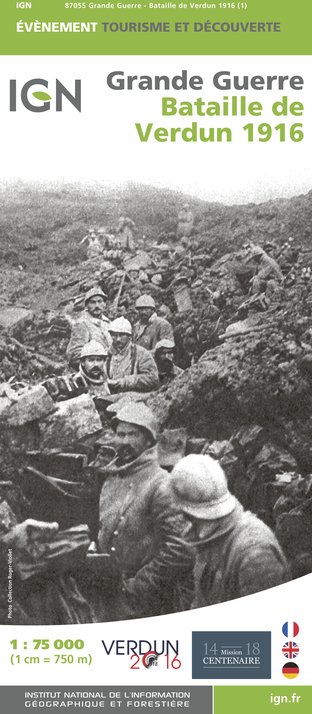
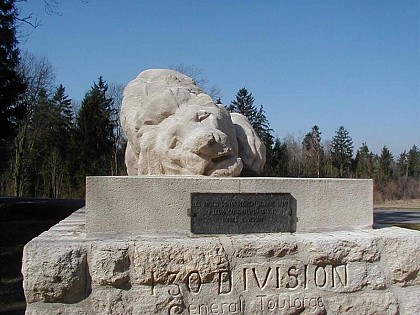
This tour allows you to discover the Left Bank and the beauty of the landscapes of the Meuse Valley along the canal. Dead man’s hill (Le Homme-mort) has suffered some of the most deadliest combats just as much as those on the right bank. Today, it is a pleasant wooded mound that you can enjoy visiting. This course is perfect for a first try of the electric bike. Easy and with little difference in altitude, it will be perfect for a nice stroll with family or friends ! Limited in supply and manpower, the Kronprinz army cannot attack simultaneously on both banks of the Meuse. In order to obtain better results on the right bank, C.Q.G. German prepared the second phase of its offensive whose main objective was to take control of the hills of Mort-Homme (Dead man’s hill) and the Côte 304. These two natural observatories regulated the fires of the French artillery; it is in fact a crucial stake for the offensive continuation. The fighting raged on there for weeks, destroying villages of Esnes-EN-ARGONNE and Chattancourt. Rapidly, the battle peaks became untenable volcanoes; suicidal assaults fade to move on to countless murderous gunshots . To protect themselves from bombing, both sides took refuge on the hillside, digging tunnels. On August 20, 1917, the generals Guillaumat and Pétain begin a to put victorious offensive which has the effect four German divisions attached to the sector Mort-Homme-cote 304 to flight. To the thousands of prisoners, material and armaments captured, must also be added more than twenty thousand victims whose units appear on the current monuments. In this inferno, the village of Cumières will disappear completely and will never be rebuilt.

4 h
48 km
Easy
1 Rue René Panau 55100 Verdun
Show

What to do in Damloup

See more suggestions
Find the best activities in Damloup and book easily online.
See more suggestions
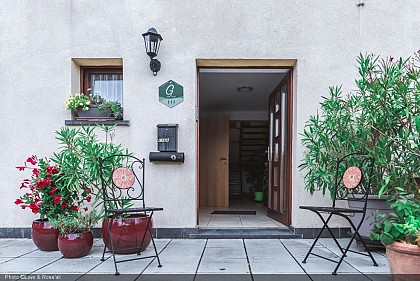
What to visit in Damloup

See more suggestions
Savor the local cuisine of Damloup.
See more suggestions
Destroyed village of Vaux devant Damloup
1.8 km

Destroyed village of Vaux devant Damloup

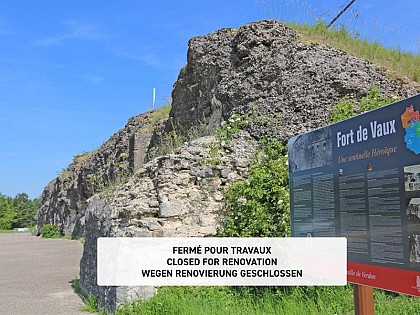
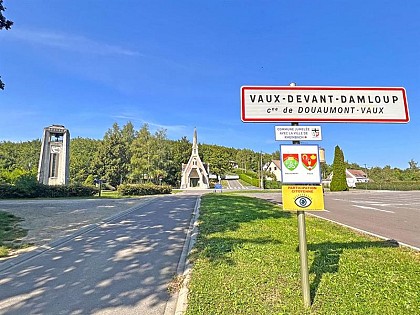
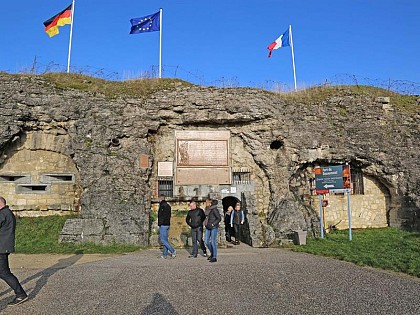
Vaux-devant-Damloup is a unique destroyed village since, being at the edge of the "red zone," it has managed to gradually rebuild a new small village close to the old destroyed village, which shares the same characteristics as its eight unfortunate companions. Belonging to the Chapter of Verdun before the Revolution, it has always been a prosperous village throughout its history. The presence of Fort Vaux nearby has always somewhat disrupted the village's history. Indeed, from its construction between 1881 and 1884, the village was heavily involved in accommodating the numerous workers rotating through; similarly during the significant reinforcement works undertaken on the Fort from 1888 to 1912. In 1915, the decision by the general staff to partially disarm all the forts transferred the defensive effort particularly to the villages. Thus, Vaux, located to the north of its Fort and in contact with the Woëvre plain, naturally became an important point in the defense system of the Verdun entrenched camp. During the great German offensive launched at the end of February 1916, it became one of the major German objectives after the capture of Douaumont, which fell on March 2, and before the capture of Fort Vaux. After fierce fighting within its walls, the village fell into German hands on March 31, 1916. The French bombardments of April then followed the German bombardments of March, only intensifying the complete annihilation of the village. After the village fell, the 50th German division hastened to seize Fort Vaux, which heroically resisted from June 2 to 7, 1916, under the command of Commander Raynal. This tragic episode became a forever famous feat of arms, as the garrison, running out of drinking water and fighting in the fort's galleries for days, eventually surrendered to the Germans, who, admiring the bravery of the surviving soldiers, decided to grant them military honors upon their exit from the Fort. In 1918, the village of Vaux-devant-Damloup found itself within the limits of the infamous "red zone," prohibiting any reconstruction. In 1919, it was also listed among the destroyed villages and, during the interwar period, its war memorial and the Saint Philippe and Saint Jacques shelter chapel were built, similar to the other eight destroyed villages. However, its location at the edge of the zone and the presence of the Eastern Railway Company's railway, which obtained permission to house its ten service agents on the site of Vaux-devant-Damloup, allowed the village to gradually regain new life over the years, starting from the interwar period. It now has a very active life oriented towards the future, especially the Internet, while not denying the tragic past of the old destroyed village, still present at its doorstep and in the memory of its 70 inhabitants. To see: The Saint Philippe and Saint Jacques shelter chapel; The war memorial in honor of the soldiers who died in Vaux (it bears the inscription: "They shall not pass"); Fort Vaux; The Vaux pond; The war memorial of the 1st Battalion of Foot Chasseurs near the pond; The memorial stone for the aviator Dussumier-Latour, shot down on June 2, 1916, on the pond's dam.

55100 DOUAUMONT VAUX
Show
Destroyed village of bezonvaux
4.3 km

Destroyed village of bezonvaux

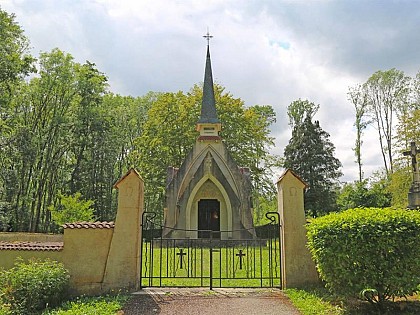
Due to ash dieback, some trees and branches in the Verdun Forêt d’Exception® are weakened and pose a risk of falling. As a safety measure, several areas are now closed or should be avoided. For more information: www.tourisme-verdun.com Essentially rural, with a population of 149 inhabitants in 1913, mainly farmers, beekeepers, or small shopkeepers, the village of Bezonvaux still had a château at the outbreak of war in 1914. The German advance to the Meuse in 1914 initially led the population to desert the village. However, as the front stabilized further north, they returned at the end of 1914 and in 1915, despite some sporadic German shelling from Ornes. They were joined by numerous military personnel passing through or stationed there, such as Sergeant André Maginot, the famous Minister of War appointed in 1922 and again in 1929, who set up his patrols there. The villagers had to leave definitively shortly before the Battle of Verdun. After the massive German attack launched on February 21, 1916, the French troops fighting in Ornes retreated to Bezonvaux on February 24. The next day, on February 25, the 4th Battalion of Chasseurs à Pied and the 44th Infantry Regiment, tasked with its defense, desperately buckled under the violent assaults of German artillery and then infantry, which took possession of the devastated village while the French soldiers retreated to Fleury. The village remained under German control until mid-December 1916. Indeed, on December 15, 1916, a French attack by the 2nd and 3rd Zouaves and the 3rd Algerian Tirailleurs, advancing from the east of Fort Douaumont, assaulted Bezonvaux, where the front stabilized for the last two years of the war. The village continued to suffer from more or less intense bombardments during this final period, which saw the destruction of both its imposing château and its modest houses. In 1918, classified as a "red zone," it no longer allowed the reconstruction its inhabitants might have dreamed of after the war. Its specific status as a destroyed village, decreed in 1919, enabled a new beginning solely dedicated to memorial work, notably with the construction of its Saint Gilles shelter-chapel and its war memorial. During World War II, it once again witnessed violent battles on June 14, 1940, in its area where the 132nd RIF managed to halt the German invader's advance for a few hours, inflicting heavy losses. Today, the memorial work conducted there has established a very interesting historical trail presenting the village's life in the past. To see: The Saint Gilles shelter-chapel (commemorative stained glass windows by Gruber, immortalizing the liberation of Bezonvaux by the chasseurs of the 102nd BCP, later nicknamed "the glaziers of Bezonvaux," on December 16, 1916, and a fresco by painter Lucien Lantier) The destroyed village monument (obelisk engraved with the citation awarded to the martyred village. Bas-relief showing the village's main street before the war) The helmeted marker on the roadside through the village, marking the front line until the Armistice on November 11, 1918 The Maginot patrollers monument Historical trail showing the locations of old houses and past activities.

55100 BEZONVAUX
Show
Fortified massif of Souville
4.3 km

Fortified massif of Souville

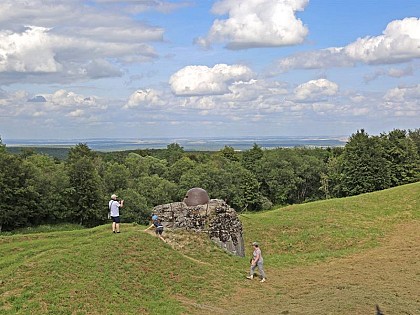
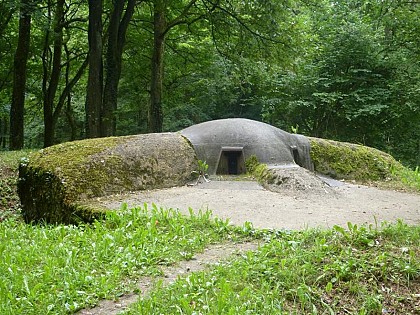
A major "first generation" fort built after the Franco-Prussian War of 1870-71, Souville only received concrete protection for its powder magazine, with the rest of the structure being masonry covered with earth, making it terribly vulnerable to large German shells. Although Souville never received Bourges Casemates for flanking fire, it was reinforced in 1890 with the installation of the prototype Bussières retractable turret, armed with two long 155 mm cannons. Unfortunately, the explosion of one of them in April 1916 meant that the turret served only as an observation and command post for the rest of the battle. While possession of the fort was crucial for the French, its capture would also allow the forces of the Crown Prince to take advantage of a final opportunity to advance unopposed into the city. The center of Verdun. On the morning of July 11, the 3rd Company of the 7th Infantry Regiment, commanded by Second Lieutenant Dupuy, entered the fort and found the survivors of the garrison practically incapacitated. The arrival of fresh troops revived the spirits of those who had not been wounded, and the defenses were put back in order. On the slope outside the fort, other elements of the 7th Infantry Regiment gave way under the fierce assault of the Germans, but fortunately, the enemy did not make significant progress before being stopped by the machine guns of the 7th, firing from the roof of the fort. The next day, Souville remained under harassing fire from German artillery, but the crisis had passed and the defenders of Verdun were able to catch their breath. Accessible by gravel paths, the fortified site of Souville today allows visitors to examine remnants such as the Batterie de l'Hôpital, the Pamart Casemates, and the roof of the fort, not to mention the unique Bussières turret. More than just a fort, Souville corresponds to a true fortified massif comprising several elements: Fort: An organic garrison (2 infantry companies and 2 artillery sections) Shelter-cave for 300 men A retractable turret for two 155 mm cannons A terraced fortress battery of 155 mm, located 100 meters from the retractable turret Communication network via trenches. Practical Information: Pedestrian access to the fort Entry into the fort is prohibited

55100 FLEURY DEVANT DOUAUMONT
Show

Where to eat in Damloup

See more suggestions
Savor culinary specialties in Damloup.
See more suggestions
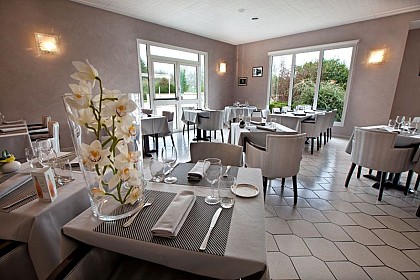
Where to sleep in Damloup

See more suggestions
Discover popular accommodations in Damloup.
See more suggestions
Caution!
We have no information on the difficulty of this circuit. You may encounter some surprises along the way. Before you go, please feel free to inquire more and take all necessary precautions. Have a good trip! 🌳🥾