Tours
Activities
Places of interest
Where to eat
Where to sleep

Experience Marseille with Marly Parc SAS

Are you the owner?
Nestled in Marseille's 9th arrondissement, Provence-Alpes-Côte d'Azur reveals its treasures around MARLY PARC SAS. Begin with a visit to the Calanques National Park, where hikes and panoramic Mediterranean views await. Explore the stunning En-Vau cove, ideal for swimming and snorkeling. Not far away, the charming Vallon des Auffes offers an authentic Marseille experience with its small quays and s...See more

Walking around MARLY PARC SAS

See more suggestions
Enjoy pleasant walks in MARLY PARC SAS.
See more suggestions
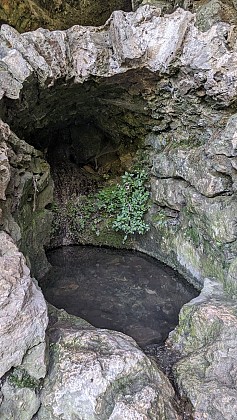
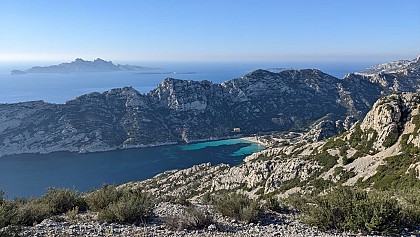
A hike throughout Voire fountain and dead man summit
1.1 km

A hike throughout Voire fountain and dead man summit

This challenging hike allows you to discover several sites such as the Voire Fountain, the Dechaux Cave, the summit of the Dead Man's Plateau, and the Selle Woods. The trails are steep, but the efforts are rewarded with a sublime 360° panoramic view and the discovery of lesser-known places by hikers. Access to the starting point of the hike is by a regular bus from the RTM (line 23). Get off at the "Sormiou shopping center" stop. After taking a few steps, turn right onto Boulevard Louis Pierotti. Continue straight until you reach a green barrier marking the beginning of a DFCI track. Go around it and continue straight following red markings that lead through the wooded valley of La Jarre. (1) Until you reach the Voire Fountain. (2) You begin your first ascent into a narrow gorge that opens up into a clearing shaped like a small circus. Take a left and follow the yellow markings that lead you onto a path that climbs even more steeply. It skirts around a rocky ledge where two large openings can be seen. This is the Dechaux Cave. (3) Continue your ascent. At mid-height, your efforts are rewarded with a clear view of the Frioul archipelago, the beaches of Prado, Borély Park, the Orange Velodrome, and Notre-Dame de la Garde. Upon reaching the highest point of this climb, you enjoy a good view of the Cayolle district, the sewage treatment plant, and in the distance, Mont Puget and beyond, Mont Carpiagne. Not to mention further away, the Soubeyranes cliffs in Cassis. The route continues and takes you to the next steep section. At the intersection, turn right to stay on the yellow trail. You reach a height that still offers a beautiful view of the Cayolle and Panouse districts, and more generally over the entire eastern part of Marseille. Continuing on, the view opens up even more and allows you to identify landmarks such as Mont Puget, Grande Candelle, Devenson Cliffs, and far away, Cap Sicié. You leave the height to weave between pine trees forming a refreshing undergrowth, where you come across a path marked by a green trace. Stay on the yellow trail which quickly climbs again and allows you to see the beginning of your hiking route, especially the steep path that skirts the Dechaux Cave. The ultimate reward is not far now. The yellow trail joins the blue trail to take you to the western summit of the Dead Man's Plateau. (4) It's time to take out your sandwich from your backpack and take a break. The view is breathtaking. This time you have reached the roof of the Calanques. Do a 360-degree turn to sweep your surroundings. No summit can escape you: Garlaban, Mont Carpiagne, Mont Puget, Pic de Bertagne overlooking the Sainte-Baume massif in the distance (topped by a white dome housing a radar and radio station), Grande Candelle, the islands forming the Riou archipelago, and the Marseilleveyre summit. Leave the plateau following the blue markings. The hike takes you down a rocky ledge. In places, the limestone rock is smooth and gravel can make you slip in this tricky passage. Use your hands to descend cautiously. A few meters before the Col de la Selle, in a wooded area, leave the blue trail to now follow the green markings which take you down to the right towards the Selle Woods. The next landmark will be a crossroads in the middle of the woods with several trails (black, red, green, and yellow). Continue your descent following the yellow and red markings. The red is the last color that brings you back to the starting point of this beautiful loop. So don't miss the last fork, where the yellow and red markings separate. A final small climb offers a beautiful overhanging view of the Frioul archipelago, the Pointe-Rouge port, the wooded areas of the Campagne Pastré, and notably the Pastré Castle. (5) A little further on, a wall may intrigue you. (6) A quick glance at the Aigle mountain (located between the wall and the city). Pass between two cairns and continue your descent towards the Voire Fountain. Nice view of the Dechaux Cave and the cavern of the Voire Fountain. You find the beginning of the trail you took earlier. Take it back in reverse to finish the hike.

3 h
7.3 km
Medium
122 chemin de Sormiou A l'arrêt de bus "Centre Commercial Sormiou" 13009 Marseille
Show
Hiking from Luminy to the Sugiton belvedere
2.7 km

Hiking from Luminy to the Sugiton belvedere

An easy stroll to the Sugiton belvedere, from where you can see most of the Calanques. Suitable for an all-terrain stroller. Ideal for walkers who don't like big differences in altitude, or who don't have much time, but still want to discover the Calanques on foot. Whichever means of transport you use (bus, bike or car), the hike starts in front of a gate that gives access to the Luminy estate. Have you brought enough water? No ? Then take advantage of the fountain a few meters behind you, under the trees, to fill your water bottle. The hike starts in the heart of the Luminy campus. At the end of the Second World War, the Luminy estate came under state ownership. While preserving the natural character of the site, the 1960s saw the development of a campus at its center, while the outlying areas were handed over to the City of Marseille in 1963 for leisure and recreation facilities. Designed by René Egger, the city's official architect, the campus was inspired by Anglo-Saxon models and adapted to the constraints of the site, between natural heritage and relative isolation. The École d'art et d'architecture, with its patios, galleries, calades and pilings, was recognized as a twentieth-century heritage site in 2007. In September 2023, the École Nationale Supérieure d'Architecture (ENSA) left its historic site, inaugurated in 1968. The 7,000m² available are now looking for a new vocation. Today, the entire facility is home to some 10,000 people, including students, professors, researchers and contractors. At the start of the walk, you pass through a beautiful wooded area with century-old trees. In the past, Luminy and Sugiton were part of the same forestry and agropastoral estate. The slightly uphill path culminates at the Col de Sugiton. Then fork right and the trail (1) takes you to the foot of the belvedere, where it ends. The reward is a 360° panoramic view (2) of the Calanques, Cap Canaille, the fishing hamlet of Morgiou (3), the Riou archipelago jutting out over the ridges, Mont Puget, the cliff of the roofs (4) and the infinite beauty of the Mediterranean Sea. During the Calanque de Sugiton quota period, this itinerary remains accessible and is not affected by the access reservation. To return, simply follow the same itinerary in the opposite direction.

5 km
Very easy
5 171 avenue de Luminy 13009 Marseille
Show
A stroll between land and sea at Pointe-Rouge
2.8 km

A stroll between land and sea at Pointe-Rouge

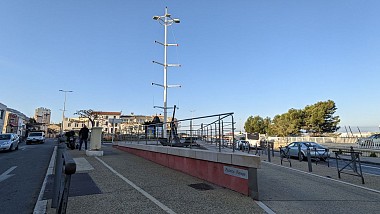
This is an urban stroll to discover the assets of the Pointe-Rouge district. The promenade offers two simultaneous atmospheres: the hustle and bustle of the seaside with its marina, beach and shops, and the tranquility of the wooded areas of Parc Pastré. The walk starts at the "Tiboulen" bus stop, served by line 19. Walk along the seafront to reach a staircase leading to the Pointe-Rouge beach(1). Walk towards the seawall, then when you come to the ASPTT building, walk along it to the left. At the intersection, turn right down the street. In front of the YCPR yacht club, turn left into "Port de la Pointe-Rouge" (2). At the next intersection, turn left and follow the sign "accès plage et commerces". Climb the stairs in front of you to reach Avenue d'Odessa. Then turn right. You'll pass a fire brigade barracks and then the municipal open-air swimming pool. On the right are the remains of a Südwall bunker (3). A little further on, there's a promontory with a view of the deep blue sea, the Mont-Rose hill (in the distance on the left) and, above all, two bathing creeks with cabins. L'anse des Phocéens, home to the men's bath (right) and the ladies' bath (left). Continue across the street to Boulevard Delpin, which you'll have to walk up to the end. Opposite you is Place Engalière and the church of Sainte Eusébie(4). It bears a strong resemblance to the Cathedral de la Major, which gives the impression of being miniaturized. Go up the street called "place" Engalière to enter a public garden and follow the path to the left. Then turn right to walk under the pine trees and go straight up. You're in the heart of the Campagne and Parc Pastré (5). Follow the path along the fence of the equestrian center to the first pool. Go around the basin to the left and walk along the Canal de Marseille (6). The canal winds its way to the sumptuous Château Pastré (7). Walk back down the main alley to the intersection with the Canal de Marseille, which you follow to the right (8). When you reach the small house, turn left to go around a second small lake in a clockwise direction. Return to the canal and follow it to the left. When you reach a wider path, turn right to go up a little, then left to continue along a line almost parallel to the canal route. When you again reach a wide track, descend to the left to reach the top of the Parangon traverse (9). Pass the Emmaüs Pointe-Rouge Community (10) and, if it's open, come on in! Reach the traffic circle in front of Lycée Marseilleveyre (11), then continue left along Avenue du Corail. On your right, at the foot of the hill, you'll see a navigation bridge and the elements usually found on a large merchant ship. This is the flagship building of the Ecole Nationale Supérieure Maritime (12). Finish your stroll by walking down the traverse Prat to the avenue de Montredon and a square lined with shops and restaurants (13).

5.6 km
Very easy
9 Avenue de Montredon 13008 Marseille
Show
Urban stroll: a veritable green corridor between the Saint-Giniez, Bonneveine and Mazargues districts
3.2 km

Urban stroll: a veritable green corridor between the Saint-Giniez, Bonneveine and Mazargues districts

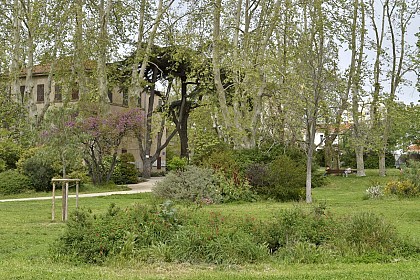
This tour, which can be done on foot or by bike, takes in some of Marseille's neighborhoods, which are home to a number of sites well worth a visit. The route is particularly pleasant in hot weather, as it is shaded. The starting point is a bridge at the beginning of impasse René Magnac (1). You'll walk alongside the sports complex named after the former president of the ASPTT club, who did a great deal for its development. You enter the Avenue de Mazargues and continue along a greener stretch of road, until you reach the back of the building housing the Ballet National de Marseille (2) and the Parc Henri Fabre (3). Continue along the original Huveaune riverbed to reach the main entrance to Parc Borély (4). Admire the view of the château (5). Pass through the gates and continue left to reach the rose garden. Pass under the imposing, majestic plane tree to reach the island of the former "Pavillon du Lac" establishment. Leave the island and head for the entrance to the botanical garden (6). If you've taken the necessary steps to reserve your entrance (it's free, but must be reserved in advance), you'll be in for a complete change of scenery. After this detour, walk past the Bird Man fountain to reach the children's play area. A gate leads from Parc Borély to Avenue Clot-Bey. Cross the avenue and continue along the narrow traverse Paul, which zigzags between properties. Fence walls protect some beautiful homes from view. You finally come to Rue Albert Dubout and, at the end, turn right down Avenue d'Haïfa. You'll come to the [mac ]musée d'art contemporain (7) and the Pouce de César (8). Via avenue de Hambourq, you'll reach the central Bonneveine park (9), where you'll also find some monumental works of contemporary art. Continue through the park to skirt the grounds of the Horticultural Society and Parc Bortoli (10). You've reached the end of the route. You now have several options: Continue the tour to discover the Mazargues district, take the 22/22S buses back to the rond-point-du-Prado, or take the 45 bus that brings you closer to the seaside, the Pointe-Rouge district and the Pastré countryside.

2 h
4.6 km
Very easy
88 Boulevard Michelet Au début de l’impasse René Magnac 13008 Marseille
Show
Hiking from Notre Dame de la Garde, to Roucas Blanc and Corniche
5.6 km

Hiking from Notre Dame de la Garde, to Roucas Blanc and Corniche

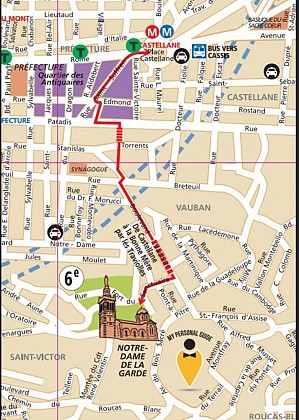
After visiting Notre-Dame de la Garde, explore the Roucas Blanc. This district, a real maze of narrow streets, can only be visited on foot and offers magnificent views of the city. The Roucas Blanc hill was also a place of free expression for 19th-century Marseilles Rocailleurs: craftsmen, masons and ornamental designers, some of whom were quite singular. Their creations can be found in the dreamy gardens of the neighborhood's opulent homes. Via uphill crossings and sloping alleyways, you'll reach Corniche Kennedy and Plage du Prophète. Its fine sand and turquoise waters are the perfect reward after a fairly strenuous walk. This really is the most stunning urban stroll, so we invite you to look at your surroundings with curiosity and care. At the foot of Notre-Dame de la Garde, as you look out towards the sea, there's a staircase leading down that you have to take. This is the Montée du Commandant Valentin and the start of the itinerary (1). Go down to the first crossroads with a house, where you turn left, the start of the traverse du Génie. A blue mark indicates the way. Then turn left on a path that slaloms between the agaves, the Chemin du Bois Sacré (2), which joins the street of the same name, which continues on the Chemin du Roucas Blanc down to the Place du Terrail (3). Turn right onto Avenue des Roches (4 and 5) to number 77b. Here, on your left, a staircase leads to rue Colline Chanot, which you must take up to the junction with traverse de Roux, on your left. At the next intersection, turn right into rue Emile Duployé to number 45. On your left, you'll find a steep, narrow staircase to climb: montée des Croquants (6), which leads to chemin du Souvenir. Catch your breath and follow it to the right (7). The path ends in front of the gate of the Buenos-Ayres villa, and you descend a staircase to the right which joins the Nicolas traverse. Take a few steps to the right to admire a tower (a dovecote?) and, above all, the Villa Maraveyre, whose slate roof contrasts with the tiles more typical of our region. Continue along the Nicolas traverse to the Napoule staircase on the left. Admire the rockwork (8) that replaces the classic white-edged blue street name signs (9) and (10). Descend the staircase until you can turn right up the montée de la Rotonde. Admire the view of the Mediterranean through the large rockwork portholes cut into the cement and complete your itinerary, which leads to the Corniche, opposite the Plage du Prophète (11). From the Corniche Kennedy, a bus line takes you to either the Rond-Point du Prado or the Vieux-Port.

45 min
1.9 km
Easy
Départ Notre-Dame de la Garde 13006 Marseille
Show
Stroll through the Saint-Pierre district
6 km

Stroll through the Saint-Pierre district

This walk takes you through the peaceful Saint-Pierre district, in the heart of the city of Marseille. It's best known for its cemetery, established in the mid-19th century. Today, families love the area, which boasts schools, numerous shops, a village atmosphere and good transport links (tramway, metro, bus and main roads). The starting point for this exploration of the neighborhood is the "Sainte-Thérèse" streetcar stop, on the T1 line towards "les Caillols". Follow Boulevard Sainte-Thérèse until you reach the rear of the Saint-Pierre church (1). Join the church square and admire the Art Deco facade on your right. At the corner of the square, turn right into rue Pascal Ruinat, which leads to the Louis Loucheur housing complex (2). After crossing the housing estate, whose facades are painted in a monochrome of orange, follow the railroad tracks to reach boulevard Daumas. At the end, turn right under the arch. You're now on the chemin de Saint-Jean du Désert. When you reach the traffic circle, turn left onto boulevard Jeanne d'Arc and walk back towards the railroad (3). You'll pass the Cristal Limiñana company (4) and the cabaret l'étoile bleue (5). Continue straight ahead on boulevard Jeanne d'Arc (6) until you come to the church of Saint-Pierre, then turn right. Rue Ruinat (7) leads to Rue Saint-Pierre (8). If you're observant, you'll notice that the Saint-Pierre district is home to many small buildings with tiled roofs, representative of traditional Marseille architecture. Turn left into rue Saint-Pierre and drive 300 meters to the main entrance to the cemetery (9). It's like entering a hemicycle extended by a vast magnolia-lined avenue. On either side of the alley are the tombs of the Marseilles bourgeoisie, who made Marseilles famous from 1850 onwards (10). Walk straight ahead to reach a little-known site: a military crypt (11). Continue straight ahead until you reach the 4th intersection (12), then turn left until you reach the depository. Turn right and climb the stairs. On the way, you'll come across several remarkable graves (13) and (14). Go straight on until you reach a staircase, then turn left to reach a secondary gate which takes you out of the cemetery. Go left down rue Saint-Pierre until you reach the remains of an aqueduct on your right (15). Continue straight ahead, skirting the streetcar tracks (16) and (17). The walk ends at the "Saint-Pierre" stop on tramway T1, which takes you back to the city center.

2 h
3 km
1 rue Moreau Point de départ : en sortant du Tramway T1, arrêt Sainte-Thérèse 13005 Marseille
Show

What to do in MARLY PARC SAS

See more suggestions
Relax and have fun with the available activities in MARLY PARC SAS.
See more suggestions
La Cité Radieuse (residential complex)
2.5 km

La Cité Radieuse (residential complex)

It is the work of the Swiss architect Charles-Edouard Jeanneret, better known as Le Corbusier. It is the work of the Swiss architect Charles-Edouard Jeanneret, better known as Le Corbusier. This impressive structure, 165 meters long, 24 meters wide and 56 meters high, was built between 1947 and 1951. Its layout is intended to suggest an urban steamboat anchored in a park. Powerful elements such as the unsurfaced exposed concrete, pilings and blank gable walls are combined with other more sophisticated aspects, such as the subtle arrangement of the multi-coloured loggias, or the superstructures on the terrace roof. This plastic richness, typical of the great architect, associates visual effects with technical organisation that was exceptional at the time. This laboratory for a new "housing system" comprises 337 flats, with 23 different layouts, providing comfortable living spaces for between one and 10 people. The most typical layout is designed for 4 people. It is a duplex on two levels. On one level it takes up the whole width of the building, with a large volume for the living room. A glass panel opens the double height living room onto a balcony. In addition to these technical refinements, numerous extensions of the living space were introduced, designed to induce a new way of living in collective housing: an indoor street with shops, and a hotel for resident's visitors and family members. On the top level is a nursery school and gymnasium. Finally, the terrace roof provides an area for relaxation with a children's paddling pool, play areas and a stage sheltered by a wind-break for open air shows. Ignoring the mockery summed up by the term "Maison du Fada” (The Crackpot's House), its inhabitants adore the Cité Radieuse. Several flats are still inhabited by the original residents of 1952, and many others have attracted a clientele of well-to-do teachers and architects. It even gained acceptance, since Le Corbusier built other “cités radieuses” in the 1950s based on the Marseille model.

280 Boulevard Michelet 13008 Marseille
Book from 0 €Book
Show

What to visit in MARLY PARC SAS

See more suggestions
Attend events organized in MARLY PARC SAS.
See more suggestions
La Jarre Park
409 m

La Jarre Park

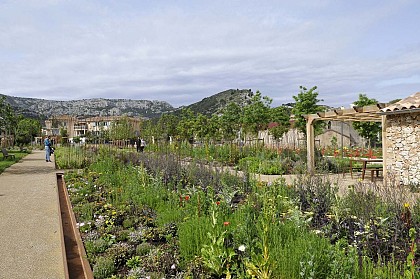
The 2 hectares of Mediterranean vegetation as well as all the fruit trees offer to the residents a green space of relaxation with many outdoor activities. In some squares, the playgrounds can still be used but are under the responsibility of parents who must ensure that health regulations are respected, including physical distance. The landscaped park of La Jarre (9th arrondissement) is part of the Urban Renovation Project (PRU) in the La Soude / Les Hauts de Mazargues sector, managed by Marseille Rénovation Urbaine, a structure that has since been integrated into the Aix-Marseille-Provence Metropolis. The park is the central public green space of a neighborhood undergoing renovation and expansion. Located between the avenue of the same name, the Boulevard Urbain Sud (BUS) and the Centaure theater, the 20,000 m² of Mediterranean vegetation (2 hectares) and all the fruit trees offer residents a green space for relaxation with many outdoor activities. Beyond its vocation as a space for exchange, sharing and social mixing, the Parc de la Jarre is intended to be a "Provencal stopover" also serving as a link between different neighborhoods. For this purpose, it integrates a soft path formed by the "allée des calanques" offering a bicycle and pedestrian path. The creation of this 54th park in Marseille is fully in line with the "EcoQuartier" approach supported by the actors and inhabitants. This title promotes quality and sustainable development for the area, and is a vehicle for new ways of life.

56 avenue de la Jarre 13009 Marseille
Show

Where to eat in MARLY PARC SAS

See more suggestions
Savor culinary specialties in MARLY PARC SAS.
See more suggestions
Where to sleep in MARLY PARC SAS

See more suggestions
Discover the best lodging options in MARLY PARC SAS.
See more suggestions
Gingko Marseille
577 m

Gingko Marseille

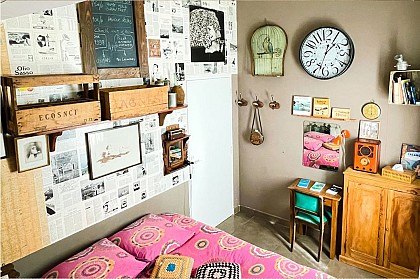
GinKgo, an ethical villa, welcomes you in an exceptional place in Marseille. Surrounded by the calanques, this urban green lung will allow you to reconnect with life while enjoying the city of Marseille. Our guest rooms have been renovated with natural materials such as lime and clay. Each room features purifying plants to encourage meditation and letting go. The furniture corresponds to the philosophy of the place, to slow down our consumption and return to the essential: sharing, mutual aid and the present moment. A healthy and tasty breakfast will be served on the terrace surrounded the vegetable garden. GinKgo is also an organic and vegetarian restaurant using local, healthy and living products, which welcomes you outside for lunch from Thursday to Sunday. Guests are independent to enter and leave the house: digicode for the gate and double keys for the house." After three seasons of plant-based dining, GinKgo is transforming into a multi-disciplinary living space. Don't be disappointed, you'll still be able to enjoy their cuisine that "feeds the body and mind" in a new form. The chef, Charlène, specifies that she wants to go further in her commitments. After two years of educating her customers about vegetarian and vegan cuisine that is increasingly creative and unique, she now wants to develop energy cooking with full awareness. Indeed, at GinKgo, the brother and sister are convinced that food must play the first role in a process of well-being and healing! On the program: workshops and courses of vegetal and wild cooking, retreats or personal development days (yoga, breathwork, ), light habitat building courses, a day of discovery of thai-qi / qi qong or even the sensitization of the youngest to meditation and plants!

3 Avenue Frédéric Le Play 13009 Marseille
Show
Caution!
We have no information on the difficulty of this circuit. You may encounter some surprises along the way. Before you go, please feel free to inquire more and take all necessary precautions. Have a good trip! 🌳🥾