Tours
Activities
Places of interest
Where to eat
Where to sleep

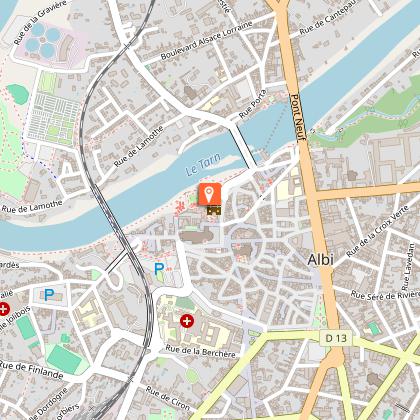
Discover Albi from ASSOC TARNAISE DE L'HOTELLERIE DE PLEIN AIR AT

Are you the owner?
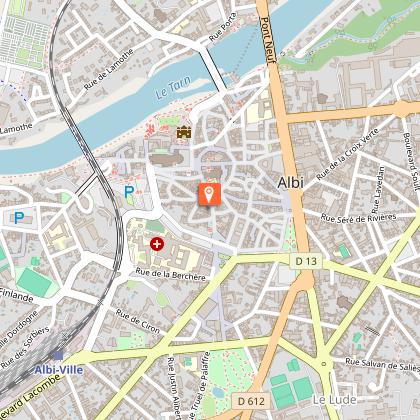
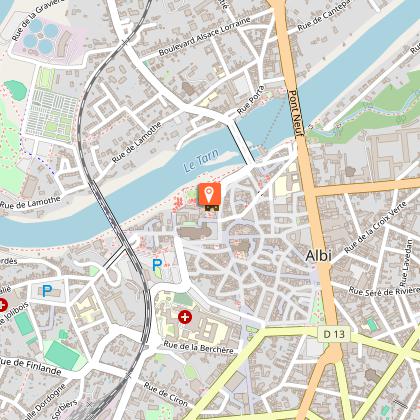
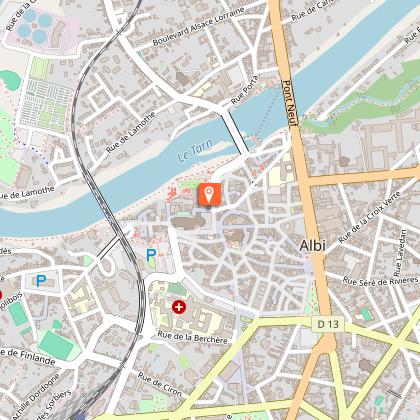
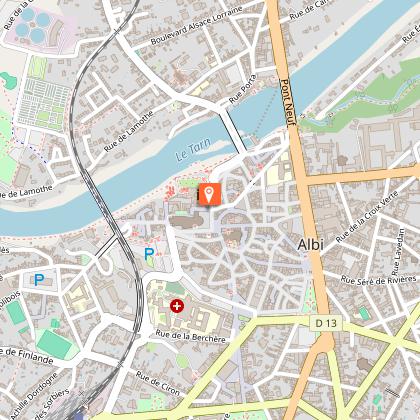
Immerse yourself in the heart of the Midi-Pyrénées region by staying in Albi, a city of art and history. Visitors can explore the famous Sainte-Cécile Cathedral and Berbie Palace, home to the Toulouse-Lautrec Museum with its invaluable works. Just a short walk away, stroll through the medieval streets of the city center and discover the culinary richness of the Tarn by savoring its local specialti...See more

Walking around ASSOC TARNAISE DE L'HOTELLERIE DE PLEIN AIR AT

See more suggestions
Walk through the natural landscapes of ASSOC TARNAISE DE L'HOTELLERIE DE PLEIN AIR AT.
See more suggestions
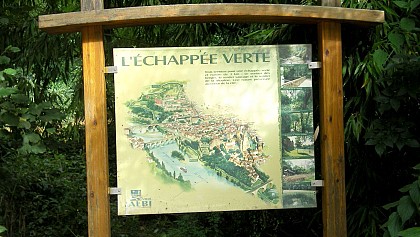
L'échappée verte, an idea for a city walk on the GR 36
295 m

L'échappée verte, an idea for a city walk on the GR 36

The Echappée Verte is a 7km round trip walk in the heart of Albi, partly on the GR36. It then stretches along the Tarn and the Caussels stream. The walk takes you through an unspoilt natural environment. Let's set off together to discover Albi, its historic and natural heritage. Enjoy this natural interlude and the potential biodiversity of our city.Follow the 21 discovery points step by step: THE START OF OUR ESCAPADENow that you're in front of the Tourist Office, we suggest you pick up the following booklets from the tourist advisers:- City map- insect guide- Bird guideYou can now begin your escapade by making your way to the starting point, Place Trébaille, around the Cathedral of Sainte-Cécile, in the World Heritage area. Our walk will last around 2 hours and you'll cover 4 km one way (and then the other). This walking tour is not particularly difficult. We do, however, recommend that you wear good shoes. Take your time to look around, you're going to discover some hidden treasures. THE TRÉBAILLE SQUARE AND FOUNTAINThe Place Trébaille evokes an ancient gateway of the same name, built into the wall known as the ‘Chanoines’, which passed in front of the bell tower to cling to the curtain walls of the Berbie. This fortification separated the Castelviel district from the rest of Albi. Its destruction in the 19th century provided a convenient link between the two areas. What remains of this wall is the section that runs along the eastern edge of the square. A fountain has been added to make this small square more pleasant.The remains of the Romanesque cathedral cloister can also be seen in the square. Like an invitation to descend to the banks of the Tarn, these remains of the cloister with its horseshoe arches form an open window onto the landscape. They bear witness to the Romanesque cloister of the former cathedral, which existed between the current monument and the Palais de la Berbie.To do: Turn towards the cathedral and look up. You'll be able to hear or observe the pair of peregrine falcons that have been present on the site since 1988, giving birth to a few young each year.Continue your visit by taking the stairs and path that lead down to the banks of the Tarn... THE TARN AND THE TOWPATHAs you make your way down to the banks of the Tarn, you start to catch a glimpse of the river.The river has been a trade and goods route since ancient times. Navigation was carried out using flat-bottomed boats with square sails, known as gabarres. Woad, saffron and wine were transported by water. While the current helped sailors to get from Albi to Bordeaux, the return journey was very difficult and had to be done by tow. In the 19th century, a barge service transported coal from Carmaux. The arrival of the railway signalled the end of this navigation.In the past, the river was towed by horse and cart, using human power. Tying rings can still be seen all along this route. IN SEARCH OF BEAVERSAll along the banks of the river, and particularly on the wild islet, you might spot our friend the beaver...The beaver is back on the banks of the Tarn. Threatened with extinction at the beginning of the 20th century, it had completely deserted the banks of the Tarn rivers. That was until 17 April 2009, when a resident of rue Porta rescued a stray beaver and handed it over to technicians from the Office Départemental de la Chasse et de la Faune Sauvage (ONCFS). The animal, a 14kg adult, was released well upstream on the river. This flat-tailed pioneer must have passed on the message to his fellow beavers, as traces of a family of 6 to 8 beavers were found on the banks of the Tarn, near the town of Castelnau-de-Lévis.This large rodent occupied a place of honour on rivers and populated France in the Middle Ages. It was hunted for its fur and then for its meat. THE OLD BRIDGEBuilt around 1040, ‘for the common benefit of the town and the Albigeois’, this bridge enabled the development of the district on the right bank, known as the faubourg du Bout-du-Pont or de la Madeleine, and increased trade.A toll bridge, it featured a fortified gate tower, a chapel in the centre, a drawbridge and the ‘ravelin’. From the 14th to the 18th century, the bridge carried houses on its piers, which were demolished after the terrible flood of 1766. In 1820, to adapt to the new transport needs of the industrial revolution, the roadway was straightened and widened.Listed as a historic monument, it is now one of the oldest bridges in France to be used for traffic.Take a look at the Right Bank: and immerse yourself in the history of the bridge on the Timescope virtual reality terminal. THE WATERFALL IN THE HEART OF THE TOWNYou can now see the Chapitre hydroelectric power station.This power station produces 9 million kilowatt-hours a year, equivalent to the annual electricity output of 8,000 inhabitants.It prevents 7,800 tonnes of carbon dioxide, the gas responsible for most of the world's pollution, from being released into the atmosphere. We would need to plant 450,000 trees to achieve an equivalent reduction in carbon dioxide. THE VERMICELLI FACTORYOpposite you, on the other bank of the Tarn, is the Vermicellerie... more commonly known as ‘Les Moulins Albigeois’. A former pasta factory, it occupied the site of a flour mill that could date back to the 12th century. The site was remodelled from the 17th century onwards and transformed into a pasta factory in 1850. It fell into disuse in the second half of the 20th century. The factory was listed as a historic monument on 11 October 1984.Things to see during your stay: photo spotlight on the Episcopal City and the Lapérouse Museum LA BAMBOUSERAIE: A MOMENT OF ZENYour wild escape begins here, on the banks of the Caussels. Enter the heart of this bamboo grove along the signposted GR36 path.In the middle of this bamboo grove, a sculpted tree trunk spans the Caussels stream.Take the time to sit by the stream and listen to the sound of the wind in the bamboo. THE WETLANDWhen the Echappée verte trail was created in 2004, the local authority discovered a cultivated area in the heart of a forest of giant bamboo. This plot of land, which belonged to the town, had been tended since the early 1980s by a family of Laotian origin who were present from time to time. It was decided to let them occupy this space so as not to deprive them of their food crops and preserve the landscape interest of this atypical plot on the edge of the path.A bamboo fence and small wooden structures add an exotic touch to the area, located 500 metres from the town centre.The experimental creation of an artificial peat bog began in January 2018. THE FORD CROSSING Continue on your way and cross the ford. In high water, the path is impassable. It's a real feat of balancing over the stream, which will amuse children and adults alike.It's up to you to play the balancing act! FISH AND FLORAContinue your adventure. You'll be walking alongside the Caussels, one of the Tarn's many tributaries.The Tarn, like most of its tributaries, is classified as a second category fish river. This means that it is mainly home to cyprinids. These fish, such as carp, chub, bleak and roach, live in lowland rivers where the water is calm and warm. They live alongside zander, perch and eel.In spring, you'll be able to spot Lathraea clandestina all along the stream: these flowers, which are on average three to four centimetres long, form a clump or disc that can reach a diameter of fifty centimetres for the largest! FRUIT TREESYou have now reached the heart of the Domaine de la Mouline. Here, all your senses will be activated as you discover the wealth of biodiversity in our town...A huge variety of ‘remarkable’ fruit trees await you here... cherry, apple and pear trees alongside chestnut, almond and plum trees. There are over 44 varieties to choose from! It's up to you to taste them! LES LIBELLULESNot far from the educational pond, on your left, a small spring will allow you to observe the 14 species of dragonflies that have been recorded on the site. Commonly known as dragonflies, these primitive carnivorous insects form the order Odonata.Odonates are classified into two suborders:- the Anisoptera (= dissimilar wings) or true dragonflies, with powerful flight- the Zygoptera (joined wings) or damselflies, with match-shaped bodies and hesitant flight. THE EDUCATIONAL PONDAn educational pond below the Mouline leisure centre has been developed to make it more accessible to the public and to facilitate observation of a rich and fragile ecosystem.A wooden pontoon has been installed so that visitors can observe the various plants adapted to this environment and present on the Echappée verte. This area is of great benefit to wildlife such as amphibians, birds and dragonflies.Rushes, reeds, water lilies, phragmites and other species have colonised the area, giving it a natural appearance. THE INSECT HOTELThere are a few simple principles to follow when setting up an insect house: it should face south or south-east, be protected from the prevailing winds and be 30 cm higher than the ground.The main insects housed are: ladybirds, lacewings, osmids, carabid beetles, hoverflies, which look like wasps but belong to the fly family, and earwigs. THE PIGEONDovecotes are very common in the Tarn (around 1,700 recorded). Light wooden structures, usually built of brick, stone, cob or adobe, their architecture, derived from feudal towers, embodied nobility and prosperity. In Albi, the pigeon lofts that have been renovated in recent years are designed to regulate pigeon populations by collecting eggs. FISH SPAWNING GROUNDSA spawning ground is the place where fish reproduce. Spawning grounds are often found on the sandy or sandy-muddy bottoms of rivers, ponds, lakes, marshes, estuaries and even very deep marine areas.They are essential to the good ecological status of rivers and catchment areas. They can be threatened by water or sediment pollution, the artificialization of watercourses (canalisation and rectification in particular), poaching, siltation and sometimes by clogging by algae or ‘encrusting’ and ‘calcifying’ bacteria. IN THE FOOTSTEPS OF ALBIGENSIAN WILDLIFENot far from the pond and the fruit trees, you'll be able to spot various signs describing the animal species you'll come across along the way. Listen carefully and keep your eyes wide open!You might come across a fox, a heron or a roe deer, to name but a few... THE BIRDS OF L'ÉCHAPPÉE VERTEA privileged area for observing and hearing many species of birds, you'll be able to recognise: the Hoopoe, the Grey CuckooOak Jay, Kingfisher, Cattle Egret and many more... THE DAMAs you continue your adventure, you'll come across a dam on the Caussels.No one knows why this dam exists. Was it installed to power an old mill on the Mouline site? It probably was. CENTURY-OLD TREESOur route ends at the foot of these ancient trees, in this clearing. We have just completed this green escape together. We hope you enjoyed it and that you were able to discover or rediscover your 5 senses. Don't hesitate to recommend it and share your impressions... 

2 h
2.9 km
Easy
Show
The mysteries of the city of Albigensia
294 m

The mysteries of the city of Albigensia

Let's set off together on a soothing discovery of Albi, where history meets nature. Let yourself be carried away by an immersive experience that will awaken your senses, revealing the richness of our historical heritage and the diversity of our natural environment. DEPARTURE FROM THE TOURIST OFFICEYour starting point will take you directly to the Tourist Office, where you can pick up a map of the town and a guide to birds and insects.Now make your way to the entrance of the Episcopal Palace... THE BERBIE PALACEFor your 1st stop, go through the gates of the Palais épiscopal and stop at the foot of the stairs...Of all the mansions built by the bishops of the south of France during the Middle Ages, there are few on the scale of Albi's Episcopal Palace.Known as the home of the Toulouse-Lautrec museum, the palace is also known as the Palais de la Berbie, a deformation of the Occitan name Bisbia, meaning bishopric. The oldest part of this impressive fortress was built by the bishops who succeeded each other in the Albigensian see during the 13th century.The Berbie Palace was built around 1250-1260 on a high, fortified site dating from the Gallic period and overlooking the Tarn, under the episcopacy of bishops Durand de Beaucaire and Bernard de Combret.At that time, the bishops of Albi were also the lords of the town.A civil structure in terms of its military architecture and religious in terms of its function, the initial palace took the form of an imposing brick keep (known as the Sainte-Catherine keep) flanked by four corner towers. Bishop Bernard de Castanet (1277-1308) gave it the scale and monumentality we know today.The palace was enlarged by the addition of a second keep (the Saint-Michel keep) and a vast rectangular wing with powerful walls.Alongside the Berbie, he began work on a new cathedral which, with its powerful brick architecture and slender Gothic style, formed the matrix of the Episcopal City and its urban coherence. THE GARDEN OF THE BERBIE PALACEDuring this stopover, we recommend that you take a stroll along the ramparts of this garden, which has been awarded the ‘Remarkable Garden’ label by the French Ministry of Culture. The brainchild of the first archbishop of Albi, Hyacinthe Serroni, the two terraces and the ‘classical’ garden known as ‘Le Notre’ at the Palais de la Berbie were created at the end of the 17th century and oriented the life of the palace towards the banks of the Tarn and its vistas, reflecting the taste for nature and the picturesque that was prevalent at the time. These gardens are known as ‘à la française’, in the classical style of Versailles.The gardens as we see them today are the result of the transformation, between 1687 and 1703, of the palace's former bailey into a place of pleasure.Three levels were created: the upper terrace, the counter-terrace and the gardens themselves in the lowest part. At the end of the 18th century, Mgr. de Stainville, Choiseul's brother, had the marble statues representing the seasons added to the promenoir, which can still be seen today.With the same goal in mind, the bishops had the enormous buttresses on the north side of the Suffragants wing cut down and used the buttress towers of the Sainte-Catherine tower to install large terraces designed to open up the rooms in this part of the palace, which had been refurbished for the occasion, towards the gardens. PLACE TRÉBAILLE AND THE REMAINS OF THE ROMANESQUE CATHEDRALOn leaving the Cité épiscopale, turn right and follow the cathedral on your left. This will take you to Place Trébaille.Place de la Trébaille refers to an ancient gateway of the same name, built into the wall known as the ‘Chanoines’, which ran past the bell tower to the curtain walls of the Berbie. This fortification separated Castelviel from the rest of Albi. Its destruction in the 19th century provided a convenient link between the two. What remains of this wall is the section that borders the square to the east. THE CATHEDRAL AND ITS INHABITANTSTurn towards the cathedral and look up. You may be able to see ‘our inhabitants’ of the cathedral. But who are they?Sainte-Cécile cathedral was built from 1282 onwards in response to the Cathar heresy, as a fortress symbolising the power of the Catholic Church.The largest brick cathedral in the world, 113 metres long and 35 metres wide, it dominates the city with its 78-metre bell tower, completed in 1492 shortly after the consecration of the choir in 1480: 200 years of continuous work!It was listed as a World Heritage Site in July 2010. THE BANKS OF THE TARNDescend the stairs leading down to the Tarn and take the time to discover this river that saw our mysterious navigator set sail on its waves...The river has been a trade and goods route since ancient times. Navigation was carried out using flat-bottomed boats with square sails, known as ‘gabarres’. Woad, saffron and wine were transported by water. While the current helped sailors to get from Albi to Bordeaux, the return journey was very difficult and had to be done by tow. In the 19th century, a barge service was even set up to transport coal from Carmaux. The arrival of the railway signalled the end of this navigation.In the past, the river was towed by horse and cart, using human power. Tie-up rings can still be seen all along this route.The attached old photograph shows how the river banks were laid out in the 19th century. THE OLD BRIDGENow head towards the bridge and get some height...The Pont-Vieux was built between 1035 and 1042 (although the oldest parts visible today date from the 13th century). Initially, it was too narrow for carts to pass over, so goods were carried on the backs of men or animals.The bridge withstood all the floods of the Tarn, but it was badly damaged in the early 15th century and it was decided to strengthen it by various means, in particular by building houses to reinforce its structure. These houses, which often belonged to merchants, were gradually destroyed after the flood of 1766. Thanks to the Pont-vieux, one of the few bridges over the Tarn in medieval times, Albi became a commercial crossroads (from the Mediterranean to Cahors and Paris; from Toulouse to Rodez and Lyon).The Porte du Tarn, part of the city walls, was also a toll plaza for goods passing through the Pont-Vieux. Ordinary travellers paid no tax. THE CLOISTER OF THE COLLEGIATE CHURCH OF SAINT-SALVIWalk up the Quai Choiseul towards the Collégiale Saint-Salvi, visit it and take the side door to reach the cloister.Together with the collegiate church, the cloister forms a remarkable ensemble just a hundred metres from Sainte-Cécile cathedral and the Palais de la Berbie.On the south side of the collegiate church was a cloister, three of whose galleries were destroyed during the Revolution and the Empire. Only the southern gallery remains. Built from 1270, it combines Romanesque forms (round arches) with Gothic capitals.The cloister was built under the direction of Vidal de Malvési, who was authorised by the canons to have a highly original coffin built for his burial, resembling a small chapel. PLACE DU VIGAN AND ITS FOUNTAINSLeave the cloister via rue Peyrolière and walk up rue de l'Hôtel de Ville to reach Place du Vigan. Here too, water is our common thread...In the spring of 1999, excavations in the Place du Vigan in Albi unearthed several elements of fortifications, linked to the nearby presence of a gateway, integrated into a barbican-type complex. Archaeological analysis has enabled us to attempt a chronological reconstruction of this defensive complex. The first system, essentially based on ditches, appears to have been put in place during the 14th century. Various modifications were then made up until the 16th century, in line with developments in weaponry and siege techniques. From this date onwards, the defensive complex slowly began to fall into disuse. Despite renewed interest in the area with the construction of a ceremonial gateway in the mid-seventeenth century, this slow abandonment came to an end with the definitive dismantling of the defences in the second half of the eighteenth century (Extract from the book ‘Archéologie du Midi médiéval : Les fortifications médiévales de la place du Vigan à Albi’ by Laurent Grimbert). THE NATIONAL GARDEN AND ITS FOUNTAINA few metres further on and you're in the National Garden. Here we find a spot of freshness thanks to its trees, flower beds and ponds.This garden was built on the ditches around the ramparts that surrounded the old fortified town.With its enclosed square and streamlined flowerbeds, a blend of the past and the present, the national garden is organised around white calda stone promenades and a circular escutcheon pond adorned with a statue by Joseph Rivière, ‘La baigneuse’.The bandstand: it was in 1875 that the town council put forward the idea of a bandstand in the Royal Garden (which would later become the National Garden). As this was not a priority at the time, it wasn't until 1898 that the idea of ‘rebuilding the bandstand’ was mooted, which would suggest that there had been one before... The town council travelled to Toulouse to meet the manager of the Saint-Éloi workshops (Maison Girard Frères). This company, which specialises in iron constructions, produced the statue for an exhibition in the pink city. The bandmaster of the 143rd infantry regiment, who was part of the delegation, also seems to have agreed in principle. The space provided by the bandstand should be sufficient to accommodate the musicians of his band. PLACE LAPÉROUSE AND ITS FOUNTAINNow walk along the lices towards Place Lapérouse. We're getting closer to our goal and finally discovering who the mystery navigator of our escape is...To create this ‘fountain’, the city of Albi decided ‘not to call on a fountain-maker, but on an artist’. Jeppe Hein, 38, graduated from the Royal Academy of Fine Arts in Copenhagen and now works in Berlin. In Albi, he will be creating ‘an aquatic work’ called ‘Encircle’. This ‘water pavilion’ will be made up of several circles of different diameters, partly juxtaposed and partly intersecting, creating new spaces. The walls of water will feature 2.2-metre-high jets. This contemporary work of art has 720 jets. THE ROCHEGUDE PARK AND ITS POOLSAs you leave the Place Lapérouse, you'll pass by Albi's grand theatre. Don't hesitate to take a walk on the roofs of this theatre to admire the city from above... This last stage of our adventure will end here and you will finally discover our famous character...Go through the gates of this park and head for the town house and statue of its founder, Henri Paschal de Rochegude.Located in the Cordeliers cultural district, this garden has been classified as a ‘Remarkable Garden’ since 2010.A classical French garden, an English garden, a bird island, remarkable trees, a waterfall... everything in the Rochegude park invites you to relax. Created in the 19th century, this public park was originally a private park belonging to Admiral Pascal de Rochegude.Three distinct parts, - the Hôtel Renaissance, which became the municipal library, then an exhibition space, and now the LAIT contemporary art centre - the French-style gardens of pruned boxwood punctuated by orangery tubs - and the English-style gardens below, on the site of the former farm, with vegetable garden, meadow and orchard.An avid botanist, Rochegude asked the town to plant dozens of remarkable trees in return for his bequest: libocedra, California umbellaria, sequoia sempervirens, plane trees, magnolias and bald cypress.

2 h
2.7 km
Very easy
Show
In the footsteps of Admiral de Rochegude
645 m

In the footsteps of Admiral de Rochegude

Let's set off together to discover Albi, its historic heritage and above all its natural heritage. Immerse yourself in a sensory experience in this remarkable garden and discover the biodiversity potential of our city. ENTRANCE TO THE PARK AND ITS HUNDRED-YEAR-OLD OAK TREEWelcome to the Rochegude Park. Follow in the footsteps of Admiral de Rochegude... Located in the Cordeliers cultural district, this 4-hectare park has been classified as a ‘Remarkable Garden’ by the French Ministry of Culture since 2010.A classical French garden, an English garden, a bird island, remarkable trees, a waterfall... everything in the Rochegude park invites you to relax. Created in the 19th century, this public park was originally a private park belonging to Admiral Henri Pascal de Rochegude.An avid botanist, Rochegude asked the town to plant dozens of remarkable trees in return for his bequest: libocedra, California umbellaria, sequoia sempervirens, plane trees, magnolias and bald cypress.Romantic statues, with women as their subject of inspiration, are to be found in the flowerbeds.As soon as you enter the park, you'll see a sculpture called ‘Bany’, created by Marta Solsona Bellara. In 1895, a statue of Sophocles dancing was installed here. Unfortunately, it was removed during the German occupation and melted down.On the left, an oak tree more than a hundred years old is one of the few remaining reminders of the park's origins.Small panels dotted around the park present the species, with enclosed areas for resident animals (ducks, geese, etc.). Playing hide-and-seek, sliding down the slides, watching the birds or the fish... or simply taking the time to enjoy this outdoor break on one of the many benches or on the grass are all pleasures to be shared in the Parc Rochegude.Enjoy the walk! THE LABYRINTH GARDENOn your left, you will enter the ‘Labyrinth’ garden. Here you can discover or rediscover 12 varieties of rose, 25 varieties of peony and 45 varieties of sage. Be surprised by the Sichuan pepper plant. Pick one of these seeds, crush it between your fingers and smell the pepper aromas. This Sichuan pepper plant (Zanthoxylum piperitum), also known as Sansho pepper or Japanese pepper, appeals both to gardeners for its hardiness and to cooks for its powerful, highly aromatic flavour. The Sichuan pepper plant is a small tree, around 5 m tall, well known to Asian food lovers. It has large thorns. Its berry husks are used to season dishes. The small spring blossom produces the famous red berries with explosive notes of lemon, mint, lemongrass and pepper. THE BUST OF ROCHEGUDE AND THE 4 HUNDRED-YEAR-OLD PLANE TREESAs you continue on your way, you will come across Admiral Henry Pascal de Rochegude. He was born in Albi on 18 December 1741, the same year as the navigator Jean-François Galaup de Lapérouse. Both were educated at the Jesuit College. Rochegude's career as a sailor began in 1757, when he entered the Ecole de la Marine, and ended in 1800 with the rank of rear-admiral. In the meantime, he was elected deputy for the Tarn region, voted in favour of Louis XVI's appeal to the people and was appointed inspector of the Navy's ports and arsenals. After the dissolution of the Convention, he gave up politics for good, devoting himself exclusively to linguistic studies, and more specifically to the study of the langue d'Oc. In 1819, he published two books:- le parnasse occitanien- Essai d'un glossaire occitanien’.Henry Pascal de Rochegude epitomised the ‘man of the Enlightenment’: atheist, liberal, Voltairean, Freemason, man of letters and philosopher, but also a great connoisseur of the natural sciences, passionate about astronomy and always driven by innovative ideas in many fields. THE PRIVATE MANSION AND ITS FORMAL GARDENOn 27 October 1787, Admiral de Rochegude moved into the property. He laid out the rear garden and had the park planted, inspired by the gardens laid out by Le Nôtre. He planted the trees, choosing them with the greatest care. When he died without issue, he bequeathed his possessions to the City of Albi, including his private mansion with outbuildings, the park and his personal manuscript collection, comprising more than 12,500 books accumulated between 1760 and 1830. Reserving the usufruct of his property to his great-grandniece, the Comtesse de Saint-Juéry. The town took effective possession of these assets in 1886 after her death.One of the treasures of this library was the manuscript of La Mappa Mundi, listed in 2015 as a UNESCO World Heritage Site under the title of Memory of the World, which is now housed in Albi's Médiathèque. A facsimile can be seen in the Treasury of Sainte-Cécile Cathedral. STATUE ‘L'IMAGINAIRE’ BY LOUIS DERBRE SOURCE DE MERVILLEThis spring originates in the heart of the park. This stream, known as ‘Merville’, flows quietly through the park and ends very close to the Bamboo Grove. However, its flow is not sufficient to supply the water reservoirs used by the Anatidae (ducks). CASCADEThis waterfall is the arrival point of a long upstream flow of water from the Tarn via a pumping system starting at Bondidou. This water is used to supply the various pools where the 2-legged ‘little inhabitants’ of the park meet. As you explore the park, you'll discover just who they are... THE ROSE GARDENThis area features a selection of old roses and English roses. 66 roses of 26 different varieties have been planted. The colour scheme is a subtle combination of warm (yellow, orange) or cool (pink, purple), saturated (bright red, bright yellow) or cool (red, purple) colours.(bright red, bright yellow) or unsaturated (pale pink, pale yellow), offering a wide range of tones and scents. Metal structures created by the department's gardeners punctuate the garden and provide support for climbing roses.It's up to you to find the most striking varieties:- Munstead Wood": this rose gives off a fruity fragrance, a warm blend of wild blackberry, blueberry and plum.- Darcey Bussel': the best red rose grown to date, and certainly the brightest!- Strawberry Hill': a superb pink rose with a fine fragrance of myrrh, honey and lemon. A sure-fire winner!- Lady of Shalott': a subtle combination of red and orange, the flowers give off a sweet scent of tea, spiced apples and cloves. PONDS AND THEIR WILDLIFEA few years ago, the LPO du Tarn inventoried 44 species of birds. Most of the avifauna is made up of small passerines (the grey flycatcher and the common grosbeak). Despite this, they appear to nest occasionally in the park.Of the birds of prey observed, only the Tawny Owl breeds here. The Kestrel and the Sparrowhawk are regularly seen here. They don't hesitate to come and hunt birds in the middle of the day!The various waterholes attract two species of heron in search of food: the Grey Heron and the Black-crowned Night-Heron. As for the Gallinule, the moorhen, it has adapted perfectly to the context of urbanurban waterholes. Despite the regular presence of users, it takes advantage of the fenced enclosure and low vegetation to hide and raise its offspring. Finally, strange as it may seem, the kingfisher sometimes makes an appearance in this remote spot!As you make your way through the park, you'll be able to admire watercolour paintings of birds by JM Salacroup, gardener and designer of the various flowerbeds in the Parc Rochegude and the City of Albi. THE PIGEONNIERIn order to regulate the pigeon population, the City of Albi has set up pigeon lofts in various parts of the town, where the pigeons can find a space suited to their lifestyle. The technique used to regulate the pigeon populationThe technique adopted to regulate the pigeon population is to rear a few individuals in a loft (known as a breeding loft) in order to obtain decoys to capture and retain the individuals present in the area. This control technique complements the two pairs of peregrine falcons present in the area. The Rochegude dovecote can be home to up to 200 pairs. Staff from the Plant Heritage and Environment Department distribute a daily food ration of 30 grams of seed per bird, as well as food supplements, and carry out health checks with professionals. Eggs are systematically collected (2 out of 3) and destroyed. Eventually, pigeon populations will stabilise and then decline. THE VEGETABLE GARDENA keen botanist, Rochegude was keen for the town to continue planting trees and shrubs to introduce new plants to the people of Albacete. In his will, he wrote (codicil dated 5 July 1832): ‘... I would like the librarian... to give an annual botany course and that part of the garden and enclosure included in his will be made available for this purpose.I would like the librarian... to give an annual botany course and that part of the garden and enclosure included in my bequest be made available for this purpose, without however being allowed to cut down the trees there...’.Every year, the City of Albi's gardeners replant a vegetable garden where the harvest is freely accessible and where everyone can discover varieties of tomatoes, cucurbits and aromatic plants... Signs indicate the state of ripeness of each plant. Now it's your turn to taste! THE BALD CYPRESSAmong the species and trees that Rochegude wanted to install was the bald cypress, or Louisiana cypress. This is a species of tree in the Taxodiaceae family native to the south-eastern United States. It is a remarkable species for its adaptation to damp environments. THE WILD MEADOW AND THE STATUE OF ‘THE CONSOLING MUSEIn this area, nicknamed the ‘wild meadow’ because of its luxuriant vegetation, you can see the romantic statue of the ‘Consoling Muse’. In 1903, the Ministère de l'Instruction Publique et des Beaux-arts acquired the plaster cast of the ‘Muse consolatrice’ for the marble translation that the artist Jules Pendariés (1862-1933) was to make. In 1906, the statue was included in the exhibition of works handed over to the Fine Arts Administration. Itwas installed in the park in 1907. THE LIED OAKExperience it for yourself. Touch the bark of this tree and try to find out what its purpose is... THE MAGNOLIA AND ITS MEADOWNot far from this magnificent Yulan Magnolia, with its white flowers at the end of winter, take a break on the lawn and why not lie down?Look up at the sky between the trees and try to guess the shape of the clouds. From time to time, a few musicians come to play their scales in this park.Perhaps you can benefit from their talent? THE HONEY TREEThis little-known tree (Tetradium danielli), which is very hardy, is interesting for its white flowers in summer, which are very fragrant and much appreciated by bees. It is followed by small red fruits, turning black, arranged in clusters. Its aromatic leaves have a bluish underside and turn yellow in autumn.Try approaching this tree in midsummer. You'll feel like you're in the middle of a swarm of bees. THE SHADE GARDEN AND ITS INSECT HOTELThe aim of this shade garden is to offer a range of plants suited to shade or even semi-shade. Yew, chestnut, maple, hazelnut and tulip tree give this garden an undeniably undergrowth feel. To enhance the garden, 1,100 plants of 29 species and 20 different genera have been planted.The ash trunk left on site serves as a refuge for animals and other insects, and complements the ‘insect hotel’ located nearby.Insect hotels help to conserve biodiversity and are a great way of raising awareness. Of course, insects need to find food for themselves and their larvae, but they also need shelter at different times in their lives:- to spend the night or the day- protect themselves from bad weather- shelter during the long winter,- breeding in the spring...Little game: Go in search of the tree nicknamed ‘the monkey's despair’ or the Chilean Araucardia.To complete your visit: Albi insect guide, also available free of charge from the Tourist Office. THE BAMBOO GROVEA naval officer under the Ancien Régime, Rochegude took part in a mission to India in 1768-1769 aboard the ship nicknamed ‘La Garonne’. Rochegude's mission was to gather intelligence in India. His stay in India ended in Pondicherry. Perhaps during his stay in India he could have brought back some bamboo shoots, the symbol of Asian countries?In this place, you can enjoy an experience. Lie down on the grass next to the bamboos and listen to the sound of the wind in the foliage, an interlude conducive to well-being and meditation.

2 h
882 m
Very easy
Show

What to do in ASSOC TARNAISE DE L'HOTELLERIE DE PLEIN AIR AT

See more suggestions
Explore the bookable activity options in ASSOC TARNAISE DE L'HOTELLERIE DE PLEIN AIR AT for all tastes and ages.
See more suggestions
The Toulouse-Lautrec museum
348 m

The Toulouse-Lautrec museum

The Toulouse-Lautrec museum is located in one of the most beautiful corners of Albi: the Berbie Palace. The Palace is one of the Episcopal City’s major sites with World Heritage status. The museum is recognised internationally for the works of this artist from Albi. TOULOUSE-LAUTREC, A UNIQUE COLLECTION IN THE WORLD The world’s most important public collection of the works of Henri de Toulouse-Lautrec, including 31 posters by the lithograph painter, is to be found in Albi. There are also no fewer than 219 paintings, 563 drawings and 183 lithographs displayed in the museum. Early works, major portraits, paintings of brothels, prints from the world of entertainment, advertisements and later works are presented there, giving this museum an exceptional collection. Each stage of the production is represented, highlighting his gift for observation, his talent as a draughtsman and his quality for capturing significant detail. The route around the museum is enriched with information panels. To visit the museum is to meet the man, this native of Albi, of whom this city is so proud. The first rooms are devoted to his early works representing his family, his friends and his favourite theme: animals. Gradually the visitor is taken into the Parisian world: the brothels, especially the world of entertainment and the circus. Room after room, we follow the evolution of this unusual artist.

Palais de la Berbie Place Sainte Cecile 81000 Albi
Book from 0 €Book
Show
Parc Résidentiel de Loisirs Les Chalets De Fiolles
22 km

Parc Résidentiel de Loisirs Les Chalets De Fiolles

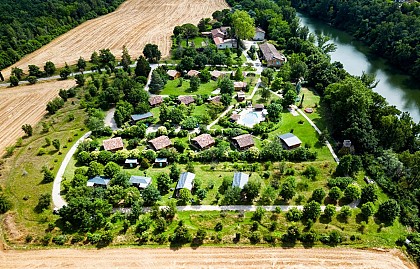
Gite village located between Albi and Toulouse, 3 minutes from Gaillac. 14 chalets, 2 lodges on stilts and 2 bungalows spread over 3 hectares. A place of escape and charm, both warm, friendly and family. River access and heated swimming pool. QUALITÉ TOURISME and QUALITÉ TOURISME OCCITANIE label A 4**** Residential Leisure Park (PRL), you will find 14 wooden chalets, 2 lodges on stilts for the unusual and 2 wooden bungalows. All our accommodation is air-conditioned, equipped for 4/5 people, has a terrace and a charcoal barbecue and is located on large, tree-lined pitches with no screws. It is a place of escape and charm, both warm and friendly, which will offer you a change of scenery, relaxation and discovery. A quiet, family environment on a human scale, an ideal place to spend a family holiday or a weekend with friends. You will find a heated swimming pool, spa, games for children (2 trampolines, swings...), games and entertainment room, table tennis, pétanque, football, volleyball. The river Tarn flows below, you can go for a walk, fish or go canoeing (on loan in July and August). Activities for young and old in July and August. Ideal starting point to discover all the treasures of the Tarn: the various perched villages and bastides such as Cordes sur Ciel at 30 min, Puycelsi at 20 min, Albi and its cathedral (registered with the world heritage of UNESCO) at 15 min. In the heart of the Gaillac vineyards, you will have a wide choice of wine cellars to visit. You can go hiking or biking, or go for a walk in the forest of Grésigne or Sivens. The pink city, Toulouse, is 40 minutes away. You can rent by the night or by the week. Our 150 m2 room can accommodate groups of up to 40 people: sportsmen, families, seminars... Groups welcome : contact us Children's activities from 04/07 to 29/08 Adult entertainment from 04/07 to 29/08 Swimming pool from 01/05 to 30/09 Heated swimming pool depending on weather conditions Bar from 01/05 to 30/09 Snck from 01/05 to 30/09

2634 Rte de Lavaur 81600 Brens
Book from 0 €Book
Show

What to visit in ASSOC TARNAISE DE L'HOTELLERIE DE PLEIN AIR AT

See more suggestions
Relax in the parks of ASSOC TARNAISE DE L'HOTELLERIE DE PLEIN AIR AT.
See more suggestions
Albi, the episcopal city
294 m

Albi, the episcopal city

The Episcopal City of Albi has been classified as a UNESCO World Heritage Site since 2010. The Episcopal Palace, which reflects a rare image of power, and the imposing Sainte-Cécile Cathedral, are the two key monuments. More than a million visitors discover the city each year. We promise that your memories of this exceptional site will be long-lasting! THE EPISCOPAL CITY, A UNIQUE URBAN BRICK BUILDING Brick is the architectural signature of the Episcopal City. It creates a unique urban appearance. The beauty of this city changes according to the light: shades of red, pink and ochre. The brick used in the Middle Ages to create this Episcopal City is extraodinary and is unique in Europe. Built with mud from the Tarn river bed, this material is omnipresent in both religious and civil architecture. The Cathedral and the Berbie Palace are amongst the largest brick constructions in the world. AN EPISCOPAL CITY, 4 MEDIEVAL DISTRICTS 4 historic districts surround the two brick giants: the Cathedral and the Episcopal Palace. - Facing the Cathedral’s bell tower, Castelviel is the cradle of the city. With its small squares surrounded by medieval half-timbered houses and open-roofed attics, it’s worthy of being a picture-postcard. - Castelnau, the picturesque district with broad, straight streets, is the symbol of the modern subdivision during the 12th century. The Maison du Vieil Alby, home of the Albi Heritage Association, epitomises this district. - The circular shaped Saint-Salvi district surrounds the Saint-Salvi Collegiate Church and Cloister. This remarkable ensemble, erected in the 11th century, combines Romanesque and Gothic architecture. - The Coombs and banks of the Tarn offer a magnificent view of the Pont Vieux (one of the oldest bridges in France, built around 1035 - 1040). This bridge was the key to commercial prosperity in the Middle Ages and was an important defensive asset, particularly during the 14th century and the Hundred Years' War.

Place Sainte-Cécile 81000 Albi
Show
The Toulouse-Lautrec museum
348 m

The Toulouse-Lautrec museum

The Toulouse-Lautrec museum is located in one of the most beautiful corners of Albi: the Berbie Palace. The Palace is one of the Episcopal City’s major sites with World Heritage status. The museum is recognised internationally for the works of this artist from Albi. TOULOUSE-LAUTREC, A UNIQUE COLLECTION IN THE WORLD The world’s most important public collection of the works of Henri de Toulouse-Lautrec, including 31 posters by the lithograph painter, is to be found in Albi. There are also no fewer than 219 paintings, 563 drawings and 183 lithographs displayed in the museum. Early works, major portraits, paintings of brothels, prints from the world of entertainment, advertisements and later works are presented there, giving this museum an exceptional collection. Each stage of the production is represented, highlighting his gift for observation, his talent as a draughtsman and his quality for capturing significant detail. The route around the museum is enriched with information panels. To visit the museum is to meet the man, this native of Albi, of whom this city is so proud. The first rooms are devoted to his early works representing his family, his friends and his favourite theme: animals. Gradually the visitor is taken into the Parisian world: the brothels, especially the world of entertainment and the circus. Room after room, we follow the evolution of this unusual artist.

Palais de la Berbie Place Sainte Cecile 81000 Albi
Book from 0 €Book
Show

Where to eat in ASSOC TARNAISE DE L'HOTELLERIE DE PLEIN AIR AT

See more suggestions
Come and taste typical dishes of ASSOC TARNAISE DE L'HOTELLERIE DE PLEIN AIR AT.
See more suggestions
Where to sleep in ASSOC TARNAISE DE L'HOTELLERIE DE PLEIN AIR AT

See more suggestions
Find the perfect lodging for your visit to ASSOC TARNAISE DE L'HOTELLERIE DE PLEIN AIR AT.
See more suggestions
Parc Résidentiel de Loisirs Les Chalets De Fiolles
22 km

Parc Résidentiel de Loisirs Les Chalets De Fiolles

Gite village located between Albi and Toulouse, 3 minutes from Gaillac. 14 chalets, 2 lodges on stilts and 2 bungalows spread over 3 hectares. A place of escape and charm, both warm, friendly and family. River access and heated swimming pool. QUALITÉ TOURISME and QUALITÉ TOURISME OCCITANIE label A 4**** Residential Leisure Park (PRL), you will find 14 wooden chalets, 2 lodges on stilts for the unusual and 2 wooden bungalows. All our accommodation is air-conditioned, equipped for 4/5 people, has a terrace and a charcoal barbecue and is located on large, tree-lined pitches with no screws. It is a place of escape and charm, both warm and friendly, which will offer you a change of scenery, relaxation and discovery. A quiet, family environment on a human scale, an ideal place to spend a family holiday or a weekend with friends. You will find a heated swimming pool, spa, games for children (2 trampolines, swings...), games and entertainment room, table tennis, pétanque, football, volleyball. The river Tarn flows below, you can go for a walk, fish or go canoeing (on loan in July and August). Activities for young and old in July and August. Ideal starting point to discover all the treasures of the Tarn: the various perched villages and bastides such as Cordes sur Ciel at 30 min, Puycelsi at 20 min, Albi and its cathedral (registered with the world heritage of UNESCO) at 15 min. In the heart of the Gaillac vineyards, you will have a wide choice of wine cellars to visit. You can go hiking or biking, or go for a walk in the forest of Grésigne or Sivens. The pink city, Toulouse, is 40 minutes away. You can rent by the night or by the week. Our 150 m2 room can accommodate groups of up to 40 people: sportsmen, families, seminars... Groups welcome : contact us Children's activities from 04/07 to 29/08 Adult entertainment from 04/07 to 29/08 Swimming pool from 01/05 to 30/09 Heated swimming pool depending on weather conditions Bar from 01/05 to 30/09 Snck from 01/05 to 30/09

2634 Rte de Lavaur 81600 Brens
Book from 0 €Book
Show
Camping Huttopia Pays de Cordes sur Ciel
24 km

Camping Huttopia Pays de Cordes sur Ciel

Stay just a stone's throw from Albi, in a lush green setting with views of the hills and the medieval town of Cordes, voted 'France's favourite village', right in the heart of the Gaillac vineyards and the Cordais region. Just a few kilometres from Albi, Huttopia Pays de Cordes-sur-Ciel opens the doors to a timeless getaway, where unspoilt nature meets the fascinating history of the Tarn. Imagine waking up each morning to birdsong, with breathtaking views over the rolling green hills and the medieval town of Cordes-sur-Ciel, voted 'France's favourite village'. Here, everyone finds their own happiness : traditional camping enthusiasts settle on spacious, shaded pitches, while those looking for something unique can choose a cosy chalet, a Toile & Bois tent, a Cahutte or a Wooden Trailer, for a total immersion in nature without ever giving up comfort. Everything is designed so that young and old alike enjoy an unforgettable holiday : take a dip in the heated pool, let the children have fun in the playground, challenge your loved ones to pétanque, table tennis or on the multisport field. In summer, share convivial moments during the activities, then meet up at the Café-Comptoir to enjoy a crêpe for a snack, an aperitif at sunset or a homemade pizza on the terrace, lulled by the gentle Occitan evenings. Set off to discover the treasures of the region: stroll through the cobbled streets of Cordes-sur-Ciel, a UNESCO World Heritage site, explore the Gaillac vineyards or set off on hiking trails, on foot or by electric bike, available for hire on site.

910 route de Cordes sur Ciel 81170 Vindrac-Alayrac
Book from 0 €Book
Show
Caution!
We have no information on the difficulty of this circuit. You may encounter some surprises along the way. Before you go, please feel free to inquire more and take all necessary precautions. Have a good trip! 🌳🥾