Tours
Activities
Places of interest
Where to eat
Where to sleep

Discover Ostricourt, Nord, Nord-Pas-de-Calais

Are you in charge of the destination?
Welcome to Ostricourt, a charming town located in the north of the Nord-Pas-de-Calais region. Ideally situated, Ostricourt serves as your gateway to enriching adventures and unique cultural discoveries. Embark on a journey through the surrounding nature trails of Parc de la Deûle or explore the region's historical remnants, such as the Fosse 9 at the Courcelles-lès-Lens pond. History enthusiasts w...See more
What to do in Ostricourt

See more suggestions
Find bookable activities in Ostricourt for an unforgettable experience.
See more suggestions

What to visit in Ostricourt

See more suggestions
Visit the iconic landmarks of Ostricourt.
See more suggestions
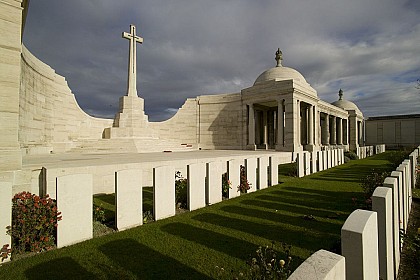
Dud Corner Cemetery and Loos Memorial
18 km

Dud Corner Cemetery and Loos Memorial

In 1914 Rudyard Kipling, author of The Jungle Book and winner of the Nobel Prize for literature in 1907, was a fervent advocate for British intervention in the European war. So much so that when his son John volunteered for service and was initially turned away for health reasons, Rudyard used his great influence to secure him a place in the Irish Guards. John Kipling's baptism of fire was in the Battle of Artois, opened by the Allies in September 1915. It was during the battle, on Gohelle Plain, that British forces used chlorine gas for the first time in reply to the German Army's use of chemical weapons at Ypres. The gas attack was initially a success but a change in the direction of the wind blew the gas towards the British lines and contributed greatly to the failure of the badly-prepared offensive. 'If any question why we died, tell them, because our fathers lied' In a single day of fighting the British Army recorded 8,500 casualties. In total 50,000 men were killed, wounded or lost in action. The names of 20,000 of these men can be seen today on the Loos Memorial which encircles Dud Corner Cemetery in Loos-en-Gohelle. One notable entry among these names is that of John Kipling who was killed in action on 27 September; he was 18 years old and his body was never identified. Rudyard Kipling never got over the loss of his son. He wrote shortly afterwards the poignant poem Have you news of my boy Jack? which reflects not only his distress but also the incertitude surrounding his only son's final resting place. An active member of the Imperial War Graves Commission, it was Kipling who suggested the beautiful phrase 'Known unto God' to be engraved on the tombs of Britain's unknown soldiers. Later he was to write in Epitaphs of the War the damning lines, 'If any question why we died, tell them, because our fathers lied.' The body of John 'Jack' Kipling was identified in 1992, three kilometres from Loos in the Saint-Mary ADS Cemetery near Haisnes-lez-la-Bassée.

Route de Béthune D943 62750 LOOS-EN-GOHELLE
Show
The Battle of Loos 1915
18 km

The Battle of Loos 1915

This was the largest British offensive mounted in 1915 on the Western Front.  The British would have preferred to remain on the defensive until the BEF numbered 36 divisions and had built up sufficient stocks of ammunition and heavy artillery. However this meant waiting until Spring 1916 and, with the Russians under severe pressure on the Eastern front and the Gallipoli campaign faltering, this was politically impossible. Sir John French's anxiety over the lack of suitable munitions unwisely led him to involve the military reporter Charles Repington. This action ignited a huge controversy back in Britain. The British Army was committed to a battle not of its choosing, in an area unsuited to an attack, without clear objectives and with its major commanders (French and Haig) at loggerheads. The opening saw the first use of poison gas by the British Army, following its introduction by the Germans, and was the first mass engagement of New Army units. Despite heavy casualties, there was considerable success on the first day but the reserve divisions were held too far from the battle front and the whole attack became bogged down. Sir John French had already been much criticised before the battle and his perceived poor handling of his reserve divisions in the battle led to his remaining support in both the Government and Army being severely eroded.He was replaced by Douglas Haig as Commander of the British Expeditionary Force in December 1915. Wikipedia Long, Long Trail

Show

Where to eat in Ostricourt

See more suggestions
Restaurants in Ostricourt offer a variety of cuisines.
See more suggestions

Where to sleep in Ostricourt

See more suggestions
Stay in unique accommodations in Ostricourt.
See more suggestions
Caution!
We have no information on the difficulty of this circuit. You may encounter some surprises along the way. Before you go, please feel free to inquire more and take all necessary precautions. Have a good trip! 🌳🥾