Alert

Alerts

To see around
See more
Open
Close
Show
Show
Show
Show
Show
Show
Show
Show
Show
Show
Show

Oups... It would appear that Cirkwi does not have permission to use your location.

Presentation
Description
Map
Steps
Points of interest
Ratings and reviews
See around

HIGHLIGHTS OF THE BATTLE OF VERDUN

HIGHLIGHTS OF THE BATTLE OF VERDUN
Credit : © Fondation Ossuaire

Description

In 1920 the Government decided to create a Red Zone at Verdun, to mark the soil rendered sterile by shell fragments and polluting chemicals. Ten years later, it received its first covering of some 10 million black pines, sent from Austria.
The nine destroyed villages included in this Red Zone will never again see the light of day, but the Prefect of the Meuse assures they will be maintained as memorials, by continuing to nominate a mayor to each one.

Starting from the Tourism Office, join the Green Way Cycle Path in the Parc Japiot opposite.

4.5 miles. Continue straight on, as far as the Canal Lock at BRAS-SUR-MEUSE.
Cross the bridge to reach the opposite bank and follow the canal as far as the next bridge.
Leave the Cycle Path, join the road and turn left, to reach the Stop sign opposite the Boulangerie.
Turn right onto the main road, then left opposite the restaurant

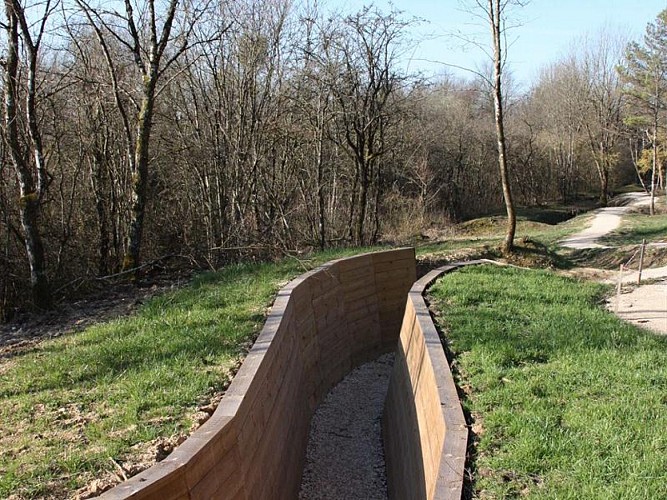
8.2 miles. Follow the main road and climb up to the Tranchée des Baïonnettes.

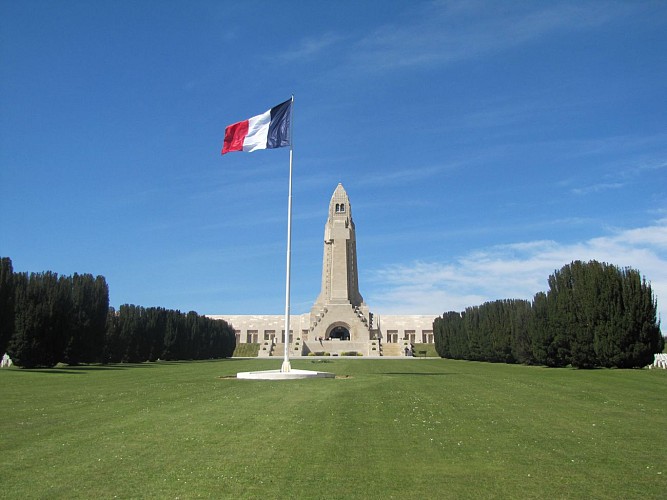
8.75 miles. Continue to climb, then after passing the restaurant, turn right and arrive at the Ossuaire de Douaumont. If you climb on foot the 204 steps inside the tower, you will have a 360 degree panoramic view of the entire battlefield

9.25 miles. Retrace your route to the Stop sign. To visit the disappeared village of Douaumont, go left and then immediately right and take the dead-end road to the disappeared village of Douaumont, then return to the main road. Alternatively, to go direct to the Fort de Douaumont, at the Stop sign turn right and descend to the next turning. At the Monument to the Unknown Soldier, turn left, towards the Fort de Douaumont.

9.7 miles. On the road to the Fort de Douaumont, you will cross over the Boyau de Londres.


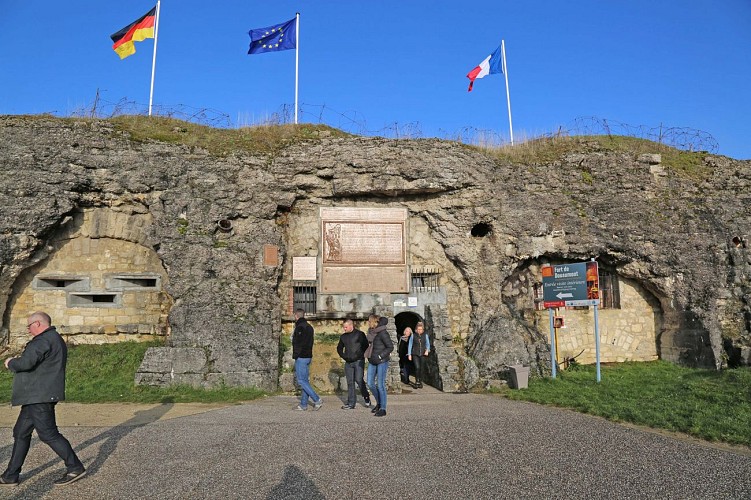
10 miles. On reaching the Fort de Douaumont, dismount and climb on foot onto the roof of the Fort, where you will have a panorama view of the horizon which in 1916 marked the German frontier.
You can also take the path on the left between the shell craters, which in 300 yards leads you to the lookout point.

10.3 miles. Return back to the Monument to the Unknown Soldier and turn left. On your left you will pass Abri (Shelter) 320 and on your right the National Cemetery.

11.8 miles. At the crossroads, turn left and pedal as far as the disappeared village of Fleury-devant-Douaumont.

12.2 miles. Continue straight on and pass the Mémorial de Verdun, dedicated to the Great War 1914-1918.

12.4 miles. Carry on to the Souville Lion, the monument which marks the nearest point to Verdun reached by the Germans in 1916, and where they were finally stopped.

12.75 miles. At the crossroads turn right and descend towards Verdun. You can visit the Souville fortified plateau by taking the small path on the left. There you can visit the unique Bussière twin turret, the Pamart machine gun casemates, and the ammunition shelters.

12.9 miles. On the road descending to Verdun, stop to admire the Maginot Monument on the left. A little further along there is a picnic area in the forest where you can rest.

15.3 miles. After crossing the railway bridge, at the Stop sign, cross over and pass by the Faubourg Cemetery. At the next Stop sign turn right, then immediately left, and pass the Braquier Dragée factory.

At the roundabout, turn right and pass the Parc de Londres. Then at the next roundabout, turn left towards the Tourism Office.

Technical Information

Electric bicycle
Difficulty
Medium
Duration
4h (1d)
Dist.
35 km
Show more

Altimetric profile

Starting point

1 Bis Rue de la Liberté , 55100   Verdun
Lat : 49.16161Lng : 5.38815

Points of interest

image du object

Trench of bayonets

Early visitors to the Verdun battlefield were often shown a curious site. It is easy to understand that local guides, for the most part veterans of the conflict, were only too tempted to embroider certain aspects of what, for the most part, resembled the surface of the moon. Thus the visitors were regaled by the tale of a group of French soldiers who, standing upright in their trench with fixed bayonets, ready to repel a German attack, were buried alive by the nearby explosions of several shells. As evidence, the tips of the said bayonets could be seen, in the alignment of a filled-in trench, protruding from the tortured soil. Thus was born the legend of the Tranchée des Baïonettes. On 8 November 1920, a stirring eulogy to the men of the 137 th Infantry Regiment who were assumed to lie there, was pronounced on the site, in the presence of none other than the President of the Republic. A rich American was sufficiently impressed to contribute out of his own pocket for the construction of a monument over the supposed trench to protect it and its occupants. The truth, revealed by Army investigators, is far more prosaic. In fact the bodies were found to have been buried laid out horizontally, and the Germans had used the bayonets as temporary grave markers. Nonetheless, the monument still stands today, and deserves visiting for what it actually does represent, namely a monument honouring brave soldiers, and witness to long-standing Franco-American friendship.d

- Tourisme Grand Verdun -
Consulter
image du object

Destroyed village of fleury devant douaumont

The village of Fleury-devant-Douaumont, situated on wooded heights, often escaped capture during invasions following the French Revolution of 1789, notably those in 1792, 1814, and 1870. However, with the construction of the Séré de Rivières line of forts along the heights of the Meuse after the 1870-71 war, its fate soon turned tragic. Its central location between the forts of Douaumont, Souville, Vaux, and the work at Froideterre became highly precarious during the great German offensive of 1916. Initially, the construction of the surrounding forts brought a measure of prosperity to the village due to the influx of workers and military personnel. By 1913, the population reached 422 inhabitants, allowing small businesses, inns, and artisans to develop alongside traditional rural agricultural activities. In September 1914, the Battle of the Marne established the front line several kilometers north of Fleury, and its inhabitants once again hoped to avoid a new German invasion. Indeed, in 1915, the village remained completely intact, teeming with combat or logistical troops preparing for the front or resting after their rotation. On February 21, 1916, at the onset of the massive German offensive, French military authorities evacuated the inhabitants to Bras-sur-Meuse and Verdun. On February 24, 1916, the fall of Fort Douaumont to the north and the advance of German troops and their heavy artillery marked the beginning of the bombardment and progressive destruction of the village. However, it was not until the fall of Fort Vaux to the east on June 7, 1916, that the village became fully encircled and found itself on the front line. From that point, German bombardment became incessant to enable their infantry to approach and enter the village for the first time on June 23, 1916. Yet, amidst raging battles, the ruins were retaken by the Poilus the very next day, June 24—though this hold was short-lived. In total, possession of the village alternated 16 times between June 23 and August 18, 1916, when it was finally recaptured by the Moroccan Colonial Infantry Regiment. Among the war events on the commune’s soil, the capture of the Powder Magazine on July 11, 1916, by the Germans stands out. This shelter, beneath 10 meters of rock, witnessed the combat death of Colonel Coquelin de Lisle, commander of the 255th Brigade. In October and November 1916, its ruins served as a base for offensives led by General Mangin, which recaptured Forts Douaumont and Vaux from the enemy, thus restoring relative calm until the end of the war in this village that had been relentlessly battered for six months. Classified as a "Red Zone" and declared "Dead for France" in 1918, it was granted the unique status of a destroyed village in 1919. Unable to rebuild their lives there, the inhabitants erected a shelter-chapel in 1934 on the site of their completely razed church. This chapel symbolically received the statue of Our Lady of Europe on its facade in 1979 to mark, notably, the advancing reality of European unity in peace. Twelve years earlier, on September 17, 1967, the Verdun Memorial had already been inaugurated on the site of the former Fleury train station, initiated and attended by Mr. Maurice Genevoix, the founding president of the National Committee for the Remembrance of Verdun. Due to the presence of the Memorial and numerous remembrance projects since undertaken on its territory, the commune of Fleury-devant-Douaumont has rightfully become the most visited of all destroyed villages. Points of Interest: The Chapel of Our Lady of Europe (Pietà fresco by Monsieur Lantier created in 1934, stained glass windows dedicated to the infantryman by Gruber in 1934) The War Memorial The Verdun Memorial (Museum on the Battle of Verdun) Paths and markers indicating the streets and houses of the destroyed village Discovery Trail of the Powder Magazine (remains of the old guard post and Vine Ravine) 650 m botanical trail between the Memorial and the destroyed village.

- Tourisme Grand Verdun -
Consulter
image du object

Maginot monument

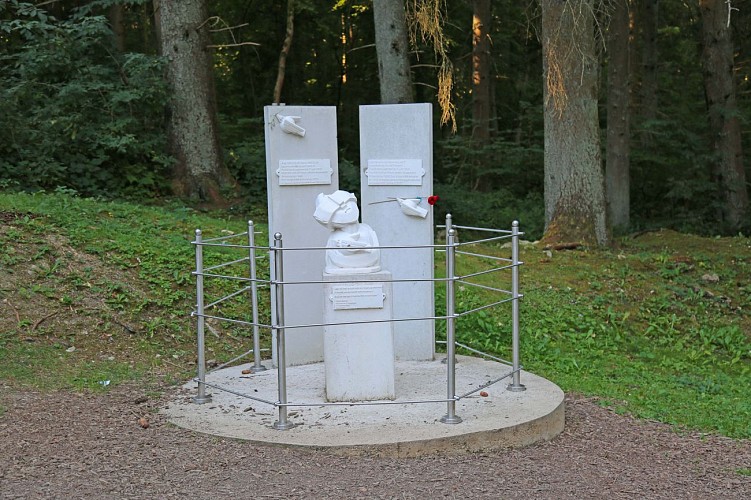
Contrary to the way the mobilisation plans were drawn up, many soldiers in the reserve rubbed shoulders with their comrades in the regular units. There was one regiment, the 44 th Territorial Infantry Regiment, which welcomed into its ranks the Member of Parliament for the Meuse, a certain André Maginot. Joining up as a volunteer in 1914, he quickly rose to the rank of sergeant, and led patrols into enemy territory. His boldness almost cost him his life, on 8 November 1914, near the Bois des Hayes. Seriously wounded, he was saved with difficulty by his men, but had to undergo medical treatment for many long months. After the Armistice, he once more took up his role of parliamentarian, as Minister for Pensions. Thus he presided over the ceremony on 10 November 1920 within the tunnels of the Underground Citadel of Verdun, when the Unknown Soldier was chosen. Falling ill with typhoid fever, he passed away in 1932, at the very time when he was busy preparing the ground for the new line of fortifications, intended to defend the North-East of the country – and which would be named after him. Three years after his death, President of the Republic Albert Lebrun inaugurated the monument by Gaston Broquet, which is let into the massif de Souville. Against the background of a warrior’s shield, the statuary group represents the scene on 8 November 1914, with two of his brave men carrying the wounded Maginot to safety on a Lebel rifle.

- Tourisme Grand Verdun -
Consulter

Data author

Place de la Nation 55100 Tourisme Grand Verdun

Ratings and reviews

To see around
See more
Open
Close
Show
Show
Show
Show
Show
Show
Show
Show
Show
Show
Show
Caution!
We have no information on the difficulty of this circuit. You may encounter some surprises along the way. Before you go, please feel free to inquire more and take all necessary precautions. Have a good trip! 🌳🥾