Alert
Alerts
From the Château de Serrières to the Communaux de Trept : a journey back in time along the river
1 alert on this circuit
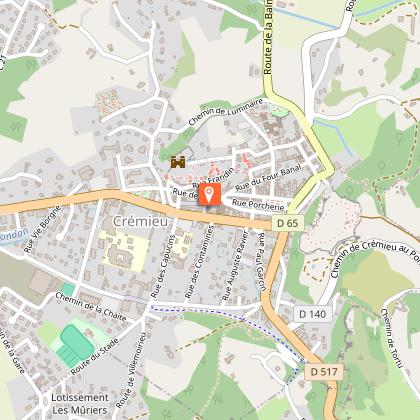
CRÉMIEU, CITÉ MÉDIÉVALE:
Alerte visiteurs
- Difficulté de stationnement lors de grandes manifestations.
- Travaux – Fermeture de la montée Saint-Hippolyte du 14 septembre au 15 novembre : accès impossible du lundi au vendredi. La montée reste accessible les samedis et dimanches.
Description
Along the paths, most of which are shaded, you can see castles, chapels, mills and wash-houses, as well as ponds and areas of dry grassland at Les Communaux de Trept, an ENS site where more than 500 animal species have been recorded.
Technical Information
Altimetric profile
Starting point
Points of interest




Additional information
Tips for the photographer
This walk has several magnificent viewpoints over the Alps (stages 2 and 8 of the walk). For macro-photography enthusiasts, the best time to visit the Espace Naturel Sensible des Communaux de Trept is in spring, when the red pulsatilla (a protected species) blooms.
Tips
A picnic break is recommended on the last part of the walk at Les Communaux de Trept. There is a shaded area.
Favourites / Must-sees
The Espace Naturel Sensible (ENS) des Communaux de Trept, managed by the association Lo Parvi, covering around a hundred hectares, is a remarkable site for its biodiversity and history. Classified as an ENS since 2003, it combines limestone slabs, dry moorland, woodland and crops. Abandoned in the 1960s, grazing has been restored here, encouraging the rehabilitation of dry grasslands and the return of rare species such as the red pulsatilla. A signposted 3km trail, which takes around 1? hours to complete, allows visitors to discover this floral heritage, with explanatory panels along the way.
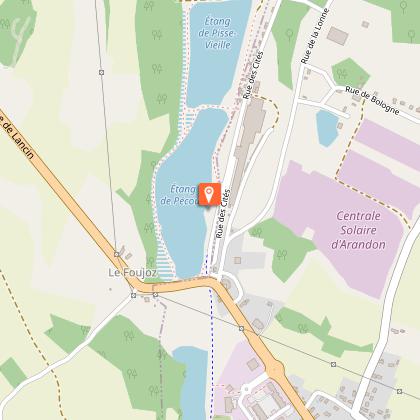
Fenières pond:
This pond was formed on morainic deposits left by the last ice ages.
From the Middle Ages onwards, water bodies, marshes and streams were developed to create ponds, encouraging fish farming and harnessing the power of water to run mills.
Along the way, you can see two millstones lying near the remains of the old Serrières mill.
Updated by
Office du Tourisme Les Balcons du Dauphiné - 07/08/2026
www.balconsdudauphine-tourisme.com/
Report a problem
Environments
Mountain view
Panoramic view
In the country
Sensitive Natural Area
Distinctions
Listed PDIPR
Open period
All year round daily.
Subject to favorable weather.
Topo guides and map references
Topo guides references :
The "Walks & Hikes" guidebook for the Balcons du Dauphiné is on sale for €14.90 at the tourist information offices in Crémieu, Morestel, Les Avenières Veyrins-Thuellin, and Saint-Chef.
A walking guide entitled “From Serrières Castle to the Communaux de Trept: a journey through time along the water” (FFR – Balcons du Dauphiné collection) is on sale for €1 at the Tourist Information Offices in Crémieu, Morestel, Les Avenières-Veyrins-Thuellin and Saint-Chef.
Type of land
Stone
Ground
Grit
Not suitable for strollers
Contact
Phone : 04 74 90 45 13
Email : tourisme@balconsdudauphine.fr
Website : https://www.balconsdudauphine-tourisme.com/
Facebook : https://www.facebook.com/profile.php?id=61556501098829
Reception complements
Hiking boots recommended.
History, culture and heritage
Château de Serrières (private, not open to the public):
Right from the start of the walk, the imposing Serrières mansion, dominating the plain, catches the eye. Built between the XIIIᵉ and XIVᵉ centuries by the powerful Dauphiné de La Poype family, this fortified house, elevated to the rank of castle in 1450, is distinguished by its main building flanked by a keep and several towers. Austere on the outside, it features a magnificent Renaissance courtyard and painted decorations. Surrounded by a vast park, the property belonged to the Louis family, who lived there until 1965. After that date, the château passed into the hands of the Renaud brothers, to whom we owe the extensive restoration work.
Stone in Trept :
Cut and dressed stone, omnipresent in the architecture of the
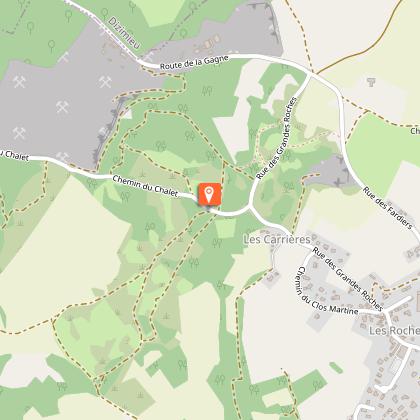
Isle-Crémieu, is clearly visible in Trept. The dry stone technique, using irregular stones with no binding agent, is frequently used for agricultural and retaining walls. The area's history is marked by stone quarrying, as evidenced by the old lime kilns and the active quarry at La Gagne, which has been operated by the Saint-Hilaire Group since 1970. This company uses limestone in a variety of sectors, including industry, construction, the environment, agriculture and animal feed.
The Truffet wash-house:
This wash-house is open on 3 sides and has a gable roof made of flaked tiles, typical of the roofs of the Bas-Dauphiné region.
Six monolithic stone posts stand on top. An essential feature until the mid-twentieth century, the wash-house was a place for socialising and chatting.
Guidebook with maps/step-by-step
1- At the starting post of the hike, go towards the church on the footpath, passing by the street "rue des Carriers".
2- At the post "Trept l'église", follow the direction Siccieu which goes round the church on the left by a small garden. After the gate, cross the D54 and take the opposite street. Continue until you reach the end of a cul-de-sac which you leave via a narrow passage. Then turn left. The road becomes a track, then a nature trail.
3- At the "La Sorbière" signpost, turn right towards Siccieu. The route joins a small road at a cross and an old bread oven. Turn left. The road, first dominated by the chapel Saint-Didier-de-Cozance located on a height, then skirts the pond of Fenières and continues by a wide track up to the post"Etang de Fenières".
4- Turn left, still towards Siccieu, past the"Etang Bouvet" post. At the "La Grande Taverne" sign, turn left onto a wide track towards "Dizimieu". At a large agricultural shed, turn right to reach the "Terre Villain" sign.
5- Head towards Trept. After 500 m on a wide track, the route turns slightly right onto a narrower track as far as the "La Gagne" sign.
6- Go straight ahead after crossing the road, direction Vénérieu, pass near the ‘Pelouses sèches’ landscaped area.
7- Turn left towards Trept. Cross the Espace Naturel Sensible des Communaux de Trept before going down to the D 517 at the "Bange" signpost.
8- Cross the road and take the street opposite as far as the Lavoir du Truffet. At the nearby crossroads, turn right. The route crosses the voie verte and continues around the village to a crossroads dominated by a cross. Turn left and follow the road up towards Trept church.
Animals
Yes. Pets allowed on lead only.
Data author
