Alert

Alerts

To see around
See more
Open
Close
Show
Show
Show
Show
Show
Show
Show
Show
Show
Show
Show

Oups... It would appear that Cirkwi does not have permission to use your location.

Presentation
Description
Map
Steps
Points of interest
Ratings and reviews
See around

Sentier a p'Art

Description

Works of art are installed in the middle of nature, on a hiking trail, for the pleasure of young and old curious.

This walk invites you to take a close and artistic look at the natural environment.

The artistic creation was entrusted to Coline Vergez, a local artist already well known in Simorre. His reflection on rural art and environmental concerns lead him to work with local artists and artisans for the realization of his 5 works and the signage of the course, using sustainable materials and/ or recovery.

Collaborations:
Jean-Michel Carcy, ironman of art in Seissan realized the arrows,
Kriss Fabr'Hic, artisan of art recycler in Biran created the birds,
Crhistophe Moine "Xof" recuperist diverter has realized the "Cycloraptosaurus",
Aliénor Rajade glass artist in Simorre has realized "Insects in light",
Jeff Cervera, cabinetmaker in Simorre has directed "La Pause des deux horizons",
Stéphane Vincent carpenter of marine in Simorre, has realized "L'oeil du cocon",
Juju and Dédé (MH Services) in l'Isle-en-Dodon have realized "The flight of flavors".
A dossier "under the magnifying glass" gives you all the details about the artists, as well as the small exhibition presented in the tourist information office of Simorre.

Discover or rediscover the p'Art trail with a series of audio guides.
Along the trail, discover the explanations of Coline Vergez, the creator of the trail.
Get on the trail using the materials available at the tourist information offices of Gimont and Simorre and flash the QR code of the document as you go.
The audio files are also available for online listening on our website.

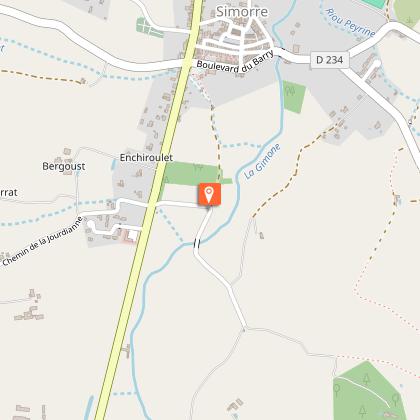
Starting point at the car park of the railway in Simorre
Distance: 4 km (walking time 1h-1h30)
Detailed file on the Path to p'Art available at the Tourist Office Coteaux Arrats Gimone.

Technical Information

Walking
Difficulty
Very easy
Duration
1h30mn
Dist.
4.6 km
Show more

Altimetric profile

Starting point

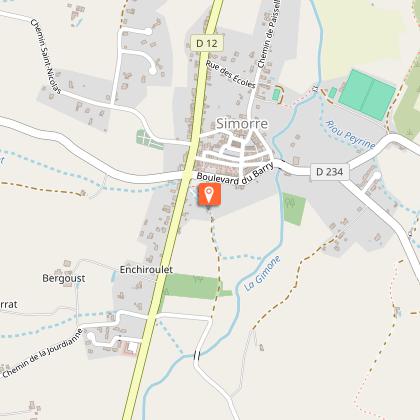
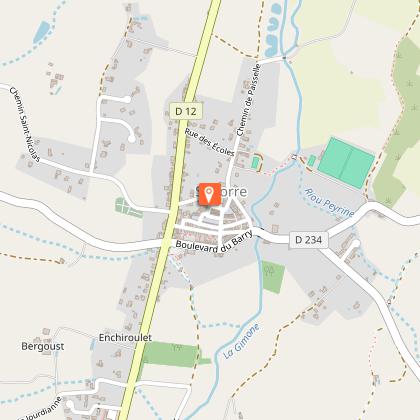
Parking du Foirail , 32420   Simorre
Lat : 43.449113Lng : 0.733902

Points of interest

image du object

Notre-Dame Abbey Church

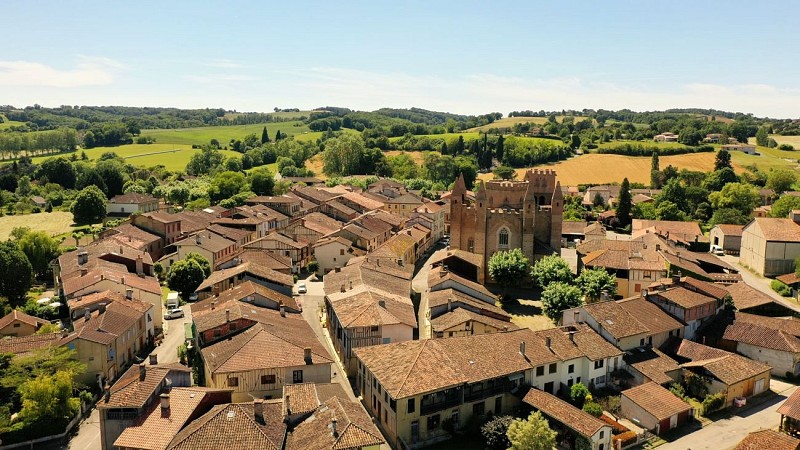
The Church of Simorre is a 14th-century abbey church built on a 5th-century oratory created by Cérats, who became the patron saint of Simorre.The History of the Abbey Church: Founded, according to tradition, in 507 by Clovis, the Benedictine abbey of Simorre was one of the most important in the region. The convent buildings, once attached to the north of the church, disappeared after being sold as national property during the French Revolution. At the end of the 13th century, a conflict between the Abbot of Simorre and the Count of Astarac, with the support of King Philip IV the Fair, enabled the church's reconstruction to be financed. Construction began around 1290, and the building was consecrated in 1309, which explains its remarkable architectural unity. Built primarily of brick, the church adopts a Latin cross plan, typical of Toulouse Gothic architecture, with a flat apse inspired by Cistercian architecture. Its finely sculpted Gothic stone portal is protected by a fortified porch, recalling the monument's defensive role in the Middle Ages. Inside, admire the octagonal vault surmounted by a lantern tower, the 14th-century murals in the former sacristy, the stained-glass windows dating from the 14th to the 19th centuries, and the choir stalls dating from the early 16th century. Classified as a Historical Monument in 1843, the abbey church was restored by the architect Eugène Viollet-le-Duc, who gave it its current fortified appearance. Restoration campaigns in the 20th century enhanced the brickwork and interior decorations. The stained-glass windows: The abbey church preserves a remarkable collection of stained-glass windows from the 14th to the 19th centuries. Nine windows, dating from 1357, depict, among other things, the Crucifixion, Saint Sernin, Benedictine monks, and Saint Louis. Their style, devoid of perspective, is comparable to that of the medieval stained-glass windows of Narbonne Cathedral. Other 15th-century stained-glass windows introduce perspective and warmer colors. They depict the martyrdom of Saint Catherine and Saint James as a pilgrim. At the beginning of the 16th century, Renaissance-style stained-glass windows appeared, representing Saint Cérats, the evangelizing bishop and patron saint of Simorre, as well as the Virgin and Child and Saint Dode, likely influenced by the workshops of Auch Cathedral. 19th-century stained-glass windows complete the ensemble. The choir stalls: The 38 choir stalls, dating from the early 16th century, are in the Flamboyant Gothic style, restrained and elegant. Donated by Bishop Jean Marre, a native of Simorre, they feature a rich sculpted program blending biblical scenes (Genesis, baptisms, martyrs) with more secular, sometimes humorous, motifs. The abbot's stall, adorned with an Annunciation scene, occupies the central position. The Sacrament Room: This 14th-century vaulted room housed the relics venerated by pilgrims. Its murals, rediscovered in 1964, depict, among others, Saint Benedict and Saint Scholastica, Saint Michael slaying the dragon, a Crucifixion, and Saint Sernin. The Crossing and Architectural Details: At the crossing of the nave and transept, an impressive octagonal dome illustrates Gothic craftsmanship and a spiritual symbolism evoking the ascent to the heavenly Jerusalem. On the walls, one can also see putlog holes, remnants of the scaffolding used during construction. The church is open during the day for self-guided visits. A descriptive document is available on site, as well as information panels installed inside the church. An audio tour is also available to visitors free of charge (press the button on the wall to the left upon entering)

- Apidae -
Consulter
image du object

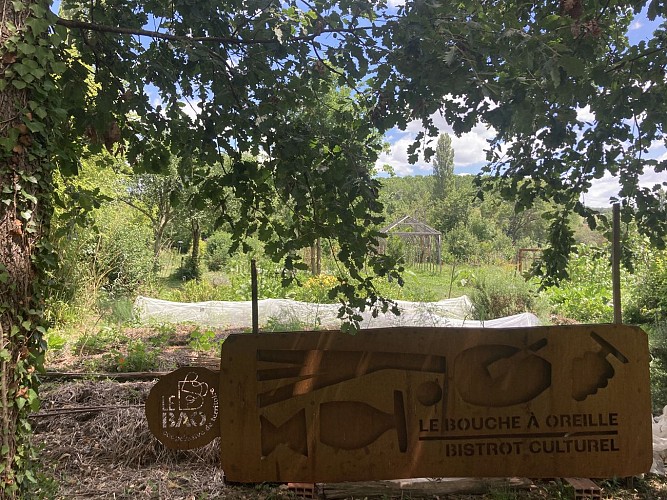
Bouche a Oreille kitchen garden

You can visit the vegetable garden at Le Bouche à Oreille restaurant, to the delight of young and old alike!Le Bouche à Oreille (‘BAO’ for those who are used to it) is a SCIC, a not-for-profit structure, bringing together more than 120 cooperators around 4 colleges: 1- Food, from the vegetable garden to the plate. 2- Culture and popular education. 3- Development of local economic initiatives. 4- Ethics and transmission, which drives the project's democracy. In addition to delicious meals and cultural events throughout the year, Le Bouche à Oreille has created its own vegetable garden in the village of Simorre. Situated along the footpaths, the kitchen garden is open to the public and allows visitors to discover the many and varied vegetables, herbs and edible flowers that have been carefully cultivated to create the sublime menus proposed by chef Séverine. The kitchen garden is accessible by a few wooden steps from a footpath, and is open to the curious. The names and varieties of the plants are listed on small slates that sometimes reveal surprises. Take your time on site, as wooden chairs and tables have been set up for resting, picnicking, chatting, watching the frogs or admiring the portraits of the women vegetable gardeners! The ‘Structure artistique à utilité potagère’ project was born out of a desire on the part of the BAO's ‘Alimentation’ collective to bring art to the ‘village kitchen garden’. The idea was not just to bring gardeners, villagers and visitors into contact with artistic works, but to use them as a vehicle for questioning and reflecting on the environment in which they live: the vegetable garden. Trained as a scenographer, Coline Vergez's artistic work always bears witness to the environment in which it is set. She seeks to highlight and question it, while integrating her pieces within it. In this way, the works fit into a logic of harmony between materials, in images that make sense and/or in their utility. The first work, ‘Un petit coin de cuisine ou...les coulisses de la vie’, is part of an overall concept that will see other installations created in the same spirit. Coline Vergez has also created an installation in the heart of the village and, in 2019, the ‘Sentier à p'Art’, a 4km walking trail made up of 5 works based on the principle of Land'Art, starting in Simorre. To get to the kitchen garden, ask for directions at the Bouche à Oreille in the village square, or from the Foirail car park, follow the signposted footpaths and the artistic signposts of the Sentier à p'Art to find the kitchen garden (100m on your left).

- Apidae -
Consulter
image du object

Artistic Structures with Vegetable Use

This artistic project was born out of the desire of the ‘Food’ collective of the Bouche A Oreille cooperative to bring art to the ‘village kitchen garden’.The idea was not just to bring gardeners, villagers and visitors into contact with artistic works, but for them to be a vehicle for questioning and reflecting on the environment in which they are displayed: the kitchen garden. The artistic work of Coline Vergez, scenographer, is always a witness to the environment in which it takes place. She seeks to highlight and question it, while integrating her pieces within it. In this way, the works fit into a logic of harmony between materials, images that make sense and/or their utility. She created her first work ‘MMMMH!’ in the village of Simorre, as well as 5 ½uvres that make up the Sentier à p'Art - a 4km walking trail starting from Simorre based on the principle of Land'Art. ‘In this project, I want to remain faithful to this way of working and propose works that are fully integrated into the intention of the vegetable garden; that respect its gesture, reveal it and serve it. My artistic approach is intended to be accessible to everyone, in a language that is clear and easy to understand, and that does not compartmentalise. I want to speak to everyone and I want my work to speak to everyone". A little corner of the kitchen or...behind the scenes of life. This first work, installed in May 2020, highlights a central element of the kitchen that plays as essential a role in the processing of food as it does in that of the people who live there: its table. ‘I chose it for its most basic function. It's the heart of the kitchen, the place where food is cut and chopped, de-boned, sorted, cleaned, weighed, pressed... The place where food becomes a meal. But it's also the place where people reveal themselves, alone or to each other. I love the idea that a single edge of the kitchen table could have witnessed the birth of love, the passing of culinary or family secrets, the tearing apart of people, the making of major decisions, the creation of projects, the growth of children, the sharing of desires... No matter how insignificant, this little corner of the table works on living things, transforms them and makes them evolve. Its scale has been enlarged to emphasise its importance, but also to make it a useful structure in the vegetable garden. Both the chair and the table can accommodate climbing plants and cucurbits, and their heights allow the gardener to pick fruit with ease, while creating a shady spot in summer. In winter, the table is covered in strips of woollen fabric coloured with plants from the garden or picked nearby. Artistic structures for kitchen use. Un petit coin de cuisine ou...les coulisses de la vie’ is part of an overall concept that will see other installations created in the same spirit. The idea is that each artistic installation should be made up of three essential elements: it should provoke questioning, it should be useful and it should be legible. These elements will be developed in different ways for each piece. In this context, Coline's work will question what is not visible to the naked eye: the purpose of market gardening (for what purpose do we cultivate, how do we transform what grows there, what is the future of what we create there? etc.) or will highlight the invisible but essential players in the life of the vegetable garden (its microcosm: earthworm, beetle, lucanus, dragonfly, etc.). The works will all have a real function within the garden, whether in the gardening process, in providing amenities for native flora or fauna, or in improving the living spaces for gardeners or visitors. This work will be aimed at a lay audience and is intended to speak to everyone. Each person will interpret the works in their own way, depending on who they are and what their artistic background is, but the creations will use a very direct and clear visual language. To facilitate this, humour and paradox will be used to demystify art and make it accessible to everyone.

Place de la mairie 32420 Simorre
- Apidae -
Consulter
image du object

Village of Simorre

A charming village, with its fortified church, its old central market hall, its museum, its half-timbered and corbelled houses, its foirail and shady squares that invite you to visit. Simorre surprises and amazes.The atmosphere of this small village is pleasant, as are the friendly musical nights in the square opposite the Bouche à Oreille. A little history: The village's picturesque narrow streets are particularly striking for their impressive fortified church, which rises up between the roofs of the houses and gives the impression of taking a trip back to the heart of the Middle Ages. After a devastating fire in 1141, the village, formerly the capital of Astarac, was rebuilt around the abbey, and the whole complex was fortified in the 12th century. To resist the Count of Astarac, the abbots constantly improved their abbey, which was given a cloister, an octagonal bell tower and extended to the west. The Abbey Church, an architectural jewel: A masterpiece of brickwork lost in the Astarac of stone. Dedicated to Notre Dame, it was built on the site of the previous church, which may have extended further west, as work carried out in 1900 uncovered remains of the construction in the extension of the current nave. Major restoration work was carried out between 1844 and 1858 under the direction of Viollet-le-Duc. The roof, which covered the walls, was lowered so that it rested directly on the vaults, and a crenellation was built around the building. ‘Simorre, a slow and committed commune! It belongs to the network of the national Cittaslow label’.

- Apidae -
Consulter

Additional information

Updated by

Office de Tourisme Coteaux Arrats Gimone - 18/09/2025
Report a problem

Open period

All year round daily.

Contact

Phone : 05 62 67 77 87

Email : contact@tourisme-3cag-gers.com

Website : www.tourisme-3cag-gers.com/

Type of land

Ground

Animals

Yes. Animals kept on a leash.

Ratings and reviews

To see around
See more
Open
Close
Show
Show
Show
Show
Show
Show
Show
Show
Show
Show
Show
Caution!
We have no information on the difficulty of this circuit. You may encounter some surprises along the way. Before you go, please feel free to inquire more and take all necessary precautions. Have a good trip! 🌳🥾