Alert

Alerts

To see around
See more
Open
Close
Show
Show
Show
Show
Show
Show
Show
Show
Show
Show
Show

Oups... It would appear that Cirkwi does not have permission to use your location.

Presentation
Description
Map
Steps
Points of interest
Cirkwi brief's
Ratings and reviews
See around

Balconies and rocks of Fontainebleau

Balconies and rocks of Fontainebleau
Balconies and rocks of Fontainebleau_Fontaine-le-Port

Description

Discovery of the Fontainebleau forest, first along balconies overlooking the Seine Valley dotted with beautiful residences, then through its woodland stands to the famous Denecourt Tower, where you will enjoy a wide panorama.

Between river and forest: landscapes rich in diversity discovery of the Fontainebleau forest and the landscapes along the banks of the Seine. From Massoury to Fontainebleau, your route, marked by beautiful mansions, leads to the famous Denecourt Tower, from which you can enjoy an exceptional panorama over the entire forest.

Technical Information

Walking
Difficulty
Medium
Duration
4h30mn
Dist.
17 km
Show more

Altimetric profile

Starting point

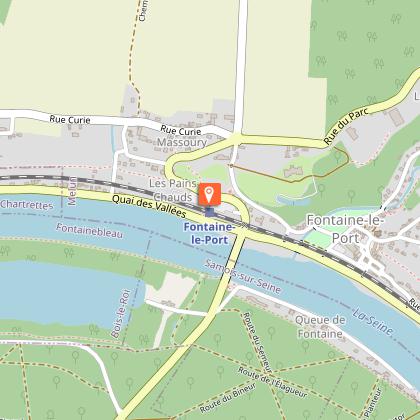
Parking de la gare de Fontaine-le-Port (côté voie arrivée de Paris) , 77590   Fontaine-le-Port
Lat : 48.48738Lng : 2.751186

Steps

Points of interest

image du object

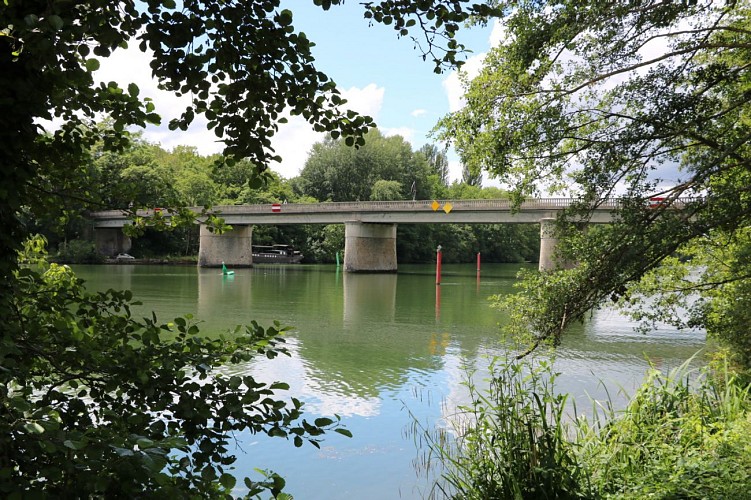
Pont de Seine

Le Pont de Seine entre Fontaine-le-Port et Bois-le-Roi est un ouvrage d'art qui fait partie intégrante du paysage. C'est en 1862 que ce pont à péage entre la rive droite et la rive gauche de la Seine fut inauguré.Une page d'histoire raconte le passage le 3 octobre 1609 de la Seine à Fontaine-le-Port par la Cour Royale accompagnant le dauphin Louis, futur Louis XIII, qui se rendait à la chasse aux loups dans les buissons de Massoury. Effectivement, jusqu'en 1862, le bac fut l'unique moyen pour traverser le fleuve. En 1862 un pont à péage entre la rive droite et la rive gauche de la Seine fut inauguré. En 1870, donc 8 ans à peine après son inauguration, le pont fut détruit pour la défense du territoire. Reconstruit en 1972, il tient bon jusqu'en 1939, mais la faiblesse de l'ouvrage obligea le service des Ponts et Chaussées de l'époque à envisager sa reconstruction pour lui donner l'aspect que nous lui connaissons aujourd'hui. Les travaux étaient en cours lorsqu'en juin 1940, après le passage de ses chars, l'armée française, pour des raisons stratégiques, décida de faire sauter l'une des travées du pont, la 1ère surplombant le fleuve, côté Fontaine-le-Port. Le chantier reprit, et en août 1941, le pont en béton armé, est rouvert à la circulation. En juin et juillet 1944, les Alliés poursuivent leur avance, la libération approche, mais Fontaine-le-Port va connaître, comme beaucoup de villages, des heures d'angoisse… Trois ans après sa réouverture, le 20 août 1944, le pont est anéanti, cette fois-ci par l'armée allemande en plein repli. En attendant le reconstruction, un service de passage de la Seine par bateaux fut établit près du pont de juin 1945 à avril 1946, date de nouvelle mise en circulation. Mais il faudra attendre 1988 pour que le pont bénéficie d'une remise en état lui permettant d'assurer un service adapté à la circulation contemporaine. En 2006, une borne retraçant l'histoire du pont fut posée.

Route Départementale 116 77590 Fontaine-le-Port
- Communauté de Communes Brie des Rivières et Châteaux -
Consulter
image du object

Fontaine-le-Port

Entre Seine et forêt, Fontaine-le-Port dévoile des siècles d'histoire : une abbaye capétienne, un pont aux mille vies, un château de sultan et une gare autrefois élue la plus jolie de France.#AUX ORIGINES DE FONTAINE-LE-PORT La commune est occupée depuis l’Antiquité, son développement reste longtemps rural, structuré autour de l’agriculture, de la rivière et des échanges liés au passage sur le fleuve. Le nom de "Fontaine-le-Port" est attesté sous de nombreuses formes anciennes : "Ecclesia de Fontanis" vers 1145, "Clausum de Fontanis" en 1180, ou encore « Fontaines le Port » en 1385. Ces variations témoignent de l’évolution progressive du toponyme au fil du Moyen Âge. Les habitants sont aujourd'hui appelés Portifontains et Portifontaines. Le blason de Fontaine-le-Port représente un pont au-dessus de l’eau, rappelant le lien du village avec la Seine et les passages sur le fleuve. On y voit aussi une fontaine, symbole du nom de la commune, ainsi qu’une branche de chêne, évoquant les forêts environnantes et le cadre naturel du territoire. L’ensemble met en valeur l’identité du village, entre eau, nature et paysage forestier. #MÉMOIRE DU PASSÉ > La Seine est au cœur de l'identité de Fontaine-le-Port, dont le nom même évoque la présence d'un gué et de sources facilitant le passage du fleuve. Dès le Moyen Âge, les moines de l'abbaye de Barbeau perçoivent des droits de passage sur les embarcations et utilisent le fleuve pour acheminer leur vin jusqu'à Paris. Pendant des siècles, la traversée s'effectue en bac, emprunté par les habitants, les voyageurs, les marchands et le bétail, et même par la Cour royale, comme en témoigne le passage du futur Louis XIII le 3 octobre 1609, en route vers les bois de Massoury. En 1862, sous l'impulsion du maire de Valmer, un pont à péage est inauguré, marquant une étape majeure pour le village. Son histoire sera néanmoins mouvementée : détruit en 1870, puis à nouveau en 1940 et en 1944 lors du repli allemand, il sera chaque fois reconstruit, avec un retour provisoire du bac entre 1945 et 1946. La Seine fut également une voie de commerce essentielle, parcourue de trains de péniches tirées par toueurs ou remorqueurs, avant l'essor du moteur diesel au 20e siècle. Avec l'arrivée du chemin de fer en 1897, le fleuve prend une nouvelle dimension : celle des loisirs, attirant les vacanciers parisiens sur ses rives. Entre 1925 et 1935, le stade des "Iris", créé rive droite par un professeur de natation, M. Chevalier, incarne cet engouement avec ses bassins, ses agrès et ses cabines. Le niveau du fleuve lui-même fut rehaussé d'environ 60 centimètres au début des années 1960, régularisation qui permit de limiter les crues catastrophiques comme celles de 1910 ou de 1955. > Fondée en 1145 par le roi Louis VII, l’abbaye de Barbeau devient rapidement un important établissement cistercien lié au pouvoir royal et à l’histoire de la vallée de la Seine. Importante fondation religieuse de la région, elle est pillée en 1793 durant la Révolution française. Elle connaît ensuite une réutilisation partielle sous le Premier Empire, notamment avec l’accueil d’un établissement destiné aux orphelines de la Légion d’honneur. Un épisode marquant concerne les restes du roi Louis VII, initialement inhumés à l’abbaye. Conservés puis déplacés pendant la Révolution, ils sont ensuite réinstallés avant d’être transférés en 1817 lors d’une cérémonie solennelle à l’église du village, puis définitivement déposés à la basilique de Saint-Denis. L’abbaye disparaît au cours du 19e siècle, mais elle laisse une empreinte durable dans l’histoire locale. > Jusqu’au 19e siècle, le village conserve une activité agricole et viticole modeste, avec des vignes principalement situées sur les coteaux ensoleillé et destinées à une consommation locale. > À la fin du 19e siècle, l'arrivée du chemin de fer transforme profondément Fontaine-le-Port. Le tracé initial, qui devait traverser le plateau par Le Châtelet-en-Brie, fut modifié en raison de l'opposition du Comte de Greffulhe, homme influent soucieux de préserver ses terres de chasse. La ligne, mise en service en 1897 par la Compagnie Paris-Lyon-Méditerranée, nécessita d'importants travaux : démolition du mur d'enceinte, expropriation de riverains, suppression de la place publique et réduction du port. Malgré ces bouleversements, la gare devint un véritable symbole du village : primée en 1955 comme la plus jolie gare de France, elle servit également de halte protocolaire pour les chefs d'État en visite officielle. Le chemin de fer favorisa ainsi l'essor touristique de la commune et son ouverture vers l'extérieur, marquant durablement le paysage et la vie locale. #VISAGES D’HISTOIRE > Louis VII "le Jeune" roi de France de 1137 à 1180, fonde en 1145 l’abbaye de Barbeau à proximité du village. Il y séjourne régulièrement pour la chasse et choisit d’y être inhumé, faisant du site un lieu lié à l’histoire royale capétienne. > Étienne Pariset, médecin, académicien et maire du village, joue un rôle important dans la vie locale au 19e siècle. Il est notamment connu pour avoir fondé la Société Protectrice des Animaux (SPA) en 1845, dont l’action se poursuit encore aujourd’hui. > Durant la Seconde Guerre mondiale, le territoire conserve également la mémoire du capitaine américain John C. Ramsay. Pilote de chasse engagé dans une mission de bombardement en juin 1944, son appareil est touché par les défenses allemandes et s’écrase dans le bois de la Renaudière, à Fontaine-le-Port. Pris en charge par des habitants après s’être éjecté en parachute, il succombe à ses blessures quelques jours plus tard. Une stèle commémorative, située sur le lieu du crash, lui rend hommage. > Jacques Schnerb, graveur, peintre et écrivain, s’engage durant la Première Guerre mondiale et meurt pour la France. Son nom est inscrit sur le monument aux morts de la commune et figure parmi les écrivains honorés au Panthéon. > Marcel Vallée (1880–1957), acteur de cinéma de l’époque du muet puis du parlant, est connu pour ses rôles comiques au théâtre et à l’écran. Il vit et termine sa vie dans la commune. > Madeleine Michelis (1913-1944), résistante française engagée durant la Seconde Guerre mondiale, possède une résidence à Fontaine-le-Port où elle séjourne régulièrement. Le village représente pour elle un lieu de repos avant son engagement dans la Résistance et sa mort tragique. Une rue de la commune porte aujourd’hui son nom en hommage à son engagement. > Arthur Koestler, écrivain et essayiste de renommée internationale, auteur du roman "Le Zéro et l’Infini", séjourne à Fontaine-le-Port entre 1949 et 1953. Il y vit dans sa maison "Verte Rive", au bord de la Seine, ce qui contribue au rayonnement culturel du village. > François Bédarida (1926–2001), historien français spécialiste de la Seconde Guerre mondiale et de la Résistance, s’installe dans la commune où il termine sa vie. Il est également inhumé dans la commune, renforçant le lien entre le village et la mémoire historique nationale. > Le sultan d'Oman Qabus ibn Saïd (1940-2020) possédait deux châteaux dans le parc de Massoury, à Fontaine-le-Port. Le château de la Barre, bâti à la fin du 19e siècle dans le style Louis XIV, fut rénové par ses soins en 2005. Le domaine comprend un parc d'une dizaine d'hectares avec vue sur la Seine. Le sultan y avait également créé un haras pour ses pur-sangs en rachetant une ferme voisine. Pour relier son château à ce haras par un souterrain, il finança en échange un rond-point de 500 000 € offert à la commune. Un arrangement « gagnant-gagnant » entre un petit village briard et l'un des monarques les plus fortunés du monde. #PATRIMOINE ET COUPS DE CŒUR > Au cœur du village, l’église Saint-Martin accompagne depuis des siècles la vie de Fontaine-le-Port. Son clocher médiéval, visible de loin, contraste avec les parties reconstruites plus tard, notamment au 16e siècle. Remaniée au fil du temps sans perdre son caractère ancien, elle garde la mémoire des différentes périodes traversées par le village et reste aujourd’hui l’un de ses bâtiments les plus emblématiques. > Les lavoirs de la Coudre, de Massoury et du ru du Châtelet témoignent de la vie quotidienne rurale d’autrefois et de l’importance de l’eau dans l’organisation du village. Alimentés par les sources et les cours d’eau locaux, ces équipements simples mais essentiels étaient intégrés à la vie des bourgs et des hameaux. Plus singulier, un bateau-lavoir a également existé sur les bords de la Seine à Fontaine-le-Port. Amarré le long de la rive, il servait à la fois au lavage du linge et de lieu de rencontre pour les habitants. Il a été utilisé jusqu’en 1945 avant de disparaître sous les attaques allemandes. > Le territoire est marqué par la présence de la forêt de Barbeau, ancien espace lié à l’abbaye du même nom, aujourd’hui intégré à un vaste massif boisé propice aux promenades et à la découverte de la faune et de la flore locales. #LE SAVIEZ-VOUS ? Durant l'hiver 1879, une vague de froid exceptionnelle s'abat sur la région, avec des températures descendant jusqu'à -24°C. La Seine, gelée pendant 21 jours, se transforme en véritable plancher solide. Les Portifontains, privés des commodités, en font alors un terrain de fête : au milieu du fleuve figé, un bal public improvisé réunit les familles du village, qui dansent pour se réchauffer. Tandis que les femmes font sauter des crêpes sur des réchauds installés à même la glace. (source : Raymont Prunet - Fontaine-le-Port d’hier à aujourd’hui).

3 rue du Général Roux 77590 Fontaine-le-Port
- Communauté de Communes Brie des Rivières et Châteaux -
Consulter
image du object

Fontainebleau forest

“It's not just a forest I want to see, it's Fontainebleau” Marcel Proust. Powerful smells from the undergrowth, the inhabited silence of the forest, shimmering colours and landscapes dictated by the seasons - the visitor delights in the multi-faceted personality of the forest of Fontainebleau.Jumbled sandstone boulders concealing caves with legendary secrets, greenness stretching as far as the eye can see, tinted with golden colours in autumn and bluish with frost on winter mornings - you can almost believe you have joined the immensity of the world! The forest at the dawn of time... The forest of Fontainebleau covers 17,000 hectares, extended by the 3,000 hectares of the massif of the Trois Pignons. Paths have been laid and marked out for 300 km. Sandstone has formed on its silty, sandy soil, throwback to the Stampian sea that covered it at the dawn of time: the grains of sand have cemented over millions of years, causing rock falls and creating caves and boulder fields, gradually eroded by rain and wind. A fresh water lake deposited limestone from shell debris on the sand and the sandstone, protecting the forest sand and keeping it white and pure. Multi-faceted flora and fauna 5,685 species of plant life have been listed: oak, beech, hornbeam, chestnut, locust, birch, maritime and Scots pine and juniper, plus a few curiosities planted by former owners: sequoia, spruce and cedar. Protected wild animals coexist in the seeming tranquillity of the forest: deer and roe deer, wild boar and foxes, squirrels, rabbits, badgers and even reptiles. Although you are unlikely to encounter any wolves, you may perhaps catch sight of some timid elk by penetrating into the depths of the forest, although they are active mainly at twilight and during the night when their kingdom is returned to them. The forest sings with the chirping of 250 different species of birds, but you need patience and a good musical ear to identify them all! Dream landscapes! The forest of Fontainebleau contains a number of outstanding landscapes and sites. Of particular note, perhaps, are the Franchard gorges, the former 12th century hermitage and the viewpoint over the forest and the far-distant plain; the Apremont boulder field and desert, famous for its rock piles; the heights of the Solle, for the panorama at their foot over the racecourse and the magnificent tall beech forest of Gros Fouteau, not forgetting the Croix du Calvaire, dominating the town of Fontainebleau and its château.

Route de l'Ermitage 77300 Fontainebleau
- Seine et Marne Attractivité -
Consulter
image du object

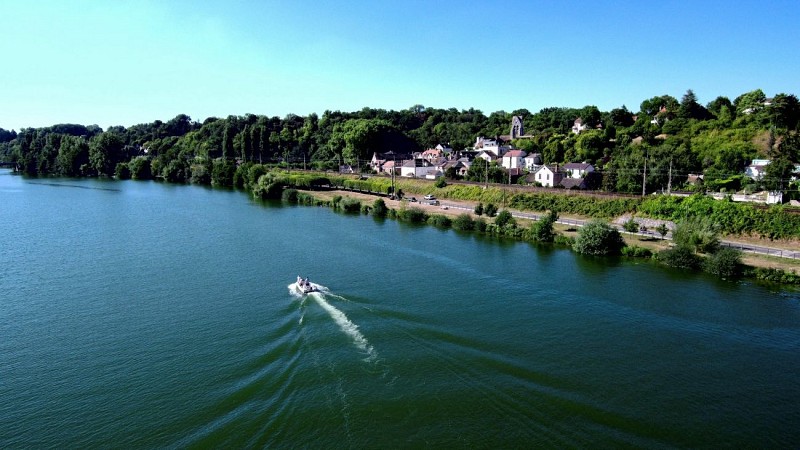
Bois-le-Roi - charming village on the banks of the Seine

Between the Seine and the Forêt de Fontainebleau, Bois-le-Roi invites you to enjoy a natural getaway between elegant villas, waterside strolls and outdoor leisure activities.Situated between the Seine and the forest, Bois-le-Roi reveals a gentle, fluvial atmosphere. Along the quays, the famous "Affolantes", elegant holiday villas with flower gardens, built between the end of the XIXᵉ century and the interwar period, dominate the Seine and bear witness to a refined riverside art of living. These residences tell the story of the stays of yesteryear and compose a unique landscape, conducive to strolling and contemplating the calm waters. Easily accessible from Gare de Lyon in Paris in just 40 minutes on the Transilien R line, the village is an ideal destination for a nature getaway. You'll also find the Île de loisirs de Bois-le-Roi, a vast relaxation area nestled between the Forêt de Fontainebleau and the banks of the Seine. This 73-hectare haven of greenery, including an 8-hectare lake, offers a wide range of sports and leisure activities for the whole family. In summer, the swimming area is the perfect place to cool off and take full advantage of this exceptional natural setting. From the village, you can also take advantage of 3 pedestrian and bicycle paths through the Fontainebleau forest to the villages of Samois-Sur-Seine and/or Barbizon, as well as to the town of Fontainebleau.

4 avenue Paul Doumer 77590 Bois-le-Roi
- Fontainebleau Tourisme -
Consulter

Additional information

Updated by

Seine et Marne Attractivité - 05/06/2026
www.tourisme-seine-et-marne.fr/
Report a problem

Contact

Phone :
01 60 39 60 69
01 60 74 99 99

Email :
seine-et-marne@ffrandonnee.fr
info@fontainebleau-tourisme.com

Website :
http://www.randonnee-77.com/
http://www.fontainebleau-tourisme.com/

Open period

All year round daily.

Environments

Riverside
Waterside
Station district
In the country
Close to a public transportation
Less than 10 min walk from a train station

Guidebook with maps/step-by-step

Departure : 1. From the car park of Fontaine-le-Port train station (Paris arrival side), go up the road to Massoury. At the bend, before the washhouse, take Rue des Grillons on the left, then Rue Curie (RD135) on the left, and before entering Massoury, take Rue des Plantes on the left. Continue along Rue du Champ-Fleuri. After the last house, in the woods, go down the path on the left. Take the path on the right overlooking the railway line. Go down the road on the left, pass under the bridge, follow the RD39 to the right for 50m, then turn left to follow the Seine to the dam.

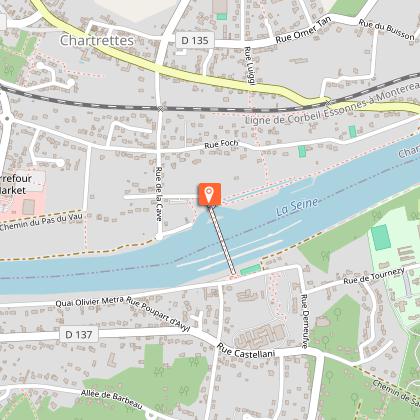
2. Take the footbridge over the Seine and continue to the right.


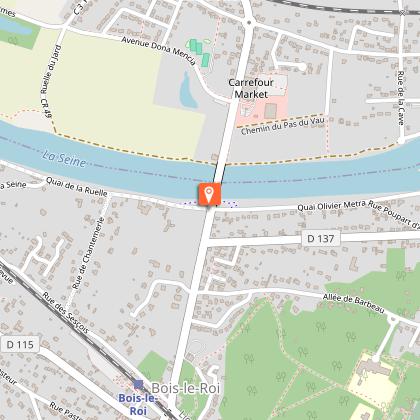
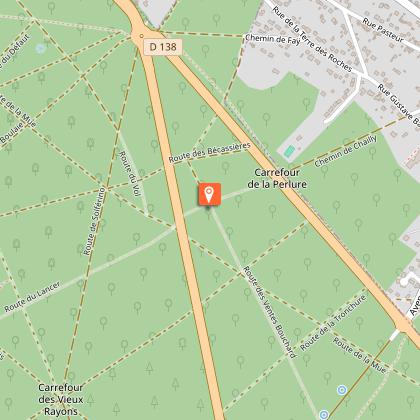
3. At the bridge, go up the avenue on the left. Take the allée de Barbeau on the left, leave allée de la Source on the right, and turn right twice to take the path between the transformer and the property. Cross the park. After the town hall, leave the park on the left. Follow the avenue to the right, pass under the bridge to the left, cross the square to the right and continue along Rue de la Paix. Take Rue Pasteur on the left, the avenue on the right, and the chemin des Coureurs on the right. Cross the RD138 and reach the junction of route de la Perlure and route des Ventes-Bouchard.

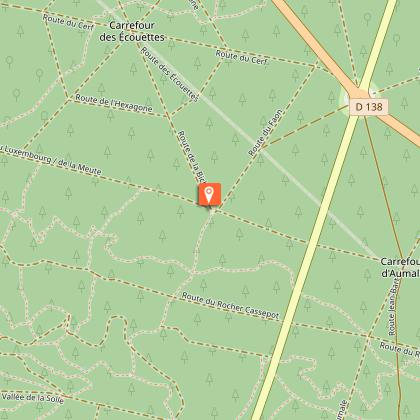
4. Turn left until you reach the crossroads of La Plaine Saint-Louis, then successively, take the second right, then turn left onto Route du Cerf, and then right at the second crossroad take Route de l'Hexagone until you reach Route de la Biche. Follow it to the right.

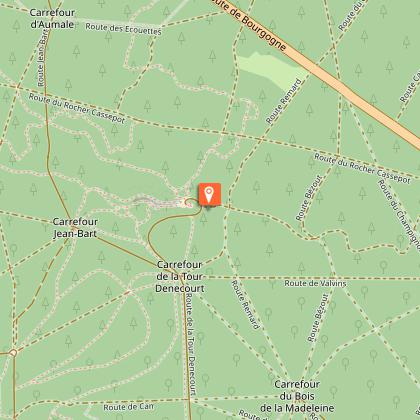
5. At the crossroads, make a left-right, cross the rocky chaos. Take on the left Route du Rocher Cassepot, cross the RD116 and at the next crossroads go right, then immediately after take on the left a path. Cross a paved track and go up to Denecourt Tower.


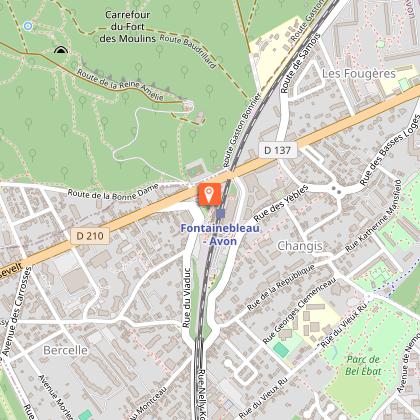
6. Go down the road on the left for 25m, then on the left a path, cross a wide track and continue on the right at the next one up to Carrefour Katrin Mansfield. Follow the second path on the right, then at the Bois de la Madeleine crossroads the third on the left. At the railway line, continue on the right and reach Avenue Franklin Roosevelt. Cross it and, by the stairs, reach Fontainebleau-Avon train station.

7. Finish

Data author

Quartier Henri IV - Place d'Armes 77300 Fontainebleau France

The Cirkwi brief

Discover Fontainebleau: An Enchanted Forest Hike

Imagine embarking on a journey that takes you through the heart of the iconic Fontainebleau forest, starting from the quaint parking lot of Fontaine-le-Port’s train station. This adventure, designed by Seine et Marne Attractivité, invites you to explore scenic balconies overlooking the Seine and its stately homes before diving deep into the forest’s dense woodlands leading to the majestic Denecourt Tower. The experience promises not just a physical trek but a voyage through the forest's lively essence, all the while offering breathtaking panoramas that span the entirety of this natural wonderland.

Technical Insight on the Trail

Spanning 16.5 kilometers with an elevation range from 40 to 126 meters, the route presents a modest challenge with a total positive elevation gain of approximately 237 meters. This trek is an ideal medium-level hike, recommending sturdy footwear due to the terrain’s mixed nature, including forest paths and rocky segments. The journey begins at the Fontaine-le-Port, offering a steady ascent towards the Denecourt Tower, marking the hike’s highest vantage point.

Seasonal Guide for Hikers

For a fulfilling experience, it’s key to gear up based on the season. Spring brings out the forest's blossoms and a cooler temperature ideal for hiking. Summer, though warm, offers lush greenery, demanding hydration and sun protection. Autumn is a spectacle of colors, with the woodland's palette turning the hike into a visual treat, though paths can be slippery with fallen leaves. Winter, often under a blanket of snow, requires careful preparation against cold temperatures. Throughout the year, always prioritize safety, staying on marked paths and using appropriate footwear.

Fontainebleau's Heritage Unveiled

Fontainebleau, nestled within the heart of the Seine-et-Marne department, is more than just a forest; it’s a living museum echoing the footsteps of French royalty and artists who found solace and inspiration within its bounds. With its historic castle and the renowned Barbizon school painters who captured the landscape's essence, Fontainebleau stands as a cultural beacon representing centuries of French heritage set against the backdrop of an unparalleled natural setting.

Climate Tips for Travelers

Fontainebleau enjoys a temperate climate, with mild winters and warm summers. The best times to visit are late spring (May-June) and early autumn (September-October), when the weather is most favorable for hiking and outdoor activities. These periods also highlight the forest's natural beauty, from the fresh green of spring to the warm tones of autumn. Be mindful of summer's peak temperatures and winter's potential snow, which can transform the landscape but also present challenges for the unprepared traveler.
Automatically generated.

Ratings and reviews

To see around
See more
Open
Close
Show
Show
Show
Show
Show
Show
Show
Show
Show
Show
Show
Caution!
We have no information on the difficulty of this circuit. You may encounter some surprises along the way. Before you go, please feel free to inquire more and take all necessary precautions. Have a good trip! 🌳🥾