Alert

Alerts

To see around
See more
Open
Close
Show
Show
Show
Show
Show
Show
Show
Show
Show
Show
Show

Oups... It would appear that Cirkwi does not have permission to use your location.

Presentation
Description
Map
Steps
Points of interest
Ratings and reviews
See around

Trompe-l'œil in Chambéry

Trompe-l'œil in Chambéry

Description

Trompe l'oeil art strongly developed in Chambéry in the 19th century. Because, on the one hand, people in Savoie have always liked painted decors, but also because it meant they could complete their decors for less, creating perspectives and movements...

Technical Information

Walking
Difficulty
Very easy
Duration
1h15mn
Dist.
2 km
Show more

Altimetric profile

Starting point

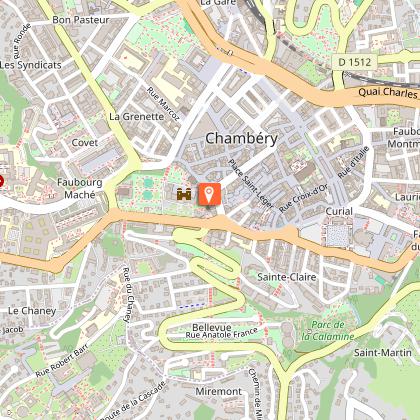
Quai Sénateur Antoine Borrel , 73000   Chambéry
Lat : 45.567231Lng : 5.926121

Points of interest

image du object

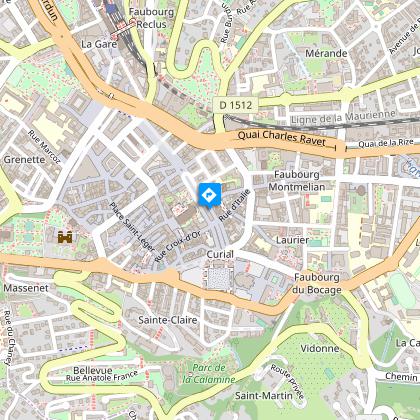
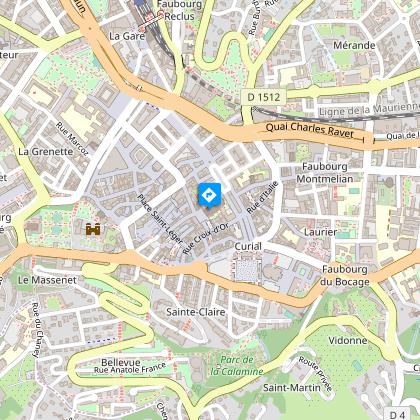
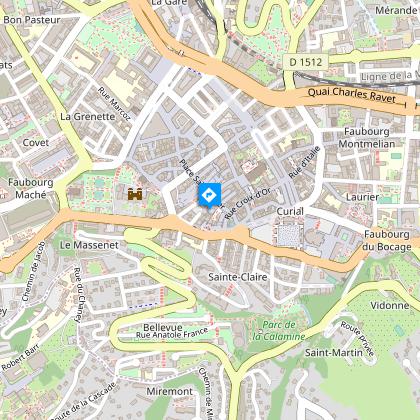
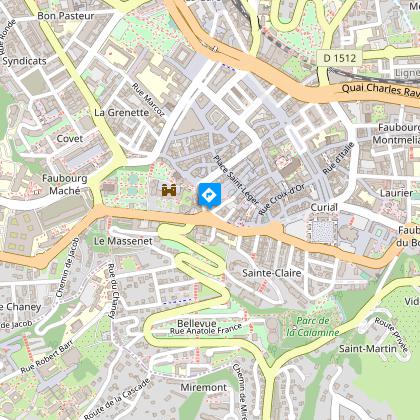
Historic centre of Chambéry

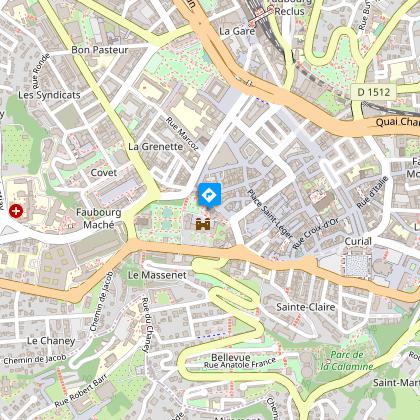
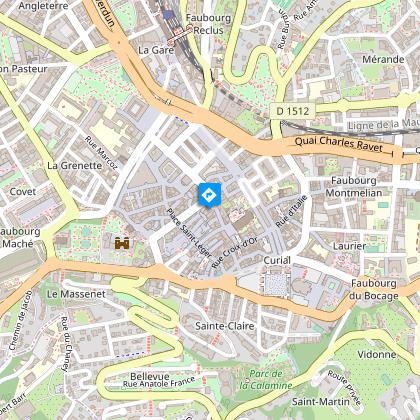
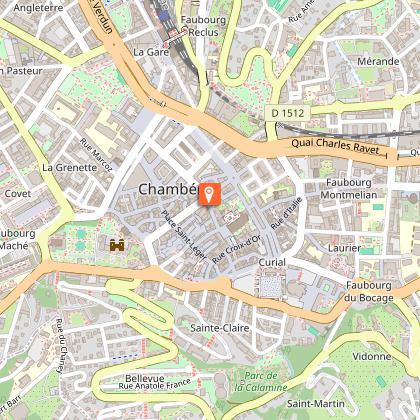
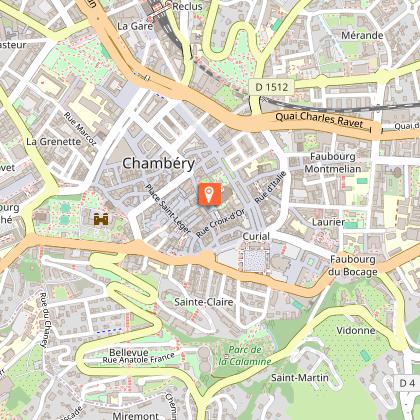
The old own of Chambéry is characterised by a maze of streets and private mansions. The Piedmont-style architecture is often enhanced by decorative elements (trompe-l'oeil, ironwork, sculpture, etc.). Guided tours all the year round.Near the castle, the historical center of Chambéry offers an urban configuration dense and original, strongly marked by the presence of water. This set is quite homogene and is protected by a saving area program. The rue de Boigne : This straight street, lined with torinese gantry, was created thank to the liberality of the general de Boigne. Real hole in the urban tissue inherited from the middle age, this is the artery that is linking the castle to the fountain of the elephants. The place Saint Léger : Primitive center of the town, this place has become an area of life thank to its development at the end of the 1970's. Behind its colored fronts, a whole maze of streets and court of hotel particulier, giving to Chambéry its particular appearance. The rue Basse du Château : This strret inherited from the middle age conserves one of the last aerial footbridge of the town. The rue Croix d'or : During centuries, travellers coming from Italy were entering the town by this street. Artisanal district and aristocratic until the XIXth century, numerous testimony are still visibles, for example : the metal gates of the Hôtel of Castagnéry (n°18) and the front of the hôtel des Marches et de Bellegarde (n°19).

Ville ancienne 73000 Chambéry
- Grand Chambéry Alpes Tourisme -
Consulter
image du object

St. Francis de Sales Cathedral

It was built in the 15th century by the Franciscans and became a cathedral in 1779, when the diocese of Chambéry was created. Behind a simple façade, it houses the largest collection of trompe-l'oeil paintings in Europe (6000m²).The work started in 1418 and the church was finished in 1587. It became cathedral in 1779 and then metropolis in 1817 when Chambéry became an archdiocese. The front isn't showing the customary greatness of cathedrals. It's explained by the franciscan modesty but also by the swampy subsoil which required the installation of more than 30000 larch piers. Such planting didn't allow the construction of a slender structure. On the other hand, the inside is striking with its greatness and its Flamboyant Gothic style very simple. The main caracteristic of the Saint-François de Sales Cathedral remains however in its trompe-l'oeil paintings which cover the walls and vaults. It was realized in 1834 by Casimir Vicario who privileged the Troubadour Gothic style which was very popular in Savoy at the time. Its romantic organ dating from 1847, classified historical monument, is the work of Augustin Zeiger. With its 50 registers on 3 piano keys and pedalboard, its one of the most important of the region Rhône-Alpes. Since 2010, a copy of the "Turin Shroud" is exposed in the cathedral. It has been offered by the Turin Archbishop for the 150th anniversary of the Savoy join with France.

Place de la Métropole 73000 Chambéry
- Grand Chambéry Alpes Tourisme -
Consulter
image du object

Holy Chapel of the Castle of the Dukes of Savoy

Built in the 15th century during the reign of Amadeus VIII, the first Duke of Savoy, this is a fine chapel built in a flamboyant gothic style.The chapel, located on the grounds of the château, has an unusually-narrow chevet (eastern end). The bell tower, or Tour Yolande, contains the Chambéry ‘carillon’, made up of 70 individual bells. Inside the chapel, admire the 16th-century stained glass windows, and the ‘trompe d’oeil’ paintings in the ‘Gothic troubadour’ style. This chapel is famous for containing the Suaire de Turin (Shroud of Turin) between 1502 and 1578. Sainte-Chapelle was commissioned by Amédée VIII and built by master builder Nicolet Robert between 1408 and 1430. On the grounds of the château, the chevet is integrated into the Château’s defences, strengthened by the height and narrowness of the 5 bay windows. A rampart walkway passes through the buttresses, which bear the weight of flying buttresses. The chapel is flanked by a bell tower, built in 1470 by Blaise Neyrand de Saint-Pourçain in Bourbonnais, thanks to Yolande of France. In the Château’s cour d’honneur, notice the Baroque façade, designed by a famous Turin architect, Amedeo di Castellamonte. This change in style is due to the restoration works that took place on the building between 1655 and 1663, commissioned by the duchesse de Savoie, Christine de France. The vaults of the building would have been renovated at the same time. Once inside, visitors are often struck by the height of the building (22m). A fire in 1532 meant the decoration sculpted by Jean Prindale and his workshop was lost, but the stained-glass windows were able to be repaired, with some being restored by a Chamberian artist, Gaspard Masery, between 1541 and 1548. These stained-glass windows had been made a few years beforehand, (1521 – 1527), by artists Blaise de Lyon, Jean Baudichon and Jean de l'Arpe, and depict 9 scenes from the Passion of Christ. In the central stained-glass window, the window depicting the Three Marys at the tomb of Jesus recalls the presence of the Suaire de Turin in the chapel in the 16th century. The vaults are decorated with surprising ‘trompe-oeil’-style paintings: in 1836, King Charles Albert began renovation works on the chapel, and ordered that the chapel be painted in this fashionable style. Painted by Casimir Vicario, from Piedmont, who had worked two years previously on a cathedral in Chambéry, most of these works were lost during restorations in 1959, and have only recently (2012) been restored to their former glory. Le Suaire de Turin (The Shroud of Turin) In 1453, Duke Louis and his wife, Anne de Lusignan, acquired an important Christian relic: a white sheet, measuring around 4.3m long and 1.1m wide, with a brownish stain in the shape of a crucified man. Some people argue that this was the shroud used to wrap the body of Christ when he was put in the tomb. How this sheet arrived in Europe remains a mystery, as its history is largely unknown before the beginning of the 13th century. During this period, the shroud belonged to the Charny family, and was displayed publicly in Lirey, near to Troyes. In 1453, Marguerite de Charny, who had no heir, decided to sell it to the Dukes of Savoie, a powerful and rich Catholic family. The Duke’s chapel was officially named Sainte-Chapelle du Saint-Suaire, on the 11th June 1502, when the relic was officially installed. Huge public displays attracted large crowds. The shroud narrowly escaped the terrible fire in the chapel in 1532, with burn marks being clearly visible on the cloth. After the Court moved to Turin, Duc Emmanuel-Philibert had the shroud transferred. As the personal property of the Maison de Savoie, the relic would not leave Turin, despite the supplications of the people of Chambéry and canons of Sainte-Chapelle. A Baroque chapel was built in Turin by Guarino Guarini, next to the Palais Royal, in order to house the shroud, and it has remained there ever since. However, it now belongs to the Church, as a bequest from the last king of Italy (Umberto II), upon his death in 1983. In 1988, a carbon 14 dating was carried out, which concluded that the cloth dated from a period between 1260 and 1390, and thus could not have been used to shroud the body of Christ. Nevertheless, this conclusion is not universally accepted, and so the relic continues to be mysterious. Two copies of the shroud, donated by the Archbishop of Turin, are on display in Saint-Chapelle and the cathedral.

Château des Ducs de Savoie Place du Château 73000 Chambéry
- Grand Chambéry Alpes Tourisme -
Consulter
image du object

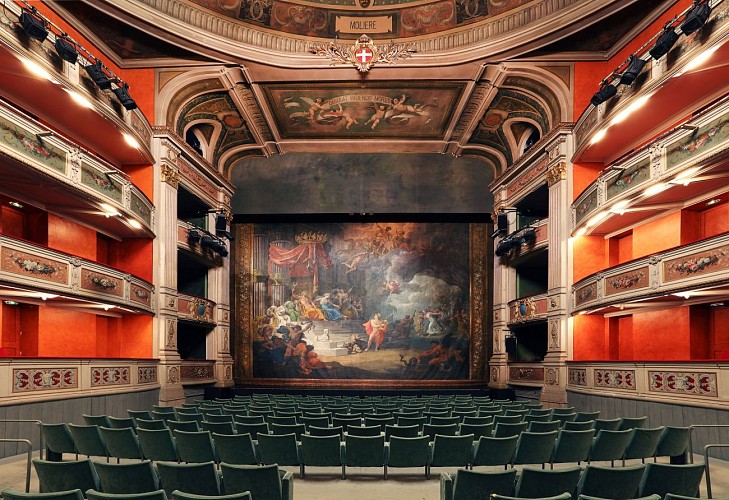
Charles Dullin Theatre

Rebuilt in 1866, this is one of the finest Italian-style theatres in France. It is named after Charles Dullin, a famous actor and director, who was born in Yenne in Savoie.Of the theater built in 1824 thank to the General de Boigne, is surviving a wonderful drop cloth, painted by Luigi Vacca and representing "The Descent of Orpheus to the Underworld". After its destruction because of a fire in 1864, the theater was rebuilt at the same place, following the plans of Charles Bernard Pellegrini and Joseph Samuel Revel. The main plan is the same as the one of the first building. The prostyle is actually a vestige of the theatre of 1820. The front, divided in a first central part and of two back part on the sides, is however much less important, which more adapted to the place. The big room surprises by its heat and its refinment. Its conception is typically italian with a horseshoe form, composed of 4 galleries superimposed. The decor of the stage and of the room are the work of Chenillion, set designer of the opera of Marseille, the decoration of the galleries are the work of Diéterle, designer of the opera of Paris. Sculptures and painting are from Delécole and Bin. The renovation of 1993 has allowed to keep the variety of colors, with the galleries and the walls ochre and the boxes and the stalls in green-grey. The theatre from Chambéry was nicknamed "the small Scala" because of its big inspiration from the prestigious milanese opera.

Place du Théâtre 73000 Chambéry
- Grand Chambéry Alpes Tourisme -
Consulter

Additional information

Environments

Town location
In centre of town

Updated by

Grand Chambéry Alpes Tourisme - 14/10/2025
www.chamberymontagnes.com
Report a problem

Open period

All year round.

Contact

Phone : 04 79 33 42 47

Email : accueil.chambery@chamberymontagnes.com

Website : https://www.chamberymontagnes.com

Animals

Yes

Data author

Ratings and reviews

To see around
See more
Open
Close
Show
Show
Show
Show
Show
Show
Show
Show
Show
Show
Show
Caution!
We have no information on the difficulty of this circuit. You may encounter some surprises along the way. Before you go, please feel free to inquire more and take all necessary precautions. Have a good trip! 🌳🥾