Alert
Alerts
PTM 3 - POUR CHEMINER AVEC L'HISTOIRE DE ST-BERTRAND DE COMMINGES ET VALCABRÈRE
Description
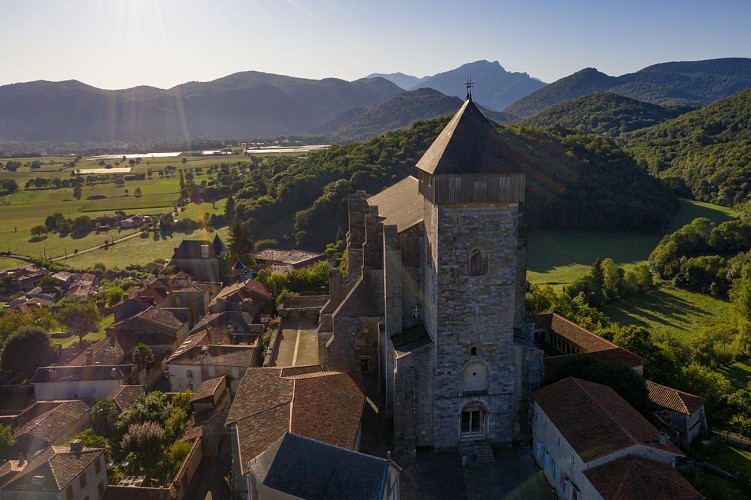
Saint-Bertrand-de-Comminges is a veritable open-air museum. As you stroll along its cobbled streets, you'll be charmed by the majestic Sainte-Marie cathedral. The village, with its medieval ramparts and gates, transports you back to a time when time seemed to pass differently. Roman ruins and archaeological sites tell the ancient story of this region, once a thriving city of the Roman Empire. You'll also discover the Saint-Just basilica in Valcabrère, another witness to this rich past.
The walk, which starts from the car park in the upper part of the village, takes in the upper town with its cathedral of Sainte-Marie, the lower town which was the suburb of the town in the Middle Ages, the archaeological site which reveals impressive remains from the Gallo-Roman era, and Valcabrère with its basilica, a pure jewel of Pyrenean Romanesque art.
Technical Information
Altimetric profile
Starting point
Points of interest
Additional information
Detailed stages
La Ville Haute - Perched on a promontory overlooking the Garonne valley, the upper town is a jewel in the crown of the Pyrenees' historic and religious heritage. An ancient Gallo-Roman city that became an important spiritual centre in the Middle Ages, today it boasts a remarkable architectural ensemble that bears witness to over two thousand years of history. At the heart of the upper town stands the majestic Sainte-Marie cathedral.
1 - The rampart - Built in the 5th
century, more symbolic than defensive, it expressed the power of the ancient city.
2 - The Hedgehog Gate - The name suggests that a portcullis was used in the Middle Ages to protect this gateway, which has now been completely destroyed.
3 - The Cabirole door - It was enlarged in the 18th century by Bishop Charles-Antoine d'Osmond (1764) when the access road to the town was created.
4 - The Bridaut house - Its architecture evokes the late Middle Ages and early Renaissance.
5 - The War Memorial - This work represents the city in the form of a female knight.
6 - The forecourt - In the Middle Ages, the cathedral was located at the centre of a fortified enclosure known as the scept. This area included the episcopal palace, two canon houses, a cemetery, the cloister and four canons' houses.
7 - Sainte-Marie Cathedral - The cathedral of Saint-Bertrand-de Comminges in its current form has undergone several transformations and several periods under the impetus of three bishops. All that remains of the original 11th-century Romanesque church are the western part of the nave, the base and first floor of the bell tower, the west gallery of the cloister and the portal.
8 - Les Olivetains - This former convent with an adjoining chapel was built by Olivetan Benedictine monks from Mont Olivet (near Siena, Italy) in 1860.
9 - The Departmental Archaeological Museum - The museum was set up in 1985 by the Conseil Départemental de la Haute-Garonne as a conservation facility linked to the site of Lugdunum, the ancient capital of the city of Convènes. Combining the scientific imperatives of conservation with museographic and educational concerns, it is a major player in the cultural landscape of Haute-Garonne. It hosts free archaeological exhibitions, as well as departmental services and a study library.
10 - The Majou gate - In the Middle Ages, it was the main entrance to the episcopal city. On the outside, the coat of arms of Cardinal Pierre de Foix (1422-1451) reminds us that he took part in rebuilding the gateway after the fire of 1419.
Lower town / upper town staircase - Next to the Porte Cabirole gateway, an 18th-century staircase links the lower town to the upper town.
La Ville Basse - The faubourg du Plan is the other name for the lower town, where you can still see Commingois farmhouses with their magnificent frameworks and claustras (openwork wooden openings) that made it easier to dry hay.
11 - Necropolis and early Christian basilica - The basilica was one of the oldest Christian churches in southern Gaul. This ancient Christian edifice was built in the 5th century on the site of the garden of a large residence. It originally consisted of a small nave and a rectangular apse, which were enlarged and transformed in the 7th century.
12 - Traditional farms - The traditional Comminge farm consists of two buildings that form an "L" shape opening onto a vast courtyard. One contains the cowshed, hayloft and barn, while the other houses the living quarters.
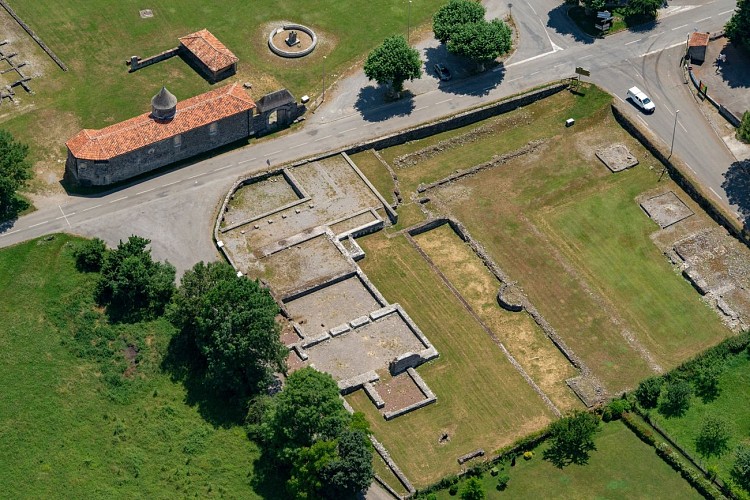
The Archaeological Site - The ancient city of Lugdunum is over 2,000 years old... Founded in the 1st century BC, the capital of the Convene territory covered an area of 36 hectares and had an estimated population of between 5,000 and 10,000. The oldest remains found on the site date back to the time of the emperor Augustus (27-14 BC).
13 - The Theatre - This modest theatre, built in the 1st century and enlarged at the beginning of the 2nd, could hold up to 5,000 spectators.
14 - Le Marché - The macellum (market) was built at the beginning of the 1st century on the edge of the forum. Burnt down and rebuilt in the 2nd century, it was razed in the 4th century and covered by an unidentified building. At 55 metres long and 26 metres wide, Lugdunum's macellum is the largest market known today in the western provinces of the Roman Empire.
15 - The Circular Enclosure Monument - Built on the site of a pre-Roman road junction in the early 1st century, the monument with its circular enclosure was intended to serve as a reminder of this ancient crossroads. Comprising a base, perhaps surmounted by a column, it marks the centre of the town. In those days, the crossroads was a sacred place.
16 - The Forum Temple - This temple, built at the turn of our era, became part of a forum and basilica complex in the 2nd century. It consisted of a cella (chamber of the deity) preceded by a vast porch with six columns set on a podium. The complex, dedicated to the official worship of Rome and Augustus, dominated a courtyard enclosed by a colonnaded portico.
17 - Les Thermes - The ancient town had 3 establishments: those in the Forum, which included hot, warm and cold baths built during the 1st century; the northern thermal baths dating from the 2nd century; and the thermal baths known as the Sales d'Arrouges, about which little is known.
Valcabrère - A small village located at the foot of Saint-Bertrand de Comminges and next to the archaeological site, its Saint-Just de Valcabrère basilica is a jewel of Romanesque art.
18 - Saint-Just Basilica - Listed as a Historic Monument, the basilica is a Romanesque building dating from the 11th and 12th centuries. Excavations have shown that the site has been occupied for a very long time (sarcophagus from the 4th century and numerous ancient finds in the construction). Thanks to a parchment discovered in 1885, we know that it was dedicated to Saint-Just, Saint-Pasteur and Saint-Etienne. Columnar statues in the antique style represent them on either side of the portal.
19 - The Roman Aromatic Garden - Of very modest dimensions (200 m2), the garden occupies a triangular plot of land on the edge of the byroad leading to the Saint-Just basilica in Valcabrère. Each plant is accompanied by a sign giving comments taken from ancient writings, combining description, properties and use. There are three main uses: culinary, medicinal and religious (incense, aromatic necklaces, etc.).
20 - Measuring grain - Grain measures were very useful for trading. This one probably comes from the market in the ancient town of Saint-Bertrand.
21 - Le Castel-Bert - The remains of a feudal castle probably built in 1080 by the Lords of Labarthe, the surrounding vegetation gave it its current name of Castel-Bert: the green castle. It watched over the Martrouilh ford, close to the mill belonging to the chapter of the cathedral of Saint-Bertrand, and was a major defensive element of the fortified village.
Start and end town
SAINT-BERTRAND-DE-COMMINGES
Data producer
Contact : HAUTE-GARONNE TOURISME
This information comes from the Haute-Garonne Departmental Tourism Network and is synchronized as part of the partnership between Cirkwi and Haute-Garonne Tourisme.
Data author
