Alert
Alerts
Hénencourt under German threat.
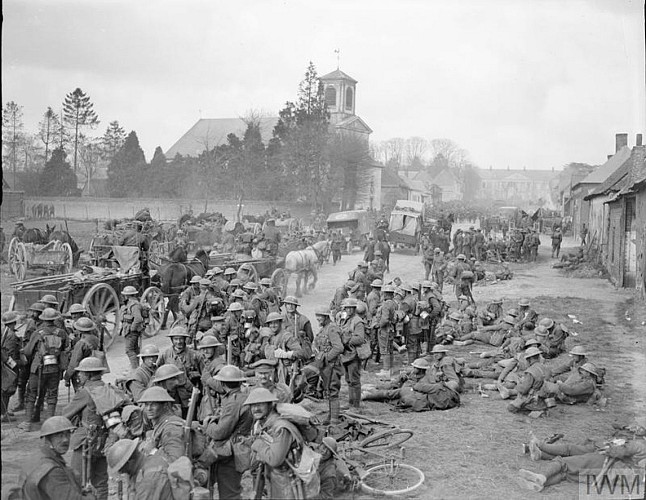
Hénencourt, rue Neuve
Description
The commune of Hénencourt served as a command centre throughout the war. The château provided sufficient space and comfort to accommodate successive military headquarters. King George V of England even attended a sporting competition organised by the army within the town’s boundaries.
However, in March 1918, the town was threatened by the German advance, and Albert fell on 27 March. The Allied troops were forced to retreat. The town’s main street was then filled with British soldiers making their way to their new positions.
In the photograph, the château is still intact; the right wing was destroyed a few weeks later in a fire.
As you continue on your way towards Bresle, stop at the pillbox located on the outskirts of the village.
Following the German advance in April 1918, the Allies feared a further attack. Consequently, to protect Hénencourt Castle, which was serving as their headquarters, several pillboxes were built in the village. The ‘Royal Engineers’ of the 47th Division were responsible for building them between July and August 1918. As the Allies went on the offensive in the days that followed, these pillboxes were never used.
Technical Information
Altimetric profile
Data author
