Alert
Alerts
Lavoir de Norolles
Description
The Norolles washhouse, which is entirely original, is one of the earliest types of washhouse to have been built in the area. It nevertheless stands out for its unique and interesting features.
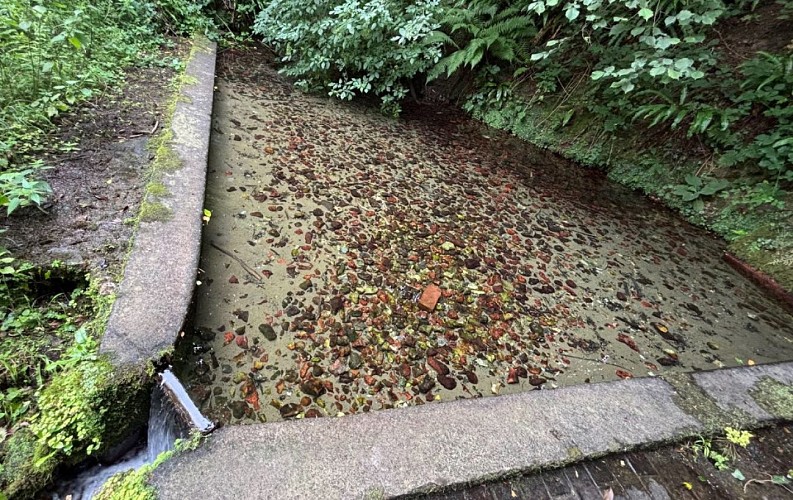
This washhouse consists of a cement basin in the shape of a half-rectangle, set against a slope covered in lush vegetation. The basin is lined with compacted earth and pebbles. Two concrete washing boards run along the length of the washhouse, and the washing areas are made of bricks. It appears that part of these areas has collapsed at the corner where the water flows out. There is a hole in the ground, through which water can be seen flowing; this is likely the site of a former post that may have served as a clothesline. The washhouse is not covered and, as far as we know, never has been.
The washhouse is supplied by the Nourry fountain, which in turn is fed by a nearby spring. The water from the washhouse and the fountain flows vigorously along the path to a spring, lending the site a great deal of charm.
The Nourry fountain, situated a few metres from the washhouse, was built in 1903, as evidenced by the date engraved on the inside of the rounded section. On closer inspection, you can see the outline of a scallop shell engraved on the fountain. This feature refers to the pilgrimage routes to Santiago de Compostela. However, no known route appears to pass through the village. Indeed, the shell can symbolise various things. For example, in ancient times, the shell was used as a talisman against witchcraft and disease. At the same time, it can symbolise resurrection, good luck or even spiritual purification. This is why this motif is very often found on baptismal fonts. During the Renaissance, the shell featured as one of the major elements in art and architecture.
Set in a stunning and very peaceful natural environment, follow the stream to the end of the path to discover the Nourry fountain and its various features, as well as the wash house. The site is accessible on foot or by mountain bike via a stony path along a hiking trail. You can also catch a glimpse of Malou Castle (16th century), a listed historic monument, situated just a short walk from the wash house.
Technical Information
Altimetric profile
Additional information
Data producer
This information is provided by OT Terre d'Auge Tourisme
Data author
