Alert
Alerts
Lavoir du Brévedent
Description
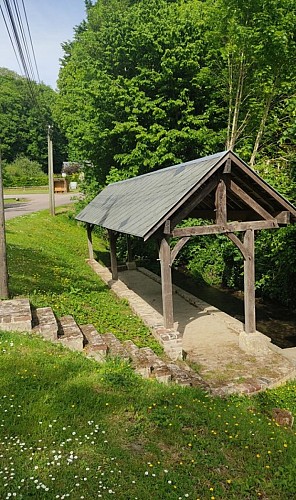
The Brévedent washhouse is a stream-fed washhouse, supplied by the Le Chaussey stream.
This washhouse was built in 1903 thanks to funds provided by the mayor of the commune of Le Faulq and was subsequently transferred to the commune of Brévedent. A few years later, in 1910, the shelter located a few metres from the washhouse was built. This shelter, which can still be seen today, allowed the washerwomen to take shelter there during heavy rain or to eat their meals. Unfortunately, the washhouse was destroyed in 1931 due to severe flooding during the winter. It was rebuilt in 1933. Finally, in 2022, the washhouse was restored to its former glory.
It is completely open on all four sides and is mainly built of brick, notably the floor, the washboard, the low wall and the steps leading up to it. The washhouse is approximately 10 metres long. The washhouse’s timber framework rests on six posts: three of them are fixed directly into the low brick wall, whilst the other three are secured by limestone flashings. The structure supports the gabled roof, which is covered in slate.
If you look closely at the stream, you cannot fail to notice the sluice gate system, supported by cement masonry, which is still clearly visible today. This mechanism was used to regulate the water level. Furthermore, the remains of a washstone are still visible beneath the water.
During your visit, you’ll be able to see this wash house by the water’s edge; it’s easily accessible on foot, by bike or by car (car park nearby). You’ll also find the church right nearby to round off your walk.
Technical Information
Altimetric profile
Additional information
Data producer
This information is provided by OT Terre d'Auge Tourisme
Data author
