Alert
Alerts
Bubry presbytery
Description
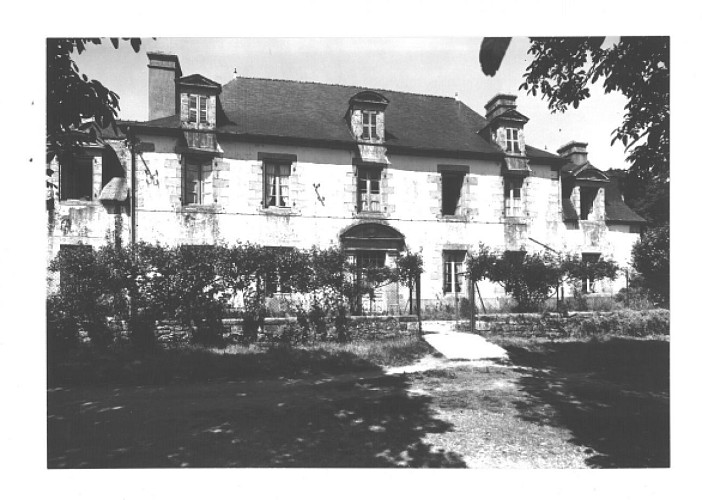
Take a moment to rest in the garden and listen to the history of the presbytery. It was built in the first quarter of the 18th century, as can be seen by the date 1702 engraved on the central dormer. Rectangular, in rendered rubble stone and granite ashlar, the building comprises a central section and two side wings with seven bays, topped by three dormer windows. The central door opens onto a corridor leading to two large rooms on the ground floor and a beautiful central stone staircase leading to the first floor.
The numerous rooms were used by the rector, his vicar and their servants. Some will remember their catechism sessions in the vast but very cold ground-floor room, where a Christmas tree with a large candle at its base was the only decoration. Partly restored, the building is still occupied by the parish priest of Bubry.
The presbytery, surrounded by high walls, still has its former gardens to the east. Divided in the 19th century into six rectangular plots separated by paths, the "priest’s garden", consisting of a vegetable garden and an orchard, ensured that the priest and his entourage were self-sufficient. In the courtyard in front of the house, the stable, the cowshed, the cart shed and a beautifully constructed well, completed the ensemble. Today it houses the canteen and media library.
Residents still remember the priests who lived here, such as the Abbé Audo, who wrote a book entitled “Histoire du Vieux Bubry” in 1981. But not many know that in 1833 and 1834, Hélène Jégado, Brittany's best-known poisoner and one of history's greatest serial killers, worked here. Over an 18-year period in the mid-19th century, she poisoned some sixty people. She was tried in Rennes in 1851 and executed on 26th February 1852. She used herbs and poisons that the trial judges found difficult to identify. Her victims suffered from colic and vomiting, sometimes fatal, after drinking her herbal teas and soups.
Hélène Jégado, first worked at the Guern presbytery where seven people died during her time there. She then entered the service of the Bubry parish priest M. Lorho in 1833 as a cook. She joined her aunt Marie-Jeanne Liscoët, who was also a cook. During her time in Bubry, five people fell ill and three died: Jeanne-Marie Lorho, sister of the parish priest, Jeanne-Marie Kerfontain, niece of the parish priest, and Marie-Jeanne Liscoët, his aunt. She claimed a fourth victim in June 1836, in the person of Mr. Keraly. He was convalescing in his château in Kernivinen, and his daughters hired Hélène Jégado in Pontivy to look after him. After her arrival, his condition worsened. In June, he returned to his home in Hennebont, where he died.
