Alert
Alerts
Sainte-Hélène chapel
Description
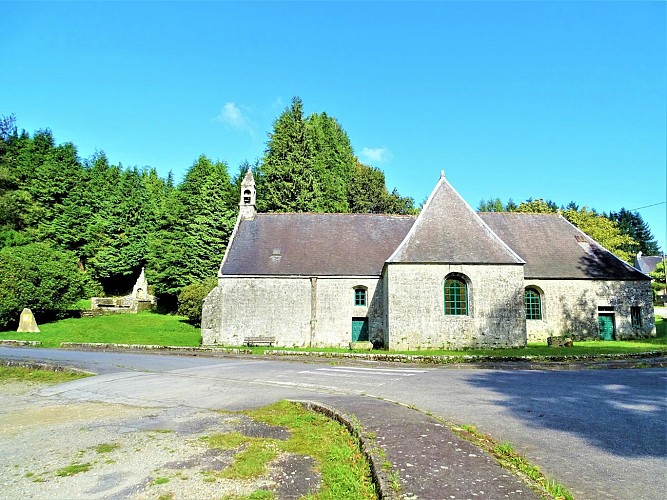
Built in 1737, St. Hélène's chapel was in very poor condition after the French Revolution and was partially repaired in 1810 before being completely rebuilt in 1839. With a Latin cross floor plan, built of granite with ashlar and rubble stone, it features a distinctive west portal framed by two buttresses and topped by a bell tower which can be accessed by an external staircase.
Inside, the furnishings date mainly from the second half of the 19th century, in particular the choir screen, the two altars and the statuary, mainly in polychrome plaster. In addition to several Virgins with Child, there are three representations of the patron saint, two of which date from the 18th century. The most recent is displayed in a niche in the upper part of the apse wall. The oldest once stood above the fountain.
Sainte-Hélène’s fountain nearby is topped by a niche and a cross framed by twopinnacles. Its paved enclosure, surrounded by low walls with stone benches, is accessible by steps and, on the chapel side, by a stile, the upright stone that once barred access to roaming animals.
Water from the fountain flows into a small circular basin, then into a rectangular one, before feeding the washhouse below. A second washhouse to the west completes the ensemble. Washerwomen used to gather here to wash their clothes, as old postcards show. The pardon on the 4th Sunday in July consists of a church service and a friendly gathering. As you leave the site, you'll see a cross on your right, that once stood next to the church and was moved here during urbanization work. On your left is the former Sainte-Hélène school, now converted into housing.
