Alert
Alerts
Bodery mill
Description
From Le Hévédic, follow one of the routes taken by local farmers to come and grind their grain at the Bodery mill. It was active from at least the 18th century, but declined after 1950. Today, the main body of the mill can be seen with the location of the wheel axle, the millstones, some elements of the mechanisms and the bypass canal. Water from the stream, captured upstream, turned a clever system of two staircase paddlewheels, placed one on top of the other, to compensate for the low water flow.
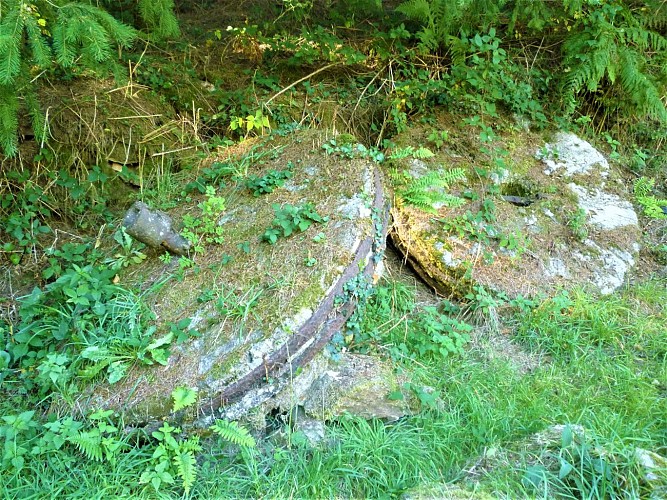
The wheels set in motion a system of gears that operated the grinding wheels. The grain was crushed between the fixed and the rotating millstone in a wooden box called an “archure”. Two different millstones can be seen lying in the grass. The first, made from one piece of granite, was replaced by the second in the 18th century. The composite checkered wheels, which were easier to produce, were manufactured in the Seine-et-Marne department and exported throughout Europe. Combining several quarters of stones of different hardnesses, granite and quartzite for example, cemented with plaster and strapped with hot iron bands, they were often transported in kit and assembled on the spot.
