Alert
Alerts
Mell beniget Kaelan
Description
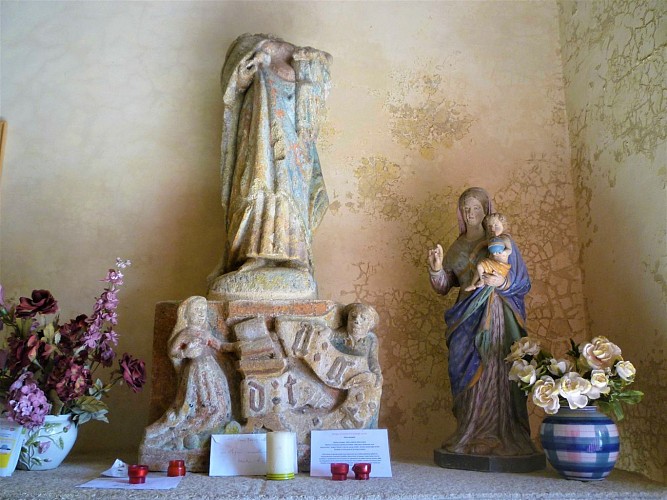
Now back at the starting point, linger a while to visit the Romanesque church. Inside, the furnishings have been enriched over the centuries: an altarpiece and its statuary, in particular a Holy Trinity, from the end of the 17th century; a baptismal font, high altar and censer from the 18th century; statues, banners, choir stalls and baptismal font enclosure from the 19th century The remains of a 15th-century Virgin and Child were found decapitated and buried in the cemetery. This practice was used in the past when people did not want to keep a statue. From the 16th century, a holy water font and two bas-reliefs of the Annunciation and the Crucifixion from an old granite altarpiece have been preserved.
For a long time, the church of Calan housed a very special stone, which has mysteriously disappeared, although its presence was known after the 1939-1945 war. Roc'h Kaelan, stone of Calan, or Mell benniget Kaelan, which can be translated as blessed ball of Calan or blessed mallet of Calan. Although we don't really know what it looked like, similar objects are reported around Brittany in churches and chapels, especially in the Morbihan. The Locmeltro stone in Guern is an impressive example: a spherical granite ball 20 cm in diameter weighing no less than 3.5 kg. But what was it for?
There are two opposing theories. For some, it could be a sacred stone, a sort of viaticum, that the dying person kissed or that was placed on the forehead as a rite of passage from life to death. For others, it could be a form of euthanasia tool used to put an end to the suffering of the dying, a rite found in many ancestral cultures around the world. In the popular memory, some speak of it jokingly, such as the testimony of this Calan woman born before 1939: “In Calan, whenever there was a long period with no deaths, we used to say: if this continues, we'll have to go and get the mell beniget from the church.” Others confirm its function to release the dying according to the sayings of the elders.
