Alert
Alerts
The fountain of Kerandiot
Description
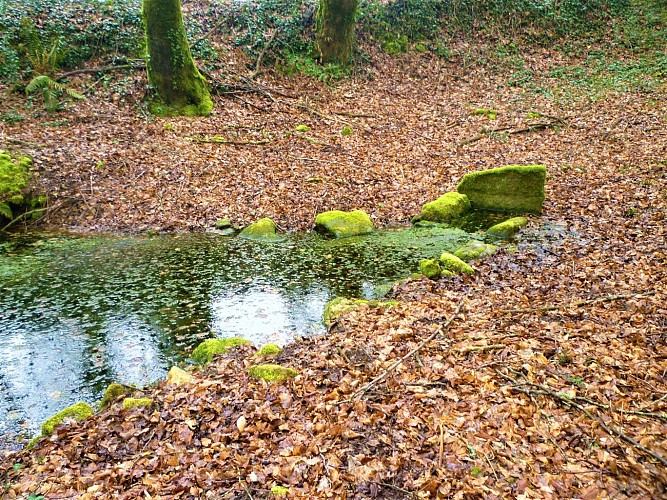
Preserved in its original state, the modest fountain of Kerandiot shows how life developed around springs, vital to the domestic life of villages before the arrival of tap water in the 1960s. It is surrounded by ashlars laid on edge, one of which is bevelled, thus reused, and is extended by a widening basin also surrounded by stones. It was probably used as a washhouse, as the sloping stone near the spring suggests, but perhaps also as a watering place.
This fountain appears on the Napoleonic land registry of Calan in 1843 which lists twelve springs. It is likely that there was at least one per hamlet. Only one at Kergueris is cited as a washhouse, a reminder that these rectangular basins were built mainly after 1851, following State aid granted for their construction.
Located below the hamlets in the wetlands, difficult to access, springs also competed with wells built by dowser masons near the houses. Curiously, not one of them appears on the Calan land register in 1843. However, among the twelve still present, some are older, such as the one at Poulgourio bearing the date 1776 on its lintel. Although inventories carried out in neighbouring towns confirm that the construction of wells intensified after 1850, as did the construction of washhouses, the conditions of the land registry inventory, which varied in accuracy from one commune to another, and perhaps also the population's distrust of surveyors, may explain these gaps.
