Alert
Alerts
Kerihuel
Description
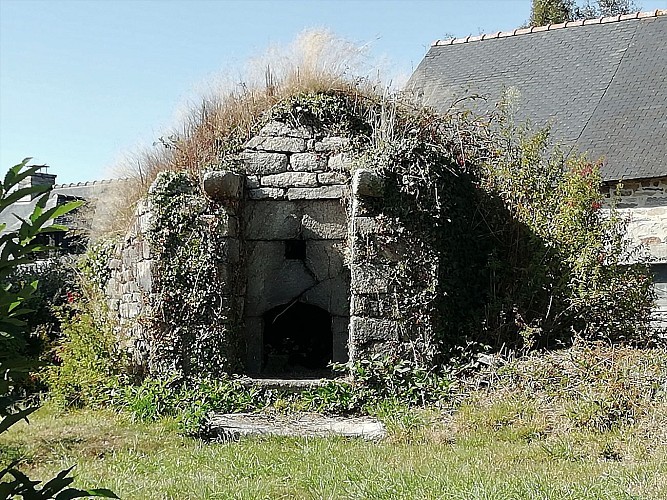
Recently built up, Kerihuel, the “upper village”, still has some old buildings, partly converted when rural buildings were updated in the 19th and 20th centuries. These houses, recognizable by their symmetrical and standardized rectangular windows, sometimes reuse older bays. They can be found on other houses: segmental arch door and segmental arch windows from the 16th and 17th centuries, from the second half of the 18th century. In 1843, this hamlet had fourteen buildings. Several longères, placed around courtyards, confirm the existence of six or seven farms. The bread oven, with its low-arched mouth, was already here too. Located at the heart of Kerihuel, this shared equipment was used by the whole village. Each family in turn had to provide a bundle of wood or heath and manage the fire, before they could bake their dough.
Analysis of the Napoleonic land registries of the area reveals that this type of construction was very common in the 19th century. The largest villages sometimes had several. In 1843, Calan had 26 ovens, including the village oven, i.e. nearly one per hamlet. One of them, marked in yellow at Poulgourio, is in ruins, and demonstrates that bread ovens were already common in the 18th century. Another, at Kercrohennec, extended by a shelter, is of the barn oven type. Others were built after this date, like the one in the village of Kergarenne.
Many of them became useless in the 20th century and were destroyed. There are ten left in Calan, including three in the town. Three of them are of the barn-oven type. It is essential to preserve these constructions showing the technical skills of past masons. Once the base of the “chapel” walls was built, an earthen mound was erected to guide the construction of the dome. The earth was then evacuated through the mouth of the oven. The floor was made of clay or paved with stones. Many were lined with firebrick at the end of the 19th century / start of the 20th century to increase their heating capacity.
