Alert
Alerts
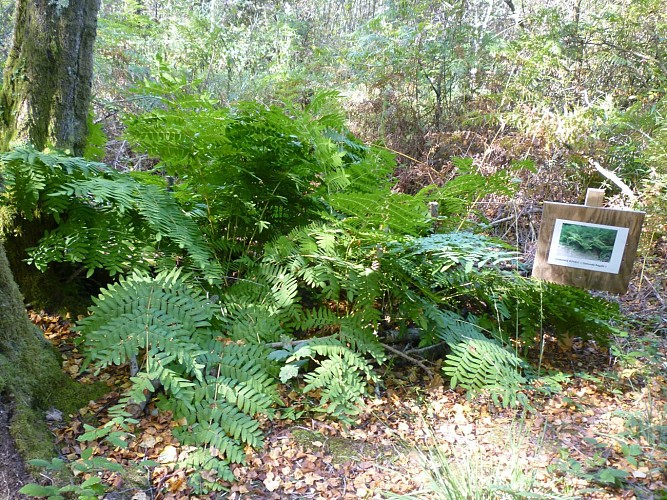
Royal Fern, queen of the wetland
Description
The route runs along the bottom of the valley through a wetland area which plays a fundamental role in the water cycle. Acting as a regulator, it stores water in the winter and releases it to the river during dry periods. It is also a purifying filter and helps improve water quality. The dense vegetation of the wetland includes various characteristic species that like to live with their feet in the water. In winter, the waterlogged brown soils, dotted with tall clumps of sedges with sharp grasses, willow and birch with thin, twisted trunks covered in fluorescent green mosses, make for a hushed atmosphere. The summer is more exuberant. The colour green bursts through. Ferns, nettles, water hemlock and angelica cover the ground and border the stream. The leaves of the trees form a protective canopy.
This poor, peaty soil is also home to the royal fern, a large, light green clump of ferns that can grow up to 1.5 metres in diameter. In the spring, stems slowly unfurl from the thick stumps to form large bipinnate fronds. Unlike other ferns, the sporangia of the royal fern do not develop on the back of the pinnate leaves, but at the top of the fronds in the form of pinkish beige to reddish brown panicles, hence its other name of flower fern. The spores disseminated at maturity ensure the survival of the fern. Present all around the globe, it is nonetheless becoming rarer. It is protected in several French regions, in the Finistère and the Ille-et-Vilaine in Brittany.
