Alert
Alerts
Grotto of Our Lady of Mont d'Iges
Description
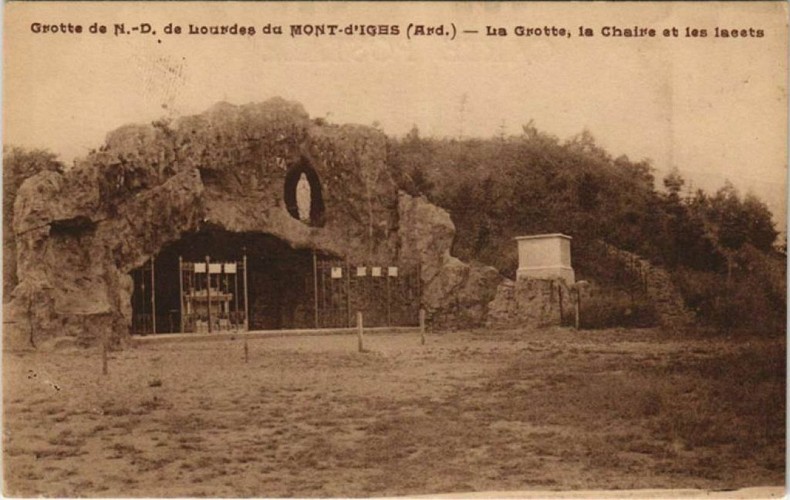
The history of the grotto of Notre-Dame du Mont d'Iges takes root in 1877, when Abbé Olivier inaugurated in Villette the first pilgrimage dedicated to Our Lady of Lourdes in the Sedan area. Faced with the growing influx of worshippers, his successor, Abbé Champeaux, decided to go further and had an exact replica of the Massabielle grotto built on the Iges peninsula, at the heart of a former quarry bordering the Meuse.
It was Monsieur Tatoux and his workers, specialists in rockwork, who carried out the construction after travelling to Lourdes to take exact measurements of the original grotto. The construction was completed in 1921 and the grotto was blessed the same year. Twelve years later, in 1933, it was the turn of the Stations of the Cross to be blessed, completing the site in its current form.
The site is also distinguished by the quality of its sculptural elements: the cast steel statues, commissioned from the Raffl workshops in Paris and the foundry of Vaucouleurs, bear witness to the care taken in its creation and to the artisanal craftsmanship of the era. Gradually integrated into the landscape of the peninsula, the grotto has become over the decades a place of contemplation and strolling, deeply rooted in local memory.
Technical Information
Altimetric profile
Data author
