Alert
Alerts
Pont Boieldieu


Description
Named after the composer from Rouen, this bridge was put into service in 1955 to replace the 19th century bridge destroyed during the war.
The pre-war bridge was immortalised several times by the Impressionist painter Camille Pissarro. One of his masterpieces, that shows his talent in rendering light, is displayed at the Fine Arts Museum of Rouen.
There, used to stand a much older construction: the stone bridge built in 1160 by the Empress Mathilda. The only bridge in Rouen for a long time, it was from its deck that Joan of arc's ashes were scattered in the river Seine after she was burnt at stake on 30 May 1431. On the right bank, a marble plaque reminds us of this event.
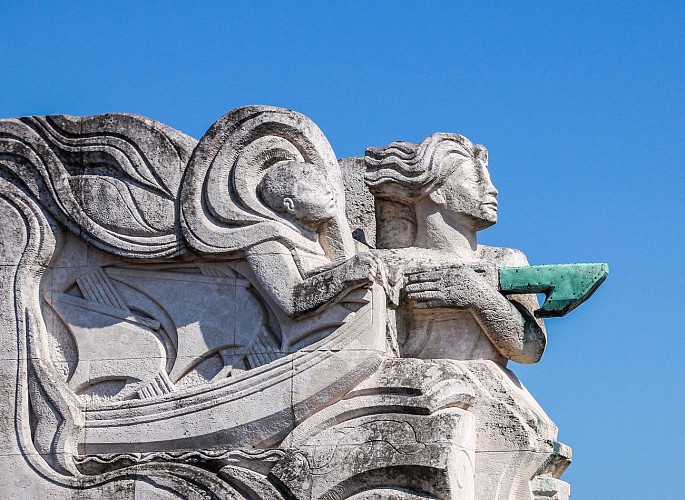
The current bridge is packed with a collection of open-air works of art. Two massive stone statues have been erected at each end of the bridge since the end of the 1950s. On the north side, the sculptor Jean-Marie Baumel depicted the explorer Robert Cavelier de La Salle leading an expedition as well as the Normans on a boat. On the south bank, Georges Saupique has carved allegories of the ocean, the river Seine and its tributaries.
Since 2007 a series of 10 bronze busts made by the Norman sculptor Jean-Marc de Pas have been exhibited on the bridge. They represent famous explorers including Marco Polo, Jean de B‚thencourt and Fernand de Magellan, which remind us of the opening of the port of Rouen onto the world.
Technical Information
Altimetric profile
Additional information
Data producer
This information is provided by Office de tourisme Rouen tourisme
Rates
Free for everyone
Data author
