Alert
Alerts
Le Sentier des Vestiges de l'Industrie de la Soie
Description
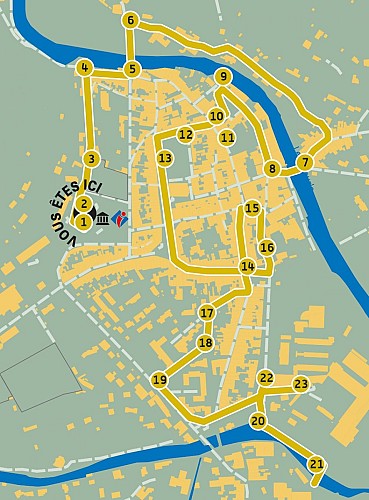
To complement the visit to the Musée de la Soie, the Silk Industry Remains Trail is an urban trail leading visitors to discover numerous silk-related buildings and remains.
The route is made up of 20 to 23 stations (depending on the circuit chosen) that take you through the town and its history linked to sericulture.
After 1750, the economy, which had just experienced a crisis, took off again with a new "product", silk imported from Asia.
Specific buildings, known as magnaneries, were built to accommodate the ever-growing "educations" of "magnans". Spinning mills, stocking factories, knitting mills - silk held an important place until the early 19th century, when silkworm diseases (pebrine and flacherie) caused Lyon's industrialists to turn to foreign products rather than Cévennes' own. The advent of synthetic yarns sounded the death knell for the industry.
1 - SILK MUSEUM. - Departure point : Silk Museum parking lot (welcome sign). From the "Musée de la soie" signpost, head towards "Vidourle".
2 - THE FORMER 17th-century CASERNE was part of the military preparatory school (1886-1934). Take the Catholic cemetery crossing.
3 - SILKWORM NURSERY. Magnanerie architecture is characterized by narrow openings just below the roof. In the 19th century, when sericulture reached its golden age, these buildings were built solely for raising silkworms.
Along the way, look out for the ancient ramparts on your right. Continue along the crossroads to the Catholic cemetery.
4 - THE ST JEAN TOWER. Resistance from the largely Calvinist population in the 16th century led to the building of ramparts leading to a fort and a watchtower to keep the town under the surveillance of the king's dragoons. From the tower, turn right, then left.
5 - LE VIADUC DE PLANQUE (railway line turned greenway). This was an essential part of the town's industrial development, as the "Nîmes - Le Vigan" railroad line enabled locally-produced silk to be exported to major industrial centers such as Lyon, and coal to be transported to the spinning mills.
Cross the Vidourle over the bridge and turn right into Rue du Faubourg de Planque.
6 - CHÂTEAU DE PLANQUE AND MILLS. On the way, we pass two old mills that also functioned as
which were also used as spinning mills. One of them still has a paddle wheel. You can see how the water from the Vidourle is channeled through a béal. Along the way, take a look at the town's old industrial district on the opposite bank.
At the end of the street, turn right onto Faubourg du Vidourle to reach the signpost at the bottom of the bridge.
7 - VIEW FROM THE VIDOURLE BRIDGE. The old industrial quarter is clearly visible upstream from the Vidourle.
The signpost takes you to rue de l'Agal.
8 - THE PUECH-ROCHER SPINNING MILL. With the arrival of the steam engine and the mechanization of factories, large
With the arrival of the steam engine and the mechanization of factories, large buildings were built close to rivers to meet their growing water needs, and large bay windows were installed to let in as much light as possible. The Puech-Rocher spinning mill dates from the 19th century and operated until 1920.
Follow rue de l'Agal.
9 - RUE DE L'AGAL. This district's activities (spinning mills, tanneries, dye works, draperies, etc.) were able to develop thanks to the supply of water from an underground canal, the Agal.
At the "Agal" signpost, head for "Ecoles".
10 - LA MAGNANERIE BOURGUET. Located on the top floor of this large 16th-century building, this silkworm nursery
shows the interest that wealthy owners took in the education of silkworms, to the point of enhancing their own homes.
Enter Rue Pasteur.
11 - THE PASTEUR HOUSE. In 1869, Louis Pasteur came to spend a few months in Saint-Hippolyte-du Fort for his research into pebrine, a silkworm disease that decimated silkworm farms.
Retrace your steps and take the Place du plan to reach the fountain.
12 - LES MAGNANERIES DU PLAN (place Jean-Jaurès). Around the square are several examples of family-run magnaneries. None resembles the other, but they are all characterized by their
openings.
Take the Cours Gambetta towards the cafés.
13 - PLACE DU PLAN. A field of mulberry trees was once planted here.
Follow the Cours Gambetta to the Place de la Canourgue, then turn left into Rue de l'Argenterie.
de l'Argenterie.
14 - LES GRANDES MAGNANERIES DE LA PLACE DU 19 MARS 1962... One of Saint-Hippolyte-du-Fort's wealthiest mansions. Established in the 19th century, the buildings were designed
designed to accommodate a silkworm farm on the top floor.
At the end of the street, turn left into Rue de l'Amiral Sap, then right.
15 - THE TOWN HALL. Under the arcades on the first floor, there used to be a market where producers sold their cocoons to traders.
Pass in front of the town hall and turn right into rue Jacques Boudon.
16 - LA BONNETERIE BRETONVILLE... Next to the pond, you can make out the old hosiery factory at the far end of the courtyard. By the end of the
From the end of the 18th century, Nîmes, Ganges and Saint-Hippolyte-du-Fort were major hosiery centers, producing silk stockings that were often embroidered and exported all over the world.
At the end of the street, turn right into Place du 19 mars 1962, then left into Rue Fondeville and quickly
turn right into the covered passage Impasse de Fondeville.
17 -THE PLANCHON ROCHEBLAVE SPINNING MILL. This spinning mill has undergone many transformations since its construction in 1824. It closed in 1937.
Make a U-turn and turn right.
18 - MULBERRY FIELD. Exclusive food for silkworms, mulberry trees were planted in large numbers near the silkworm farms. There was a large mulberry field here.
Continue along the street, then turn right to cross the garden, then cross the parking lot to reach the "Ecoles" sign on boulevard des Remparts.
19 - THE MOURGUES BOUSQUET FACTORY. Built in 1850 as a spinning mill, it was transformed into a hosiery factory in
1930 by the Lyon-Cévennes company, whose inscription can still be seen on the façade.
It closed in the 1970s. At the "Ecoles" signpost, follow signs for "Argentesse".
20 - VIEW FROM ARGENTESSE. Opposite the Argentesse river, you can see the Baudoin hosiery workshops, which operated until the 1990s.
Continue along the Chemin du Pont de secours to the bridge.
21 - LA MAGNANERIE DU PONT DE SECOURS. Following the river as far as the Pont de secours du Fort, you'll come across an
farmhouse that once housed a silkworm nursery. The openings are narrow, as the isolated building faces the north wind. You'll notice mulberry trees all around.
Make a U-turn on the Pont de secours road and turn right at the end of the road.
22 - THE TEMPLE. The largest in France.
Make a U-turn and turn left into the street leading to the Fort (now Ets Jallatte).
23 - LE FORT. Part of the citadel (with ramparts and watchtower) built in the fight against the Camisards. Private site, not open to the public. End of the tour.
Technical Information
Altimetric profile
Additional information
Price(s)
Free of charge. The trail is freely accessible. There is a charge for visiting the museum.
Updated by
Office de Tourisme Intercommunal Piémont Cévenol - 09/04/2026
piemont-cevenol-tourisme.com/
Report a problem
Open period
All year round daily. Subject to favorable weather.
Contact
Phone :
04 66 93 06 12
04 66 80 54 46
04 30 67 26 94
Email : tourisme@piemont-cevenol.fr
Animals
Yes
Data author
