Alert
Alerts
Saint-Luc church in Houldizy
Description
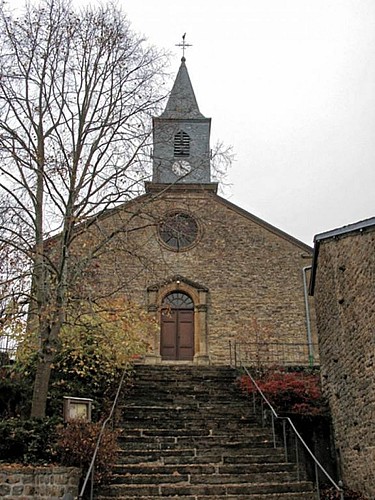
Saint-Luc church, in the centre of the village, has a chancel dating back to the 16th century. In 1843, the nave was enlarged by the addition of side aisles, work carried out by Jean-Louis Nonnon, a carpenter from Renwez. In 1854, the architect Delerue proposed demolishing the Romanesque tower of the bell tower and rebuilding one at the ridge of the nave, with the installation of the bell in 1862. In 1869, the sacristy was built under the supervision of the agent voyer Druart and the mason Jules Drouart. The church also served as a military hospital during the Second World War.
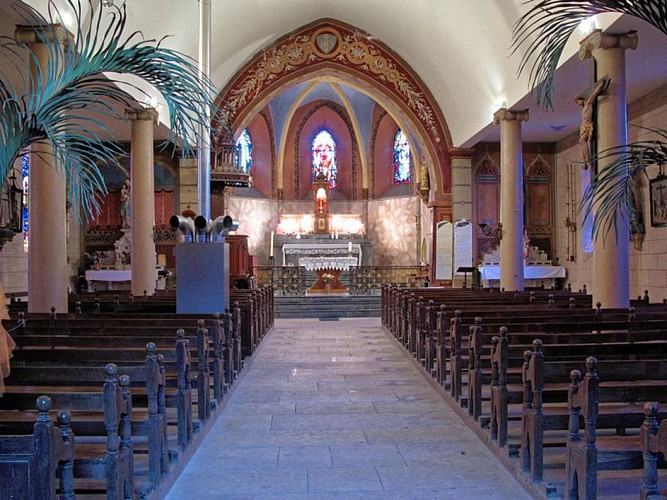
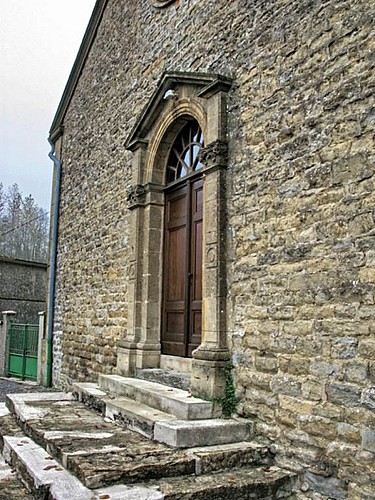
The church has an elongated plan and faces north-east. The three-vessel nave has four bays, with an organ loft in the first bay and a spiral staircase in the north-west corner. The chancel comprises two straight bays and a three-sided apse, with a sacristy adjoining the south side and a storeroom on the north side. The timber-framed bell tower is located on the ridge of the nave, on the west side. The building is constructed of limestone rubble and Dom-le-Mesnil ashlar. The interior walls are rendered, and the floor is paved with limestone.
The church is single-storey, with round-arched windows in the nave and pointed arches in the chancel. The nave is divided into three naves by Ionic columns. The central nave is covered by a pointed barrel vault, and the side aisles have ceilings. The chancel is rib-vaulted with seven quarters in the apse. The roofs are slate, with long-sloped roofs for the nave and choir, a hipped roof for the apse, long-sloped and hipped roofs for the sacristies, and a polygonal spire on the bell tower.
Technical Information
Altimetric profile
Additional information
Chapô
Closed to the public
Data author
