Alert
Alerts
Church of Saint Rémi de Gespunsart
Description
The church was rebuilt between 1789 and 1790 at the instigation of the parish priest Pierre Louis Micheau, with contractor Marion Templus and plans by Jean-Baptiste Prevost. The choir dates from 1768-1769. A chapel of Saint-Rémy was given to the collegiate church of Braux in 867. The parish is mentioned in a pouillé dating from before 1312 and is located to the south of the town, outside the village.
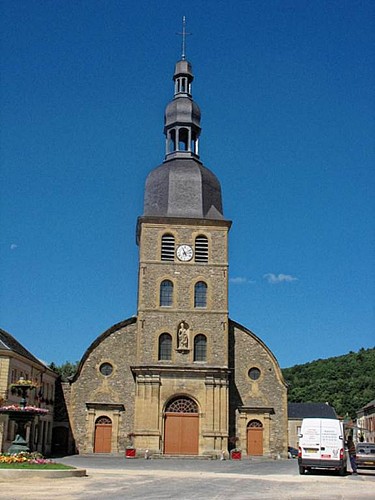
Built of rubble stone with ashlar quoins and a slate pavilion roof, the main façade is open, closed by a wrought iron gate and protected by a canopy. The church houses a 12th-century baptismal font, listed in 1964, with sculpted heads and a basin decorated with fantastic animals. It also has stained glass windows created in 1955 by the G. Gross workshop in Nancy. The furnishings date from the 19th and 20th centuries and include limestone side altars, 10 wooden stalls and two paintings by K.H. Digby.
The church has an elongated plan with a three-sided nave of six bays, preceded by a west aisle containing the bell tower framed by chapels. The chancel comprises a right bay and a semi-circular apse, with a sacristy at the corner of the left aisle.
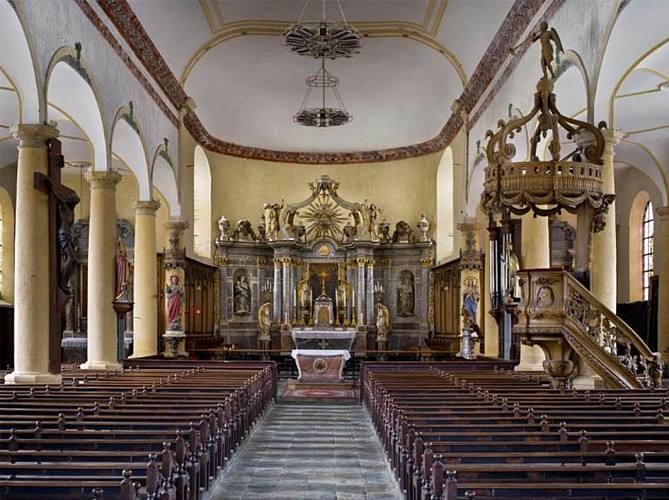
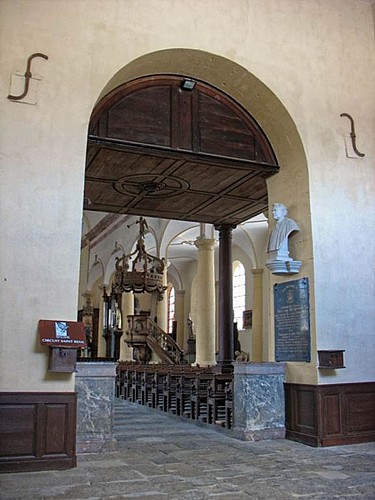
The building is built of schist rubble, with ashlar quoins and cornices. The floor of the nave is made of large limestone slabs, and that of the choir is a checkerboard pattern of veined black and grey marble. The interior walls are rendered, with round-arched windows.
The main façade features three semi-circular portals framed by Tuscan pilasters, with oculi and gabled roofs for the side portals, and three levels of bays for the central one. The central nave is covered by a false barrel vault, supported by depressed arches with Tuscan columns, while the side naves have ribbed vaults. The entire building is covered in slate, with various styles of roof.
Technical Information
Altimetric profile
Additional information
Équipements
Parking
Chapô
Open from 9.30am to 11.30am on Mondays, Tuesdays and Thursdays.
IGN cards







Data author
